Bassday Range Vib: covering distance when the wind rules out everything else
One lure, endless conditions. CarnaFish reads your spot from a photo so you are not just guessing.
Some spots have nothing to do with colour, retrieve or time of day: the water holding the fish is sixty metres out and you simply cannot get there. A current seam at an estuary mouth, a sandbar behind the first wave, a shoal busting offshore of a beach — with a twenty-gram minnow and a crosswind, you land fifteen metres short every single cast.
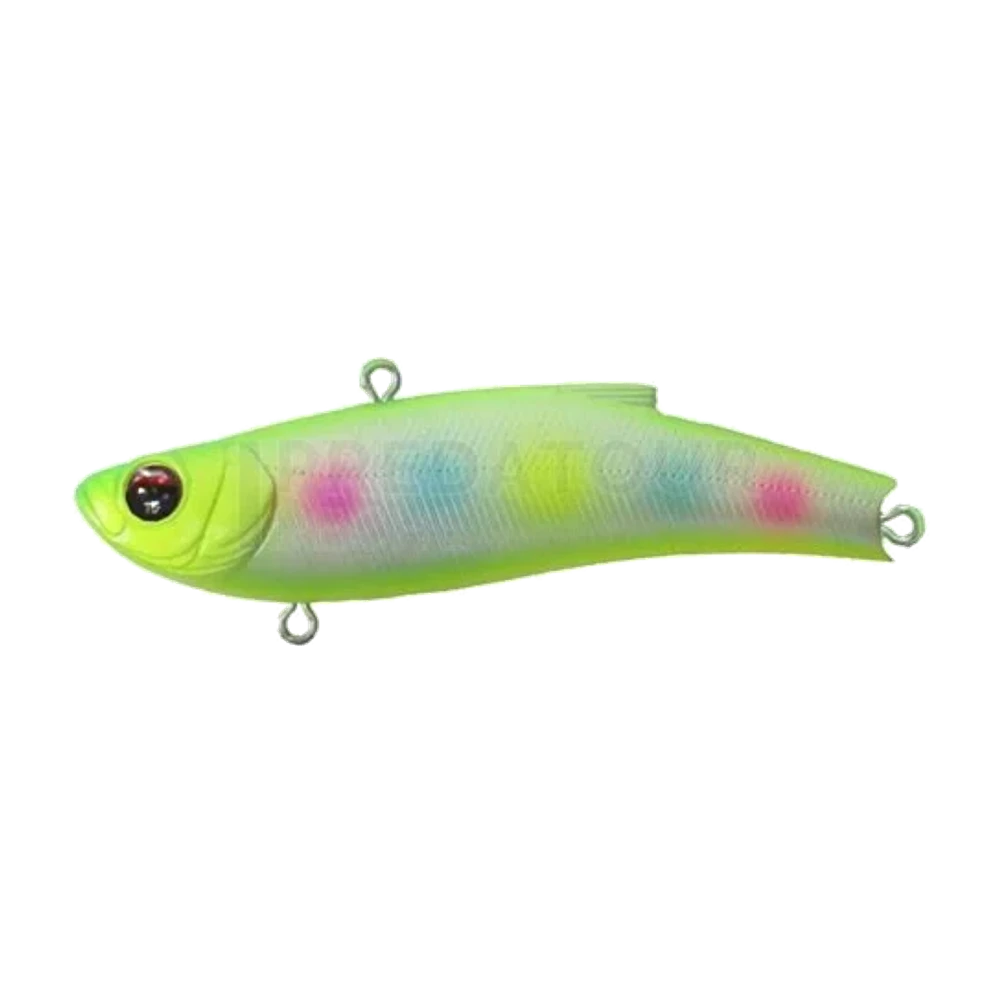
A sinking saltwater lipless solves that with density. No lip, no parasitic lift, a compact heavy body that flies straight and cuts the wind. The Range Vib belongs to that family, and it is fished very differently from a freshwater lipless: no yo-yo, no pause, a continuous retrieve from start to finish.
Why it is not fished like a lake lipless
In fresh water the classic pattern is to let it fall and lift it back in stages — the principle is covered on the Duo Realis Vibration 62 page. In salt water, three reasons make that pattern counterproductive:
- The bottom is often sand or rock only a few metres down. Two seconds of fall and the lure is sitting on it. On sand it buries; on rock it wedges.
- The current pushes the lure off line during the fall. You lose control of the path in exactly the zone you wanted to fish precisely.
- Sea bass do not react the same way. A hunting bass chases prey that flees fast and straight. The chopped-up yo-yo, effective on a sulky zander, breaks that reading.
The right approach is therefore to set the depth by sink count before you start, then retrieve without ever stopping.
The retrieve: count, then never stop
- Cast everything you have, rod low, feathering the end of the flight so you do not crack the line off.
- Count under your breath through the fall, with a semi-tight line. One number per second.
- Start a brisk, steady retrieve the moment you hit your count. The vibration should set in immediately.
- Do not pause at all. If you want a different layer, change the sink count on the next cast, not mid-retrieve.
- Over the last ten metres, speed up slightly. A following bass very often commits when the prey seems to bolt as it reaches the edge.
The sink count is your only depth control, and it is what makes this lure methodical: you can sweep one layer after another with everything else held constant.
| Sink count | Layer fished (no current) |
|---|---|
| 0 to 2 s | subsurface, 0 to 50 cm |
| 3 to 5 s | 1 to 1.5 m |
| 6 to 8 s | 2 to 2.5 m |
| 10 s and over | bottom, for clean ground only |
In a running tide, cut the count by a third: the lure drifts instead of dropping, and you end up higher than you planned.
On the water: when you get a fish, memorise two numbers straight away — your sink count and the number of handle turns before the bite. Those two values are enough to reproduce the presentation exactly, and on a shoal of feeding bass you can take four or five fish on the same track. The anglers casting at random get one.
Rattling or silent
Most saltwater lipless baits come in a rattling version and a silent one. That choice is not cosmetic.
Rattling version: coloured water after a blow, end of the day, active feeding. The rattle carries and helps the fish locate the lure in churned water.
Silent version: clear calm water, fish along the edge, heavily fished marks. Somewhere everyone fishes, a silent lure often scores where a noisy one clears the area. If you can only have one, take the rattler — but keep the silent one for flat-calm days.

Not sure what to tie on?
Photograph your spot: CarnaFish reads the scene, cross-checks the conditions and gives you the zone, the lure and the retrieve. Free on iOS and Android.
Where it excels, where it does not belong
- Open beaches into a headwind, when you need to clear the bar and reach the gutter behind it.
- Estuary mouths on the ebb, along the line where fresh meets salt and the bait gets pinned.
- Visible feeding activity offshore, to land in the middle of the shoal in one cast.
- Big zander reservoirs in strong wind, where the density lets you work an exposed bank when nothing else can be cast.
It is wrong over heavily broken rocky ground, where the lack of a lip leaves the trebles unprotected and you lose a lure every ten casts. It is also wrong over flat clear water with bass sitting in under a metre: the continuous vibration of a metallic body is too aggressive then, and a topwater stickbait or a slim minnow beats it comfortably. Finally, it is not a slow-fishing lure — if you need to slow down, change family.
Range Vib or a saltwater minnow
The Bassday Sugar Minnow covers the same edge water with the opposite logic: a more natural swim, a slower presentation, a fixed depth. That is the right call on a calm sea with bass inspecting. The Range Vib takes over as soon as distance becomes the limiting factor, and as soon as the water is moving enough that a strong signal is an advantage rather than a deterrent.
Against a Sebile Vibrato, another long-casting sinking lipless, the difference is mostly profile: the Vibrato is deeper-bodied and slower to sink, the Range Vib more compact and faster down, so easier to hold deep in current.
If you want the same vibration principle in fresh water and a light format, the logic changes completely — the Lucky Craft Bevy Vibration is fished high and skimming over weed, the opposite of this lure. Our guide to sea bass lure fishing covers how to string these families together through the tide. And if you are unsure which layer to attack in front of the mark you are looking at, CarnaFish reads a photo of the spot and answers.
Key takeaways
- High density and no lip: this is the distance lure for a headwind.
- Depth is set by the sink count before you start, not along the way.
- No pauses during the retrieve: the lure noses down and snags.
- Memorise sink count and handle turns on every bite so you can repeat the track.
- Wrong over broken rocky ground and over flat water with wary bass along the edge.
FAQ
How do you set the depth of the Bassday Range Vib?
By counting the seconds of the fall before you start retrieving. Two seconds keeps you subsurface, five seconds puts you around a metre and a half, eight seconds around two and a half metres in still water.
Should it be yo-yoed like a lake lipless?
No. In salt water the fall pushes the lure off line in the current and gets it snagged or buried in the sand. The retrieve has to be continuous and brisk from start to finish.
Rattling or silent version?
The rattler in churned or coloured water, and over active feeding fish. The silent version on a flat sea, in clear water, or on heavily fished marks where the fish are wary.
How far can you cast this lure?
With a 25 to 30 g version and thin braid, sixty metres is reachable from the shore in a moderate wind, more with the wind behind you. That is precisely the main argument for this family.
Can it be used in fresh water?
Yes, on big zander reservoirs in strong wind, where the density lets you work an exposed bank. The fishing logic is unchanged: sink count, then a continuous retrieve.
What rig should I use?
Thin braid of 0.12 to 0.16 mm for distance, a metre of 0.30 to 0.35 mm fluorocarbon leader, and a small reinforced round snap fitted straight to the dorsal ring so the vibration is not restricted.
The full sea bass lure guideSeason-by-season strategy: which family of lure, when, and why.Go from theory to fish
CarnaFish reads your spot from a photo and gives you the game plan: zone, lure, retrieve. Free on iOS and Android.