Daiwa Yamamoto Neko Fat Worm: the fat worm built around the neko rig
The right lure in the wrong spot still catches nothing. CarnaFish spots the zone that works, from a single photo.
Late summer, when bass settle onto hard breaklines and let everything fast go by, the usual reflex is to downsize. That is often the wrong lever: the problem is not volume, it is speed and fall path. A thick worm that goes down nose-first, tail up and quivering, stays visible in the strike zone for a long time without ever looking like it is fleeing. The Neko Fat Worm, a collaboration between Daiwa and Gary Yamamoto, is drawn for exactly that situation.
A stick worm body, and a tail that isn't really one
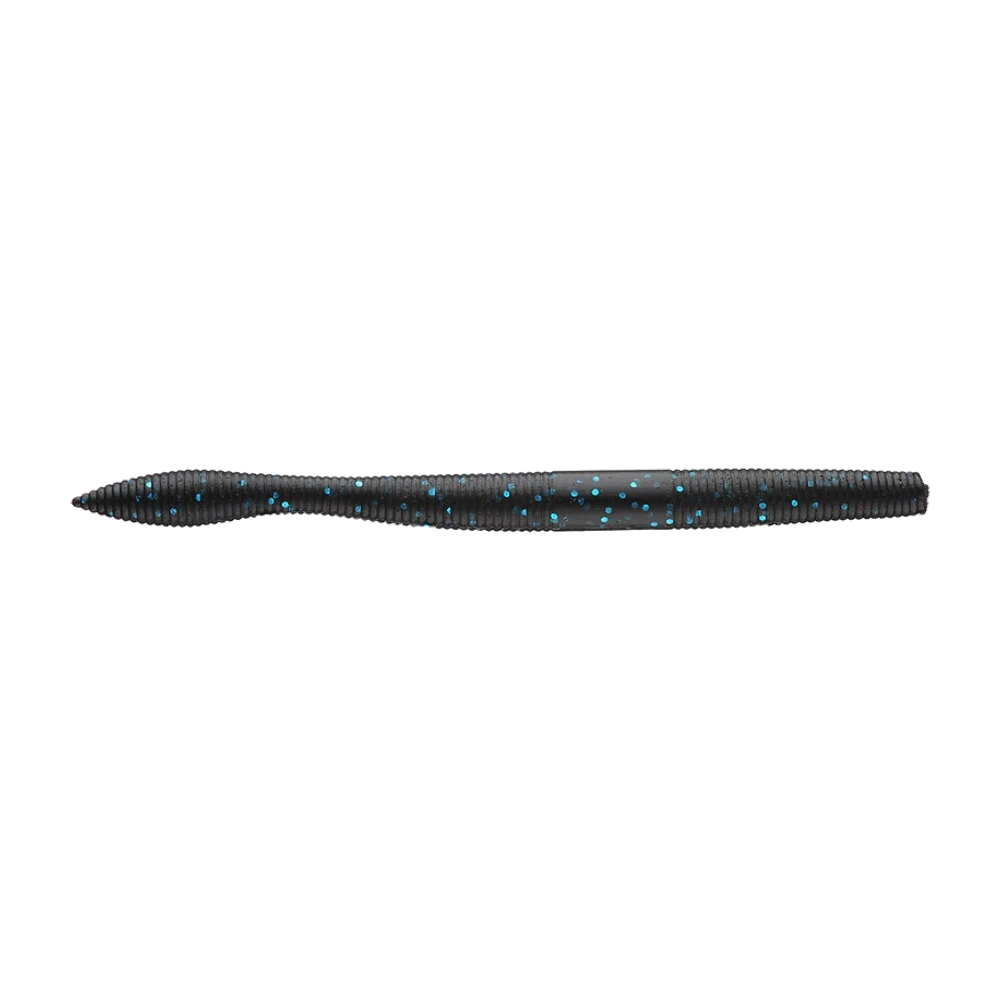
Daiwa and Yamamoto built this worm around a thick body, close in diameter to a Yamamoto Senko 5, rather than the slim profile of a standard finesse worm. That choice has three direct consequences in the water. The extra plastic slows the fall and makes it easier to read on a slack line. The thickness gives enough material to take a nail weight in the head without the body splitting on the third cast. And above all, the mass of the body acts as a counterweight to the rear end, swollen into a bulb, which starts quivering the moment the bait moves half an inch.
That bulb is what separates the Neko Fat Worm from an ordinary stick worm. A Senko works mainly through the roll of its whole body on the fall; here the body drops fairly straight and it is the back end that vibrates, with a short, fast amplitude. Two different signals, so two different responses from the fish: when a wide roll stops drawing anything, that localised quiver still gets bites.
The body is ribbed over almost its whole length, with a smooth band at the centre — the zone meant for the O-ring or the hook. Those ribs are not decoration: they break the water film and give the plastic something to grip on with the smallest rod-tip movement.
The neko rig, the whole reason this worm exists
The rig this worm was drawn for is the neko rig: a nail weight pushed into the head, a hook pinned crossways through the body roughly at the middle. The bait then stands head-down on the bottom, body close to vertical, bulb pointing up. Each small hop makes it dig its nose in, scrape the substrate, then slowly straighten back up while the tail keeps quivering on its own. Very few baits hold that posture for so long without any input.
The point of the nail weight goes well beyond the look of the rig. A weightless worm sinks far too slowly to be genuinely fishable past a few metres, and it forces a very light outfit just to cast it. The nail solves both at once: it gives a usable sink rate, it allows a heavier rod and line, and it therefore opens up depths that classic finesse fishing leaves alone.
Picking the nail weight
Start with the lightest head that still lets you feel contact: 0.9 g (1/32 oz) down to two or three metres in calm water, 1.8 g (1/16 oz) as the do-everything setting, 3.5 g (1/8 oz) when there is current or more than five metres under the boat. Going heavier speeds up the descent but shortens the time the tail spends quivering at rest, which is precisely what you are after.
Protecting the hook point of entry
The weak spot of a neko rig is not the weight, it is the hook hole: after enough hops the plastic goes oval and the worm flies off on the next cast. A rubber O-ring set on the smooth centre band, with the hook passed under it, solves the problem and makes a bait last ten times longer. On a technique where every bait comes out of a ten-piece bag, that changes the cost of your day.
Fished weightless, when nothing else gets looked at
The manufacturer insists on a second use: with no weight at all. The worm then falls flat, very slowly, rolling slightly on itself, with the same tail quiver but a horizontal path. That is the presentation for a dock, a seawall or the edge of a weedline. The downside is well known: past two or three metres the wait becomes unrealistic and line control gets vague.
Where and when it takes over
The Neko Fat Worm is a bait for settled fish, not feeding fish. Hard-bottom breaks, rock piles, dock edges, thin reed lines: anywhere you know fish are holding but nothing reacts to a bait that travels through. It is at its best in clear water under heavy fishing pressure, because it offers a slow, localised movement rather than a displacement.
In Europe it is also a rig that works on perch, in the 4 in size, over the same rocky spots. Bites are then much subtler: often just a weight appearing on the line, with no clean pull. Do not count on it for pike, though — neither the plastic nor the rig survives a single tooth.
The mistake that costs bites
Over-working it. The natural reflex, after two fishless minutes, is to increase the size of the hops. On this worm that backfires: a wide pull lifts the bait off the bottom, cancels the vertical posture and kills the tail quiver that works while the bait is at rest. The right action comes down to three moves — a sharp fifteen-centimetre hop, give slack, wait.
Actually count the seconds after each hop. Most anglers who blank on a neko rig wait two seconds when it takes seven or eight. Time it once in your head and you will see the gap between the rhythm you think you are using and the one you really are.
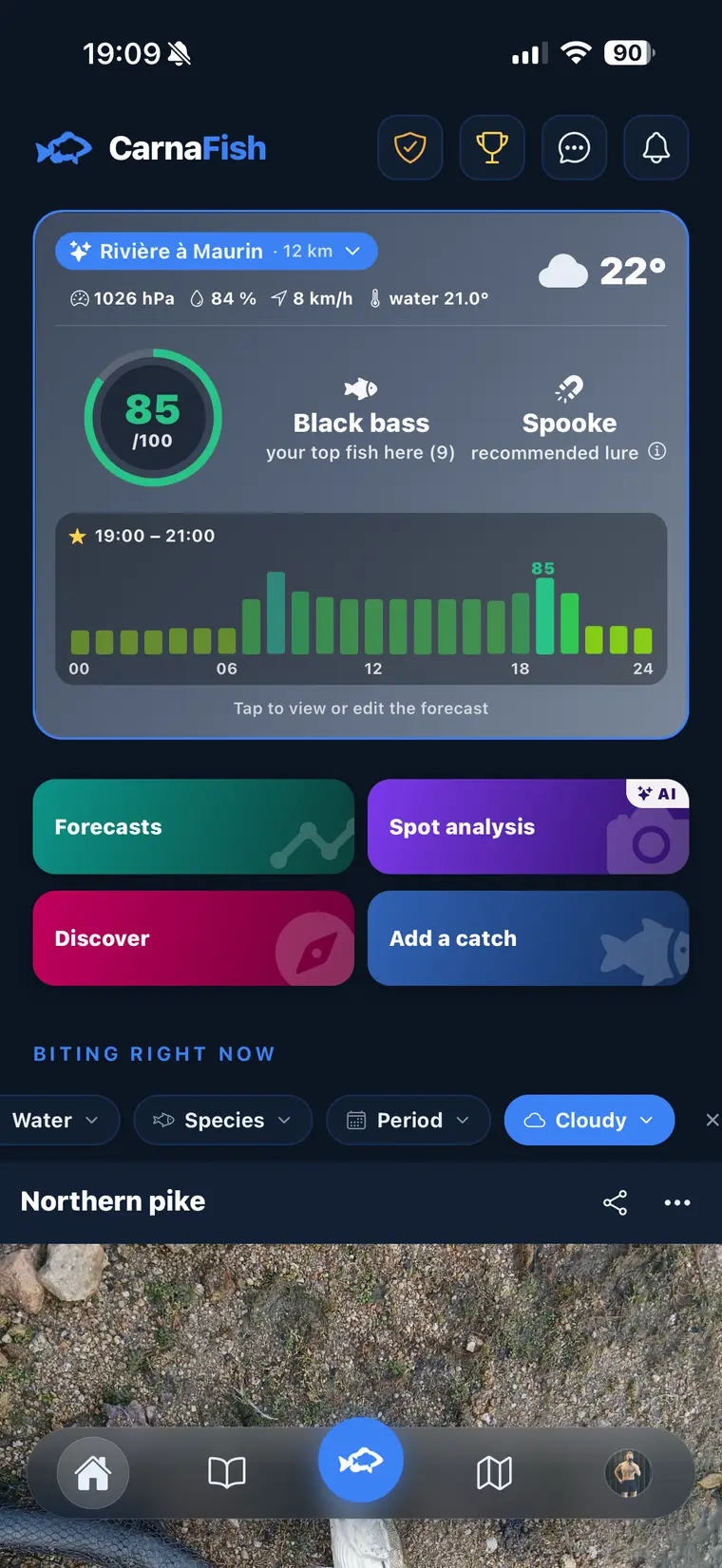
Not sure what to tie on?
Photograph your spot: CarnaFish reads the scene, cross-checks the conditions and gives you the zone, the lure and the retrieve. Free on iOS and Android.
Colour by water clarity
- Clear water: Green Pumpkin, the tone that works everywhere once the fish sees well and has already seen plenty of baits.
- Stained water or low light: Black/Blue Flake, the one in the photo — a clean silhouette that the blue flake wakes up at the first shaft of light.
- Rock and crayfish: Cinnamon Brown, which matches both the substrate and the dominant prey over boulder fields.
The range uses the Yamamoto colour chart, so proven natural tones rather than aggressive finishes. If you want fluorescent colours for very dirty water, this is not the right bait.
Two sizes, and one spec nobody publishes
The worm comes in 4 in (about 10 cm) and 5 in (about 12.7 cm), ten per bag. The 4 in is the baseline in clear water and on pressured fish, the 5 in comes out when the fish run bigger or the water is more stained. The manufacturer, however, publishes no per-piece weight and no density: there is no honest figure to give you for the weightless sink rate. Set the descent with the nail instead.
Picking the right worm never replaces reading the spot: you still need to know where the break runs and how deep the fish are sitting. That is exactly what CarnaFish makes easier — a photo of the spot, and the app suggests the zone and the presentation that fit the day. For the finesse tackle basics and the classic holding spots, our beginner's guide to bass fishing covers the rest. And if you want to compare with another school of worked worm, the Jackall Flick Shake Worm plays on a permanent body curve where this one bets on thickness.
Key takeaways
- Senko-thick body plus a bulbous tail: the fall stays straight and it is the back end that quivers non-stop, even with the bait sitting still.
- The nail weight is not an accessory, it is what makes the worm fishable past two or three metres and castable on normal tackle.
- An O-ring on the smooth centre band multiplies the life of the bait by ten.
- The manufacturer gives no per-piece weight: only the two lengths, 4 and 5 inches, are documented.
FAQ
Should I pick the 4 in or the 5 in?
The 4 in for clear water, pressured fish, or if you are also targeting perch. The 5 in when the water is stained, the fish run bigger, or you want a slightly slower fall for the same nail weight.
What nail weight should I use?
Start at 0.9 g down to two or three metres, move to 1.8 g as the all-round setting, and go to 3.5 g with current, wind or more than five metres of water. The lighter you fish, the longer the tail keeps working at rest.
Can this worm be fished with no weight at all?
Yes, the manufacturer presents it as a strong weightless choice. The fall becomes horizontal and far slower, ideal under a dock or along a bank, but unworkable in deep water.
How much does a Neko Fat Worm weigh?
Daiwa does not publish a per-piece weight, only lengths and the count per bag. Set your descent with the nail weight rather than a figure nobody actually prints.
Does the worm survive several fish?
Without an O-ring the hook hole goes oval fast and the bait eventually flies off on the cast. With a ring on the smooth centre band it takes several fish without complaining.
Is it a pike bait?
No. The plastic and the rig are built for fine work on bass and perch; a pike strike cuts the whole thing, fluorocarbon leader included. For that species, go to an armed bait and a suitable leader.
The full bass lure guideSeason-by-season strategy: which family of lure, when, and why.Go from theory to fish
CarnaFish reads your spot from a photo and gives you the game plan: zone, lure, retrieve. Free on iOS and Android.