Big Bite Baits Nekorama Worm: the worm designed around the neko rig
Rather not fish it blind? Photograph your spot — CarnaFish cross-checks the conditions and points you the right way.
The neko rig has one flaw nobody mentions: the O-ring slides. You set it a third of the way down the worm, fish for twenty minutes, and it has migrated two centimetres without you noticing. The bait's angle on the bottom changes, the balance with it, and the presentation you dialled in no longer exists. The Nekorama Worm, designed with MLF pro Drew Gill, solves that in a very simple way.
Two ridges for one ring
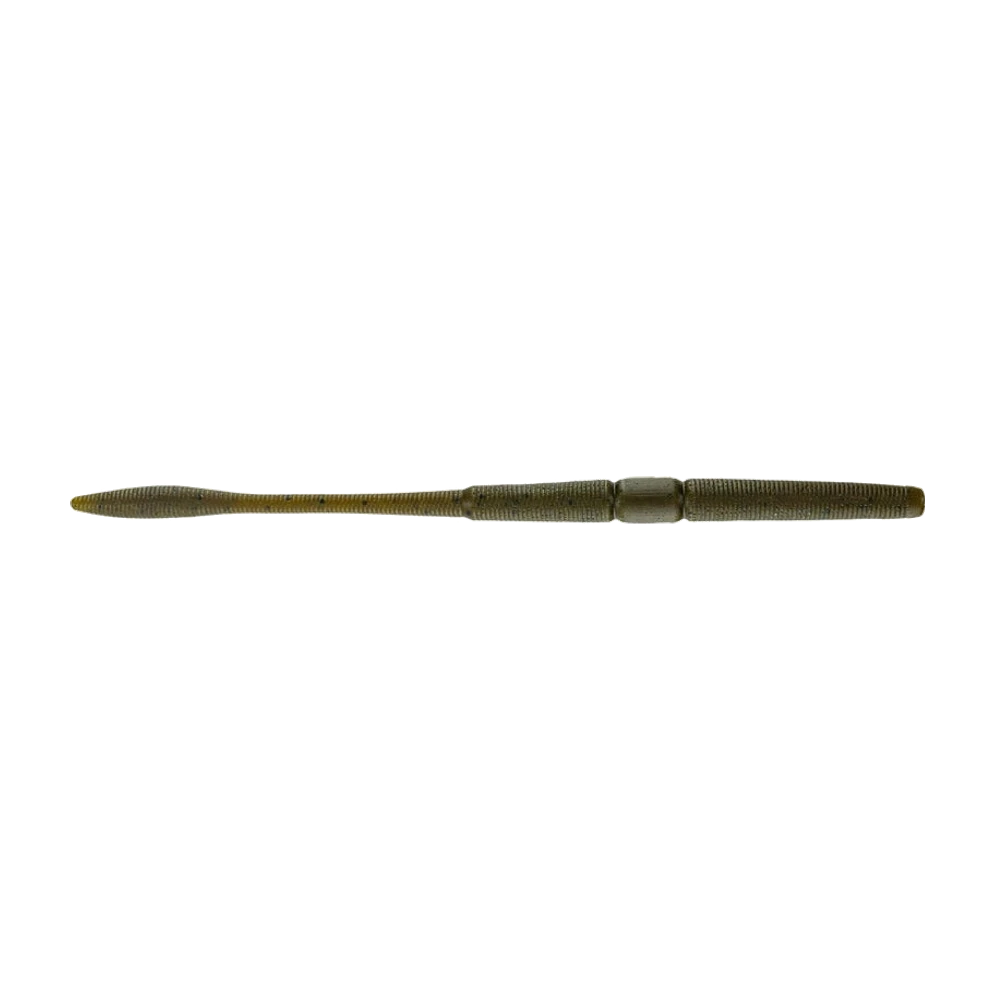
In the photo, about ten centimetres from the tapered tip, you can see two smooth ridges that interrupt the body's regular ribbing and frame a slightly recessed collar. That is where the O-ring goes, and nowhere else.
The payoff is twofold. First, the ring stops moving, even after a dozen fish and a hundred casts. Second, and less obviously, you get exactly the same presentation from one bait to the next. In a technique as fine as the neko, where two centimetres of offset change the worm's angle on the bottom, that consistency matters more than any colour detail.
The rest of the body is ribbed along its whole length, matte, with a tapered tip at one end and a clearly thicker tail at the other. The manufacturer also notes a small curved flat on the belly, whose job is to create extra resistance in the water — a subtlety you cannot see in the shop but which explains why the worm does not drop as straight as a stick.
The bulbous tail and what it does on the bottom
A standard neko worm has a roughly constant section. This one is deliberately unbalanced: the mass sits towards the back. With the nail weight in the thick tail, the bait plants nose-down — so far, so normal.
The difference is in what sticks up. A thin, uniform worm leaves a slim vertical stem, barely visible. The Nekorama leaves a stem topped by a swelling, which grabs more water and sways more widely on every pulse sent down the line. That is exactly what you are after on a neko rig: a pendulum motion on the spot, without the bait travelling.
Do not hop it. Drop the worm on the bottom, take up just enough slack and shake the rod tip in place for five to ten seconds without reeling in a single centimetre of line. That is the neko retrieve. If your bait is moving, you are reeling too much — and that is the number one reason so many anglers find the neko rig disappointing.
The two sizes
Big Bite Baits offers the Nekorama Worm in 5.5 in (14 cm), fifteen per pack, and 7 in (17.8 cm), twelve per pack.
The 14 cm is the reference size, covering bank fishing, breaks and dock posts. The 17.8 cm is a big-fish bait: it falls more slowly for the same nail weight, stays visible in stained water and naturally filters out small bass. On educated fish in summer, the bigger model is sometimes the one that makes the difference, counterintuitive as that sounds.
Which nail to use
A 0.9 to 1.3 g nail for fishing shallower than three metres and keeping a slow fall. 1.8 to 2.5 g as soon as you pass five metres, or when there is wind or current. Beyond that the worm plants too fast and loses the fall time that is part of its appeal.
Insert the nail in the centre of the thick tail, dead on the axis. A crooked nail tips the worm over instead of standing it up, and you lose the pendulum.
Rigging it without damaging it
The neko rig hinges on one detail: the hook does not pass through the bait, it passes under the O-ring. The worm is never pierced, so it survives far more fish than a standard Texas rig.
Use a dedicated neko hook, or a short-shank fine wire hook with the point facing the tail. For rigs like this the VMC Neko Rig hooks are a safe pick, and our page on the neko rig walks through seating the rubber step by step.
If you are fishing wood, switch to a weedless version with the point tucked into the worm's back, keeping the O-ring as the attachment point. You give up a little hook-up rate and gain the ability to fish where the fish actually sit.
Not sure what to tie on?
Photograph your spot: CarnaFish reads the scene, cross-checks the conditions and gives you the zone, the lure and the retrieve. Free on iOS and Android.
Matte colours by water
The manufacturer offers this range in matte finishes, and that is not a styling choice. A matte surface reflects far less light than shiny plastic, which counts on fish that have already watched ten baits go by that day.
- Clear water, bright light: matte Green Pumpkin, the colour in the photo. Discreet, natural, it never gives itself away.
- Educated fish, very clear water: Morning Dawn or any translucent pink tone, imitating a worm or a moulting crawfish without hard contrast.
- Dark water or low light: Black Blue, for a readable silhouette when nuance no longer registers.
A specialist alongside general-purpose worms
The Nekorama is not a do-everything worm. A Roboworm Straight Tail stays more versatile on drop shot and wacky rigs, and a Jackall Flick Shake Worm works differently thanks to its permanent curve. The Nekorama does one thing: it optimises the neko rig, and it does so with a design detail few worms offer.
The best-tuned rig in the world still will not tell you where the fish are. That is exactly what CarnaFish makes easier: a photo of the spot, and the app suggests the zone and the presentation suited to the day. To build tackle and spot fundamentals for bass, our beginner's guide to bass fishing remains the right way in.
Key takeaways
- The two ridges lock the O-ring in the right place and guarantee an identical presentation from one bait to the next.
- The bulbous tail grabs water and gives a wide pendulum on the spot, where a uniform worm stays subtle.
- Two sizes, 14 and 17.8 cm, the larger one mainly there to filter out small fish.
- The neko is not fished in hops: you shake it in place without reeling line in.
FAQ
Where exactly does the O-ring go on the Nekorama Worm?
Between the two smooth ridges moulded on the body, near the thick tail. That is their only purpose: they stop the ring sliding and guarantee the same presentation angle every time you rig.
Which size should I pick, 14 or 17.8 cm?
The 14 cm, fifteen per pack, covers the large majority of situations. The 17.8 cm, twelve per pack, falls more slowly, stays visible in stained water and draws bigger fish while cutting the number of bites.
What nail weight should I use?
0.9 to 1.3 g down to three metres to keep a slow fall, 1.8 to 2.5 g beyond that or in strong wind. Push it in straight along the tail's axis, otherwise the worm leans instead of standing upright.
Why is my neko rig not catching?
Most of the time because you are retrieving it. The correct action is to shake the rod tip without taking in line, so the worm stays planted in one place and sways there for several seconds.
Does the Nekorama Worm handle wood?
On an exposed neko hook, no. Switch to a weedless hook with the point tucked into the worm's back, keeping the O-ring as the attachment: you lose a little hook-up rate but you can fish cover.
Why matte colours rather than flake?
A matte finish reflects far less light, a genuine advantage on fish that see a lot of baits. In very clear water under bright sun, it is often what separates a bite from a follow.
The full bass lure guideSeason-by-season strategy: which family of lure, when, and why.Go from theory to fish
CarnaFish reads your spot from a photo and gives you the game plan: zone, lure, retrieve. Free on iOS and Android.