Damiki Stinger: the ribbed stick worm that rolls on itself
Rather not fish it blind? Photograph your spot — CarnaFish cross-checks the conditions and points you the right way.
Some days the fish are not refusing the bait, they are refusing the travel. You see the follows, you feel the nudges, and nothing closes. It is not a question of size or colour: it is that your bait is going somewhere. A stick worm that simply rolls on the spot, never looking like it is fleeing, fixes that more often than swapping an entire tackle box. The Damiki Stinger belongs to that family, with two shape details that set it apart.
A ribbed body, and a tail point like nothing else
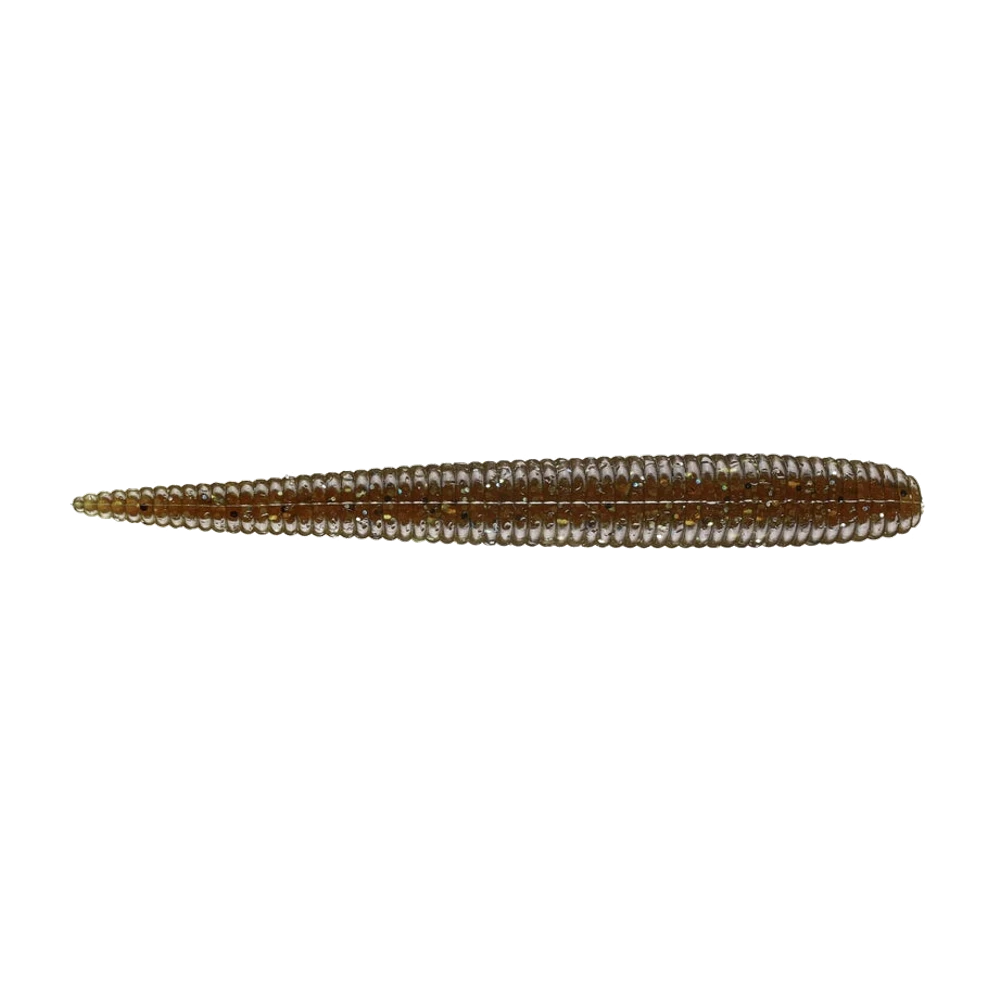
Two things jump out in the photo. First the ribbing: deep, tightly spaced grooves along the whole length, far more pronounced than on a smooth classic stick worm. Second the back end, which does not finish in a round tip but in a very fine, almost fragile needle point.
Those two details do the same job at two scales. The ribbing breaks up the bait's surface: it traps micro-bubbles as the worm lands, grips more water on the smallest movement and increases lateral resistance, which amplifies the roll. The tail point is fine enough to start vibrating under a minute flow of water — a single tremor of the rod tip sets it working before the body has even moved.
Damiki also calls the plastic "super soft". That is consistent with the logic: the softer the material, the more the point vibrates for very little energy. The trade-off is familiar to anyone who fishes soft plastics — it wears out fast, and we come back to that below.
The side-to-side roll, and why it demands slowness
The manufacturer describes a rolling action from side to side, meant for slow finesse presentations. That is not an empty phrase: a stick worm that rolls does it on the fall and during micro-moves, not on a retrieve. The moment you reel properly, the body stabilises and the bait becomes a piece of plastic crossing the zone.
So the right speed is close to zero. You cast, let it drop on a controlled line, give a ten-centimetre twitch, wait. Most of the work happens during the fall and during the settling that follows the twitch. It is the same philosophy as a Yamamoto Senko 4, but with a different signature: the Senko wobbles with its whole volume, the Stinger rolls and makes its tip quiver.
The real test with this kind of worm happens at the bank: drop it into a metre of clear water and watch it fall without doing anything. If you can see the point quivering while you have not touched the rod, the rig is right. If the point stays stiff, your hook is too heavy or your line too thick.
Four sizes, and a pack count that says something
Damiki gives four lengths: 3 in (about 7.6 cm, ten per bag), 4 in (10.2 cm, twelve), 5.5 in (14 cm, ten) and 6 in (15.2 cm, five). The piece count drops as size goes up, which is normal, but the jump is sharp on the 6 in: five units only.
For bass, the 4 in is the reference size on a wacky rig, and the 5.5 in is what you reach for when you want more volume and a longer fall. For perch in Europe, the 3 in is the only genuinely relevant one, on a fine-wire hook, drop shot or lightened wacky.
What the table does not give is per-piece weight and density. Neither "Floating" nor "Sinking" appears in the manufacturer's spec sheet. In other words: nobody can quote you a sink rate, and we are not going to invent one. In practice you will set it through the rig anyway — hook, O-ring, optional nail weight — far more than through the density of the plastic.
The rigs that use the shape
Wacky through an O-ring
This is the rig Damiki pushes, since it lists O-ring tools on its own product page. Hook passed under a rubber ring set at the middle of the body: both halves of the worm beat independently on the fall, and the tail point quivers on top of that. The ring is no gadget on plastic this soft — without it the bait tears after a handful of casts.
Neko rig
A nail weight in the rounded end turns the horizontal fall into a head-down descent, point upward, exactly as on the Daiwa Yamamoto Neko Fat Worm. The Stinger's fine point then acts as a vibrating antenna above the bottom. If the rig is new to you, our page on the neko rig details weights and hook placement.
Weedless Texas and drop shot
The elongated profile slips well through a weedless Texas rig to reach under branches and through thin vegetation. On a drop shot, nose-hook it and let the current or a simple rod-tip tremor work the point: that is the rig that exploits the tail vibration best for zero energy.
The mistake to avoid
Setting the hook like you would on a hard bait. The plastic is very soft and the hook goes through it easily, but a violent set tears the worm every time. A progressive pull, reeling into the fish, is plenty and doubles the bait's life. And keep in mind that with soft plastic, replacement is part of the cost of the technique: that is the price of the vibration.
Not sure what to tie on?
Photograph your spot: CarnaFish reads the scene, cross-checks the conditions and gives you the zone, the lure and the retrieve. Free on iOS and Android.
Colour by bottom and water
- Rock and crayfish: the translucent flaked brown from the photo, which blends into the substrate and gives back just enough sparkle to be spotted up close.
- Clear water, pressured fish: green pumpkin, the safe bet as soon as the fish has time to inspect.
- Stained water or low light: black, for a clean silhouette. On a bait fished slowly and close, the outline matters more than the shade.
A finesse bait, with everything that implies
The Stinger is not a search bait. It covers no water, makes no noise and cannot be fished fast. It is a second-pass tool: you have identified a spot, you know fish are there, moving baits produced nothing, and you come back to set down something that does not run away. In that precise role, a ribbed and very soft stick worm does a job few baits do.
You still need to know where to set it down. That is exactly what CarnaFish makes easier: a photo of the spot, and the app suggests the zone, the depth and the kind of presentation that fit the day. For finesse tackle basics and reading spots, our beginner's guide to bass fishing takes it from the top.
Key takeaways
- Two distinct signatures: deep ribbing that amplifies the roll, and a tapered tail point that quivers for almost nothing.
- Four sizes from 7.6 to 15.2 cm, with packs of five to twelve pieces depending on length.
- No per-piece weight and no buoyancy class in the manufacturer's table: sink rate is set by the rig.
- Very soft plastic: an O-ring is mandatory on a wacky rig, and hook sets should be a progressive pull.
FAQ
Which Stinger size should I choose?
The 4 in on a wacky rig for bass, the 5.5 in when you want more volume and a longer fall, the 3 in for perch or very clear water. The 6 in stays a specialist size, sold five to a bag.
Does the Stinger sink or float?
The manufacturer gives neither a per-piece weight nor a buoyancy class in its spec table, so there is no way to state it. In practice the rig — hook, O-ring, optional nail weight — determines your sink rate.
Why does the tail end in a point?
Because a very fine tip starts vibrating under a minimal flow of water. That is what lets the bait produce a signal even when still, when a simple tremor of the rod tip is enough to work it.
Do I need an O-ring for the wacky rig?
Yes, and it is not optional on plastic this soft. Without a ring the hook turns the hole oval within a few casts and the worm eventually flies off. With one, the same bait takes several fish.
Is the Stinger suited to perch?
Yes, in Europe the 3 in size works well on perch, on a drop shot or a lightened wacky rig, over the same rocky spots you fish for bass. Bites are very subtle and usually read on the line rather than through the rod.
How long does a Stinger last?
Less than a standard plastic, which is the trade-off for the softness that makes the point quiver. An O-ring and a progressive hook set rather than a sharp strike extend its life noticeably.
The full bass lure guideSeason-by-season strategy: which family of lure, when, and why.Go from theory to fish
CarnaFish reads your spot from a photo and gives you the game plan: zone, lure, retrieve. Free on iOS and Android.