Damiki TOT Type1 Double Willow: the flat-bladed spinnerbait
Rather not fish it blind? Photograph your spot — CarnaFish cross-checks the conditions and points you the right way.
There is a precise moment, working a reed line in spring, when you feel the blades let go. The vibration disappears for half a second, the bait glides along saying nothing, then picks up again. That gap in the signal is often what costs you the bite — and it is exactly what Damiki went after with the TOT Type1, a spinnerbait built around never losing vibration contact, whatever the speed.
Flat blades, not cupped blades
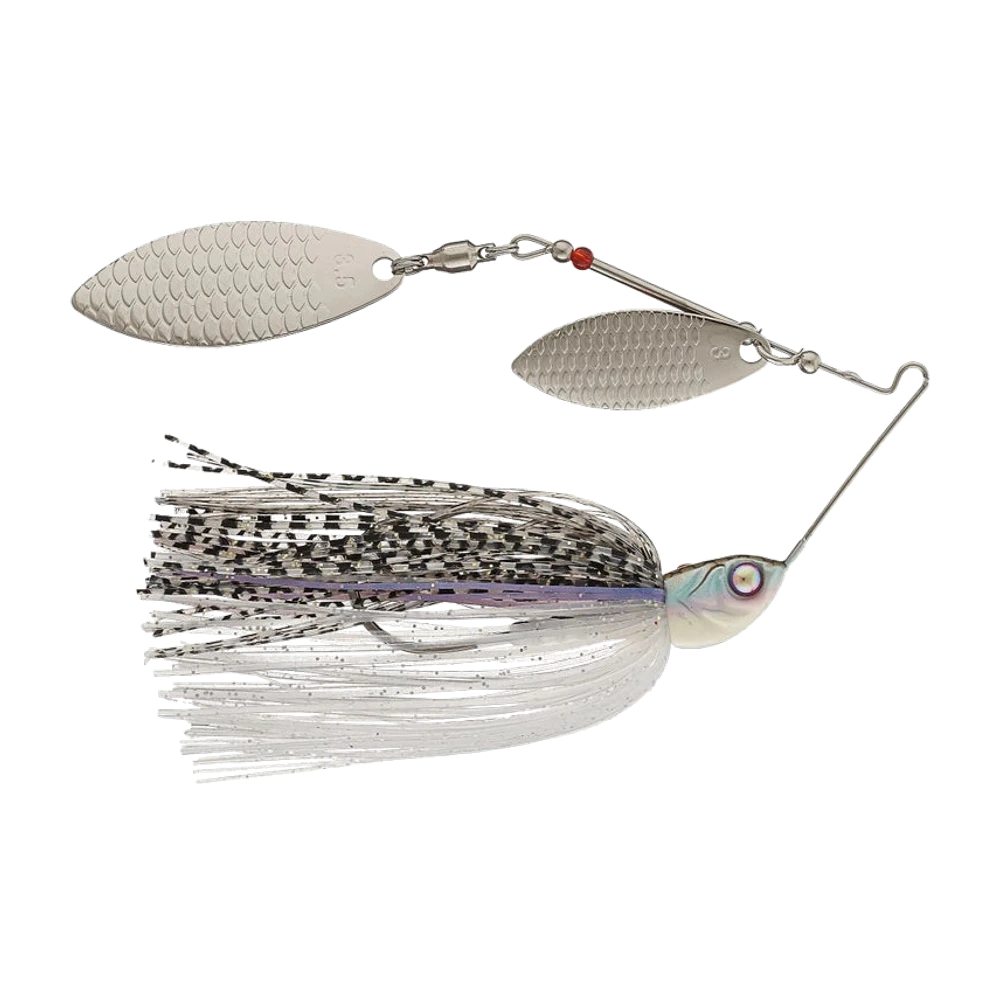
The TOT Type1 runs two willow blades, but not the ones you see everywhere. Damiki specifies flat blades, where almost every spinnerbait on the market uses a blade stamped with a concave cup. The difference is not cosmetic. A cupped blade channels water and spins easily, but it puts out a relatively fine vibration. A flat blade presents more surface to the flow, takes more resistance, and sends a heavier thump and a cleaner vibration back up the line — which is precisely what the maker claims.
The metal is not smooth either. A scale pattern is pressed into the blade, clearly visible on the sample photographed. That relief breaks the reflection into a shower of small flashes instead of one mirror sweeping the water. The flash is brighter and more broken up, which matters a lot in lightly stained water: a fish does not see a reflection, it sees flickering movement.
In practice that puts this spinnerbait somewhere between a classic double willow setup — subtle, built for clear water and speed — and a Colorado setup that pushes a lot of water but drags. You keep the slim profile and the clean passage of a double willow, and you get back part of the thump of a rounder blade.
Before swapping lures because "they aren't biting", drop the rod horizontal and retrieve slowly with a finger on the blank. If you cannot feel a continuous thump, colour is not your problem: speed or retrieve angle is. A spinnerbait that does not vibrate in your hand does not vibrate for the fish either.
The wire frame, the part you look at last and the one that decides everything
Damiki built the TOT Type1 on a heavier gauge wire frame. That choice has direct consequences on the water. Thin wire bends on the first good fish or the first hard pull out of a branch, and an arm bent two millimetres is enough to throw the whole bait off: it runs sideways, rolls onto its flank and becomes unusable without a pair of pliers. Thick wire holds its geometry far longer, at the cost of slightly less crisp vibration transfer.
Two more parts deserve attention. The maker specifies a ball bearing swivel and a quality clevis, both there to guarantee the blades keep turning at any speed. That is the real weakness of cheap spinnerbaits: at very low speed the front blade hesitates, stalls, restarts. With a decent bearing the slow roll becomes genuinely usable, and that is what opens winter and early spring up to the spinnerbait.
The head is described as highly detailed and engineered to come through cover efficiently while staying balanced at any retrieve speed. In the photo it is a baitfish head with pearl flanks and an inset 3D eye, built on a long shank single hook — the hook stays hidden under the skirt, and no trailer comes fitted.
Weight is not published in the manufacturer's description, and I am not going to invent a figure: check the packaging or the retailer listing before ordering, because on a spinnerbait the weight drives everything else — running depth, minimum speed, rod size.
Three ways to fish it
Slow rolling a drop-off
This is the use that justifies the ball bearing. Cast perpendicular to the break, let the bait sink on a semi-slack line while you count, then retrieve just fast enough that the blades barely turn. The bait follows the slope, ticking bottom now and then. Every contact with the bottom or a stump creates a break in rhythm, and that is very often when the bass commits. A cold-water cadence, between 8 and 14 °C, when a fast retrieve stops drawing anything.
Burning it along vegetation
The opposite approach, in spring and summer on active fish: run the edge of a weed bed or a reed line fast enough to keep the bait in the top thirty centimetres, blades flashing in and out of view. The slim head slips through scattered weed without loading up. This is walking-and-casting fishing, fanning long casts to find fish before slowing down.
Working wood
The third use is the most productive and the most expensive in lures. Aim deliberately at sunken branches, dock pilings and laydowns, let the bait bump the structure and then give half a turn of slack. The change of attitude caused by the deflection triggers fish holding tight to it. The heavy wire makes real sense here: it takes that treatment without deforming.
The classic mistake
Fishing a spinnerbait with the rod high and the tip pointing at the sky. You lose the feel of the blades, you run the bait too close to the surface and you are badly placed to set the hook. Rod low, tip towards the water at 45°, arm down by your side: you feel everything, you control depth with speed alone, and the hookset becomes a sideways tightening rather than a big vertical sweep.
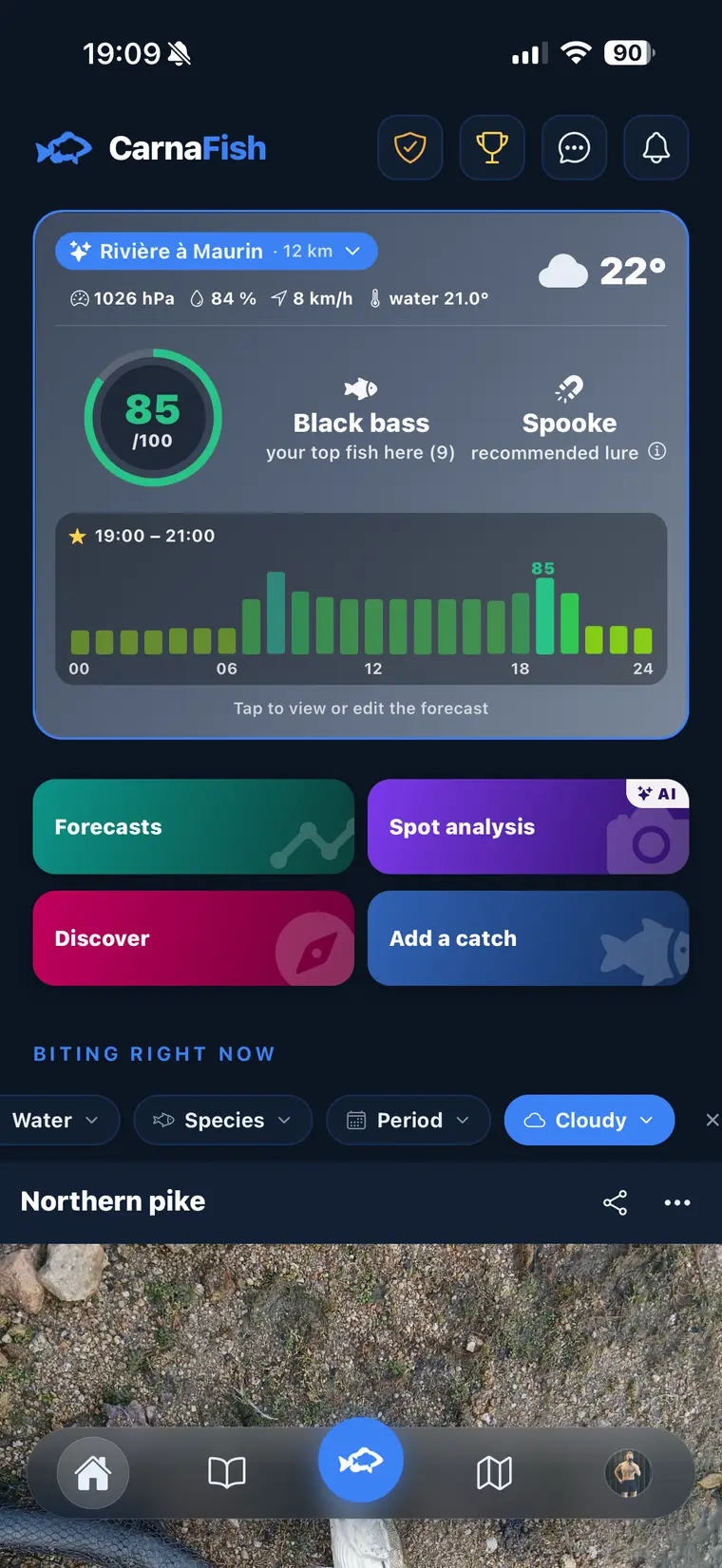
Not sure what to tie on?
Photograph your spot: CarnaFish reads the scene, cross-checks the conditions and gives you the zone, the lure and the retrieve. Free on iOS and Android.
Skirt and trailer
The skirt is hand-tied and mixes silicone with reflective Mylar strands. A tied skirt breathes differently from one clamped by a collar: the strands open and close further on each twitch, which gives a visible pulse even when the bait is sitting still. That pays off on short pauses, the moment the bait drops down the face of a structure.
The bait also carries a triple coned bait keeper, there to lock a soft trailer onto the shank. Adding a trailer is not automatic: a paddle-tail shad adds lift and vibration, useful in stained water but it slows the fall; a flat craw-style trailer keeps a fast fall and suits a deep slow roll better. With no trailer the bait sinks faster and stays more compact — often the right call in winter.
If you want a reference point, the Strike King Tour Grade Spinnerbait represents the classic American school with cupped blades, while the Booyah Blade Double Willow plays the maximum-flash card. For an even harder vibration in dirty water, a Zman ChatterBait JackHammer is louder, at the cost of coming through wood.
Colour by water clarity
- Clear water: pearl white and black, the finish on the sample photographed. The silver strands extend the flash of the blades and the dark back gives a credible silhouette seen from below.
- Stained water: chartreuse and white, the universal spinnerbait compromise. The chartreuse stays readable when visibility drops under a metre, the white keeps a natural base.
- Muddy water or low light: solid black. Counter-intuitive but effective — silhouette is what counts, not colour, and black reads better than any bright tone against loaded water.
That said, a spinnerbait only works if it lands in the right place: on an empty bank the best setup in the world produces nothing. That is exactly what CarnaFish helps with — a photo of the spot, and the app suggests the zone to cover and the lure type suited to the day's conditions. To place the spinnerbait among the other families worth knowing, our guide to choosing a pike lure covers the situations where it becomes the right tool.
Key takeaways
- Flat blades put out a heavier thump and stronger vibration than a standard cupped blade, with a flash broken up by the pressed scale pattern.
- The heavy gauge wire frame takes repeated contact with wood without bending, which is the number one reason spinnerbaits get thrown away.
- A ball bearing swivel and a quality clevis make a genuinely slow roll possible without the blades stalling.
- The maker publishes neither length nor weight: check the packaging before buying, because weight decides running depth.
FAQ
What does a flat blade actually bring over a cupped one?
More water resistance, so a heavier thump and a stronger vibration up the line, according to Damiki. You gain in vibration signal what you give up in effortless rotation at very high speed.
What weight should I start with?
The manufacturer's description gives no weight at all, so go by the packaging. As a rule on a double willow spinnerbait, a light model serves the subsurface game and a heavier one the deep slow roll.
Should I always add a trailer?
No. The triple coned keeper allows it, but a trailer adds lift and slows the fall. In winter or on a deep slow roll, the bare bait sinks better and stays more compact.
Does this spinnerbait work for pike?
Yes, that is a standard spinnerbait use in Europe. Fit a wire or titanium leader as soon as pike are present on the spot, otherwise a bite-off is only a matter of time.
Why do my blades stop turning?
Either you are retrieving too slowly for that model, or the clevis or swivel is fouled with sand or algae. Rinse it and check rotation by hand before blaming the bait.
How do I fish it when the fish are pinned to the bottom?
Slow roll it: let it sink on a semi-slack line counting the seconds, then retrieve at the slowest speed that keeps the blades turning, accepting the occasional bottom contact. Bites almost always come right after a deflection.
The full bass lure guideSeason-by-season strategy: which family of lure, when, and why.Go from theory to fish
CarnaFish reads your spot from a photo and gives you the game plan: zone, lure, retrieve. Free on iOS and Android.