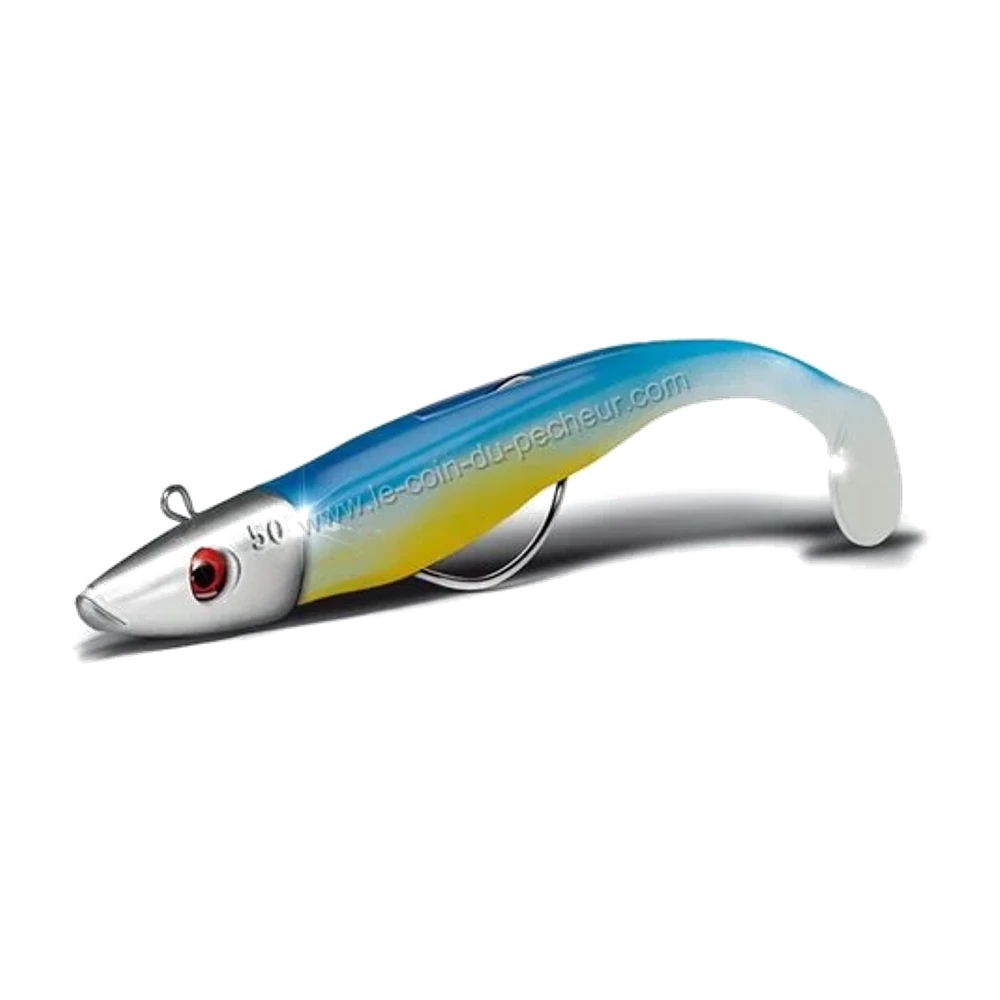
Delalande Swat Shad: the zander shad you fish on the reel handle
Before tying this one on, it helps to know if the spot actually calls for it. CarnaFish reads the scene from a photo.
Everybody fishes zander the same way: lift, drop, pause, lift. On busy stretches the fish see that rhythm ten times a day, all season. And there comes a moment — typically in midwinter, or in high summer on stable water — when they follow the lift without ever committing.
The answer is not to work the lure more, it is to work it differently. A slow bottom-hugging retrieve, reel only, rod motionless, means moving the shad in a straight line ten centimetres off the bottom, with no break in its path at all. The Swat Shad is cut out for that: its tail starts working at a speed where many shads are still inert, which lets you hold an almost ridiculous pace without the lure going dead.
A tail that starts very early
The difference between a lifting shad and a straight-retrieve shad comes down to one parameter: the speed at which the tail kicks in.
On a wide, stiff paddle you need a certain flow of water before the tail beats. Below that, the lure is a piece of plastic sliding along. On the Swat Shad the tail is more compact and joined to the body by a thin section, which lowers that starting threshold. You get a regular beat at a retrieve speed of roughly one turn of the handle every two seconds.
Two direct consequences:
- You can fish slowly without being forced to stop. That is decisive on zander, which take badly to acceleration but will happily follow a steady prey item.
- The lure stays stable in current. The solid body and contained roll stop the shad from spinning as soon as the flow picks up, which is the usual failing of wide-paddle shads in a river.
The bottom-hugging retrieve, step by step
- Cast and let it sink on tight braid, counting. Note the number of seconds to contact: that is your depth reference for the whole spot.
- On contact, start the retrieve at a constant speed, rod pointed at ten o'clock and not moving again for the rest of the sequence.
- Slow down until you lose the bottom. You are looking for the slowest speed at which the lure no longer touches. That is your cruising pace.
- Every five to ten seconds, slow a notch to touch the bottom once, then pick up again. That occasional contact kicks up a cloud and confirms you are at the right height.
- Never stop completely. Pause and the lure settles, and you are back to lift fishing, which is not the point here.
On the water: you adjust with speed, never with weight. If you stop touching the bottom, slow down — do not go heavier. If you are scraping constantly, speed up slightly — do not go lighter. Changing your head on every spot destroys the counting reference you have just built, and it is that reference that tells you where the drop-off is.
Weight: a choice per depth, not per habit
| Depth | Current | Jig head | Shad size |
|---|---|---|---|
| 1.5 to 3 m | none to weak | 7 to 10 g | 8 to 10 cm |
| 3 to 5 m | weak | 10 to 14 g | 10 cm |
| 3 to 5 m | moderate | 14 to 18 g | 10 to 12 cm |
| 5 to 7 m | weak to moderate | 18 to 20 g | 12 cm |
| Very shallow margins | none | 5 to 7 g | 8 cm |
Prefer a round head for a clean straight retrieve, and a football head over rocky bottom: it tips less and wedges far less often between stones. Our plain jig head rigging page sets out the hooking that keeps the shad perfectly straight — an essential condition for a straight retrieve, where the smallest misalignment makes the lure spin for the whole way back.
Reading a zander bite on a straight retrieve
On lifts, you feel the bite on the drop: the line moves sideways, or the expected contact never arrives. On a straight retrieve the signal is completely different, and plenty of anglers miss it for their first season.
Three forms of bite:
- The weight that settles in. The lure suddenly feels heavy, as though it had picked up a dead leaf. That is the commonest, and it calls for an immediate hookset.
- The blank. You lose all feel for a second: the zander has taken the lure and is coming towards you. Reel fast to regain contact before you set.
- The sharp tap. Rare on a straight retrieve, it corresponds to a decisive attack. That one you will not miss.
Set the hook sideways, wide, without lifting the rod vertically. A zander's mouth is bony: a soft hookset plants nothing.

Not sure what to tie on?
Photograph your spot: CarnaFish reads the scene, cross-checks the conditions and gives you the zone, the lure and the retrieve. Free on iOS and Android.
Where it excels, where it is the wrong tool
Its windows:
- Large reservoirs and dammed lakes in winter, on settled, apathetic fish.
- Rivers with moderate current, where its stability keeps it from spinning.
- Even flats and gently sloping margins, which lend themselves to a bottom-hugging retrieve.
- Heavy-pressure afternoons, when the lift-and-pause rhythm has stopped producing.
Its limits:
- Very cluttered bottom. A bottom-hugging retrieve through sunken wood costs lures; switch to lifts or to a weedless rig.
- Vertical work under the boat. Wrong tool: vertical fishing needs a lure that works without horizontal travel.
- Very murky water. The signal stays moderate; a blade bait or a bulkier shad carries better.
Swat Shad or a soft curl tail
The most useful comparison is with the Delalande Sandra 12. The curl works through a slow, broad tail beat that makes it deadly at very low speed, almost at a standstill, but it holds poorly in current and its silhouette is slim. The Swat Shad offers a wider profile, closer to a baitfish, and better stability as soon as the flow picks up. In winter, on a calm deep spot, the curl often stays ahead; in a river, and as soon as you want to cover ground on a straight retrieve, the shad takes the lead.
Against a Fox Rage Zander Pro Shad, the two play the same role and the difference is in the detail: the Swat Shad's tail starts a little earlier, which allows an even slower retrieve. In your box, one does not replace the other; they cover two neighbouring speeds.
Our beginner's guide to lure fishing for zander sets out the choice between straight retrieve and lifts by season. And if you are unsure what weight to fit when you arrive on a spot you do not know, CarnaFish analyses a photo of the spot and answers.
Key takeaways
- A bottom-hugging retrieve lure: reel only, rod motionless, ten centimetres off the bottom.
- The tail starts at very low speed, which allows a pace of one handle turn every two seconds.
- Adjust height with speed, not with weight, so you keep your counting reference.
- The bite usually shows as a weight settling in or a loss of contact, rarely as a tap.
- Wrong tool for sunken wood, vertical work and very murky water.
FAQ
What jig head for the Swat Shad?
7 to 10 g between 1.5 and 3 m, 10 to 14 g down to 5 m with no current, 14 to 20 g as soon as there is flow or beyond 5 m. Round head over clean bottom, football head over rock.
Straight retrieve or lifts for zander?
Both work, but the bottom-hugging retrieve becomes the better option when the fish are apathetic or used to the classic lift. Start with the straight retrieve on heavily fished spots, and keep lifts for cluttered bottoms.
How do I know I am hugging the bottom properly?
By slowing down until you touch bottom once every five to ten seconds. If you never touch it, you are too high; if you scrape continuously, you are too low or too slow.
How do I set the hook on a straight retrieve?
The moment the lure feels heavy or you lose contact. A wide sideways hookset, never vertical, with enough force to get through a bony mouth.
Which size should I choose?
8 cm for perch and shallow water, 10 cm as the all-round zander size, 12 cm as soon as you fish deep, in current, or when you want to sort out the bigger fish.
Does it work in a river?
Yes, that is one of its strengths: the body stays stable and does not spin when the flow picks up, which is not the case with every wide-tailed shad.
The full zander lure guideSeason-by-season strategy: which family of lure, when, and why.Go from theory to fish
CarnaFish reads your spot from a photo and gives you the game plan: zone, lure, retrieve. Free on iOS and Android.