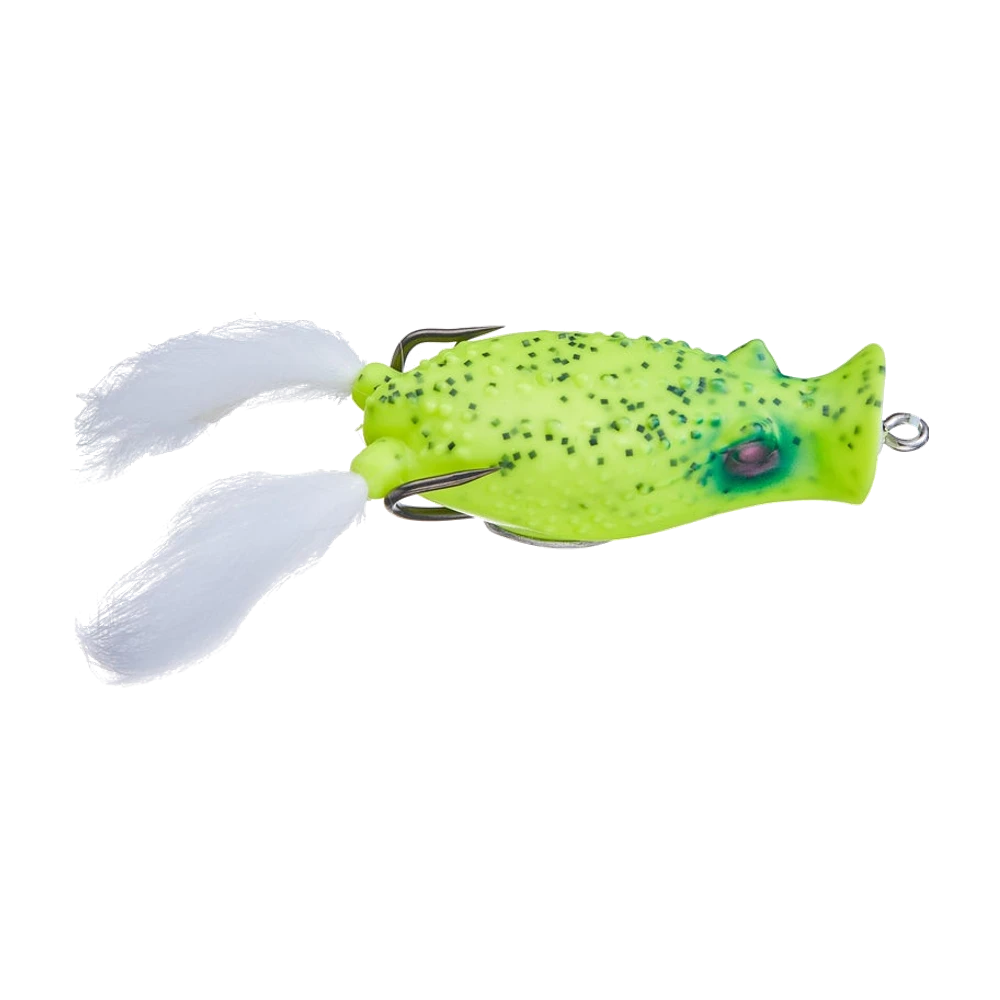
Deps Buster K: the hollow body popping frog with fur legs
Not sure this lure fits YOUR spot today? CarnaFish tells you in 10 seconds, from a photo.
The duckweed mat is thirty metres long and two centimetres thick. Underneath it there is shade, cooler water, bait and at least one fish. No conventional lure gets in there: a crankbait loads up in a metre, a Texas rig dives under the mat and never comes back. Exactly one family of lures is left, and the Deps Buster K is a Japanese take on it that adds a cupped mouth to the usual recipe.
A hollow body that pops
The vast majority of hollow body frogs have a pointed or rounded nose, designed to slide silently across vegetation. The Buster K takes the opposite option: Deps gives it a cupped mouth that spits and splashes as the lure moves along, including when it travels up, over and around matted vegetation.
That choice changes how you fish it. A silent frog is worked in a tight walk-the-dog, relying on silhouette and movement to trigger. A popping frog adds an acoustic component, which pulls up fish holding further away or deeper under the cover. On a thick mat the fish cannot see the lure: it hears it through fifteen centimetres of vegetation before smashing through the ceiling to take it. That is precisely what Deps emphasises.
The published figures are clear: 2.4 in, so 6.1 cm, for 1/2 oz, so 14.2 g. That is a very high weight-to-size ratio, typical of frogs: you need mass to cast an air-filled hollow body a long way, and it is that same mass that lets the lure cross mats without being stopped dead.
The maker publishes no buoyancy class in its table, but it explicitly describes a lure that moves along the surface and over vegetation. So this is strictly surface fishing, as with every hollow body frog.
Rattle and weight transfer
Two internal elements, each serving two purposes. The lure carries a rattle and a moving weight transfer system. The rattle adds noise, which stacks on top of the mouth's crack. The moving weight does two things: it contributes to the sound, and above all it slides back on the cast to stabilise the lure in flight, then returns to position to stabilise the attitude on the surface.
The first effect is the one people underestimate. A hollow frog, light for its volume, is an aerodynamic disaster: it tumbles, loses twenty per cent of its distance and lands sideways. With a mass shifting rearward in flight, the lure flies nose-first and touches down cleanly, without the slap that puts fish on alert.
On a dense mat the first pop does not happen in open water. Cast well past the zone, work the lure onto the mat counting the strokes, and only start working it seriously once it is over the edge or a hole. A fish holding under cover attacks at the break between vegetation and open water, not in the middle of the mat.
The outbarb hook, the feature that makes it last
This is the most original point of the lure, and it deserves an explanation. A conventional double hook mounted in a hollow body has its barbs facing inwards. On every hookset and every fish, the barbs pierce the lure's skin from the inside. After ten fish the frog fills with water, sinks, and goes in the bin.
Deps developed an outbarb double hook whose barbs face outwards. The direct consequence: they do not go through the hollow body, and the lure lasts considerably longer. The maker also notes that this geometry makes releasing fish easier, which is genuine comfort when you are handling a bass at the edge of a mat with a double buried in its jaw.
A second, less obvious effect: this hook tolerates fur legs. Deps explains that conventional silicone skirt legs get caught in inward-facing barbs and choke the hook gape on the set. With an outbarb and fur, the problem disappears. And fur works differently: it undulates continuously in the water even with the lure at rest, where silicone strands fall limp and stay inert.
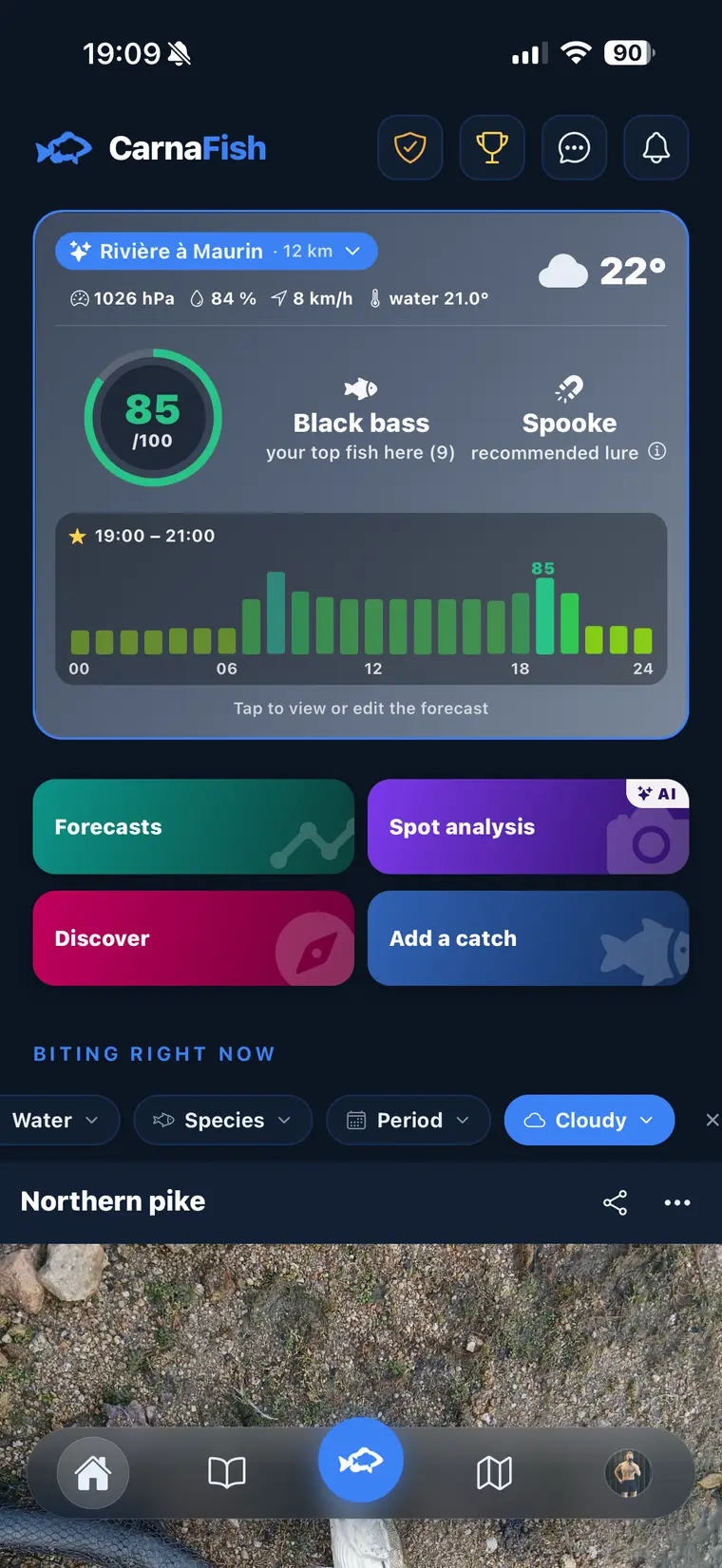
Not sure what to tie on?
Photograph your spot: CarnaFish reads the scene, cross-checks the conditions and gives you the zone, the lure and the retrieve. Free on iOS and Android.
Tackle and hookset
This is not a style of fishing where tackle is negotiable. You need a heavy to extra-heavy rod, long enough to cast 14 g and stiff enough to set the hook through a mat, and 30 to 50/100 braid with no fluorocarbon leader at all. Any stretch in the line and the hookset is absorbed by the vegetation before it reaches the hook.
The hookset itself is specific. When the fish explodes, you do not set. You wait until you feel weight — one second, sometimes two — then set hard, sideways and continuously, without easing off, reeling at the same time to pull the fish out of the vegetation before it wraps up in it. It is the hardest countdown to hold in all of lure fishing.
The classic mistake
Setting on the sound, as on a conventional popper. The difference here is that an early set rips the lure out of the mat and leaves you with a frog hung up in the branches three metres away. With a frog, the conversion ratio rarely exceeds fifty per cent even among good anglers: accept it, and focus instead on not losing the fish that genuinely got hooked.
For comparison, the Spro Bronzeye Frog is the American benchmark for the pointed-nose hollow body, and the Booyah Poppin Pad Crasher covers the same popping register at a far more accessible price. Within the Deps catalogue, the Buzzjet fills the noisy topwater slot when the vegetation does not force a hollow body on you.
Colour by light
- Overcast skies: the green-flaked chartreuse of the sample photographed. It is the most visible colour for the angler — and in fishing where you must know exactly where your lure sits in a mat, your own visibility counts as much as the fish's.
- Full sun, wary fish: a dark tone. Seen from below, the fish only sees a black silhouette against a bright background; a bright colour adds nothing, and a clean silhouette helps it time the strike.
- Clear water and scattered vegetation: a natural green finish, for when the lure is visible by more than sound and the fish has time to inspect it.
Of course you still have to know which mat is worth the effort, because across ten hectares of lily pads they are not all equal. That is exactly what CarnaFish helps you narrow down: a photo of the spot, and the app suggests the zone and the presentation suited to the day's conditions. To frame the basics of bass fishing, our beginner's guide to bass fishing covers the tackle and the classic spots.
Key takeaways
- Figures confirmed by Deps: 6.1 cm for 14.2 g, a high weight-to-size ratio needed to cast and cross mats.
- The cupped mouth adds an acoustic component that pulls up fish that cannot see the lure.
- The outbarb double hook does not pierce the hollow body: the lure does not drown after a few fish.
- 30 to 50/100 braid with no fluorocarbon, and a delayed hookset until you feel weight.
FAQ
What exactly is the Buster K's size?
Deps publishes 2.4 in, so 6.1 cm, for 1/2 oz, so 14.2 g. It is a compact but heavy format, consistent with the need to cast a hollow body and push through vegetation.
Why fur legs rather than silicone?
Deps explains that silicone strands get caught in the barbs of a conventional hook and choke the gape on the set. Its outbarb hook solves that, and fur undulates continuously even with the lure at rest.
What does the outbarb hook really bring?
Its barbs face outwards and therefore do not pierce the skin of the hollow body. The lure does not fill with water fish after fish, and unhooking is simpler.
What braid should I use?
30 to 50/100, with no fluorocarbon leader. Stretch is the enemy of a hookset through a mat: you need a direct connection between rod and hook.
Can you fish for pike with a frog?
Yes, it is a common use in Europe over weed-choked margins in summer. Add a wire or titanium leader without fail — a pike's teeth cut 50/100 braid without difficulty.
Why do I miss so many fish?
Because that is normal with a frog, and because you are probably setting too early. Wait until you feel weight in the rod, one to two seconds after the blowup, then set hard and sideways while reeling to drag the fish out of the cover.
The full bass lure guideSeason-by-season strategy: which family of lure, when, and why.Go from theory to fish
CarnaFish reads your spot from a photo and gives you the game plan: zone, lure, retrieve. Free on iOS and Android.