Molix Pop Frog: the hollow frog that pops or walks, your call
Not sure this lure fits YOUR spot today? CarnaFish tells you in 10 seconds, from a photo.
A carpet of duckweed over a backwater, a few black holes in the middle, and the certainty that there are fish underneath. That is the exclusive ground of hollow body frogs, the one place no other lure reaches. The Molix Pop Frog, developed with the American Team Frog Eaters, stands out on one point: it does not make a single noise, it makes two depending on how you hold the rod.
Two actions in one body
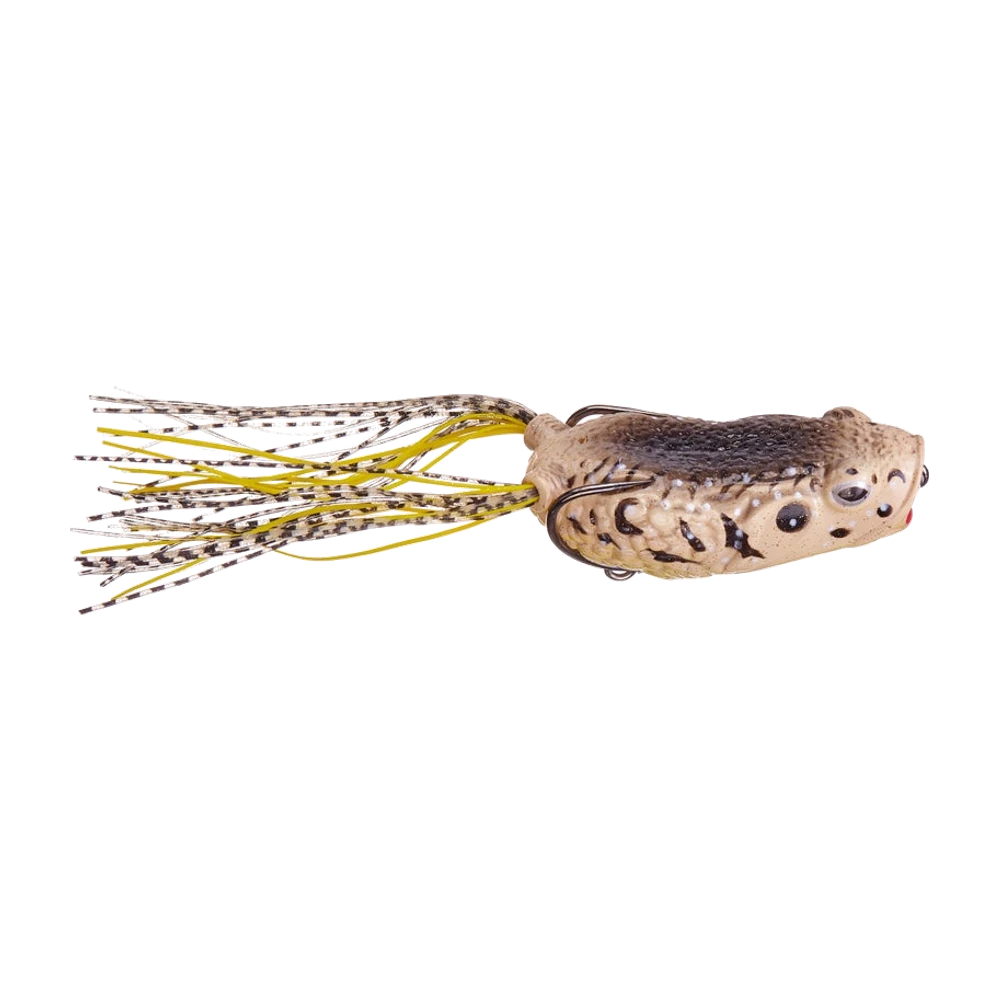
Most frogs are drawn for one thing. Pointed-nose models walk left and right, blunt-faced ones pop. The Pop Frog has a cleanly cut face, visible in the photo, which lets it throw water and smack on a sharp rod snap. But the maker also claims a clean side-to-side walk, obtained with softer snaps and a slightly slack line between each one.
That is a real advantage on a spot where you do not yet know what the fish wants. You start popping the holes, then switch to walking the dog along a clear edge, without changing lure and without losing ten minutes re-tying. Next to a purely walking frog like the Molix Sneaky Frog, you gain a whole extra range of noise.
Molix adds internal rattles. They are not there to make volume for its own sake: over dense matted weed, the fish does not see the frog, it locates it by sound and by the wake. The rattle carries the signal on after the pop, long enough for a bass to come up.
A compact, heavy format, and what that changes
The Molix table is short but complete: 6.3 cm / 2.5 in, 17.7 g / 5/8 oz, floating. Those three figures say a lot. Six centimetres is a modest size for a frog — well under the 7 to 8 cm of many American models. But 17.7 g at that length is dense: the Pop Frog is short and heavy, not short and light.
In practice that density gives you two things. First casting distance, because a heavy lure on a powerful rod reaches a hole thirty metres out without effort. Second inertia on the animation: the frog stays where you stopped it, it does not slide ten centimetres on every pop the way a light frog does, so you can work a patch of water the size of a table for a long time.
There is a flip side. Over very thin cover — a few scattered stems, a film of surface algae — a 17.7 g frog sinks between the strands more easily than a light model. That is not a fault, it is a working range: the Pop Frog is built for solid mats, not for a thin veil.
Always count to two after you see the blow-up, before setting the hook. The fish has to close its mouth and go back down, otherwise you pull the frog back untouched over its head. That is mistake number one with this kind of lure, and it comes from a reflex that fires too fast, not from poor tackle.
The hooks and the collapsing body
The body is soft but claimed to be durable: on the take it compresses and frees the two points of the OMTD double fitted as standard, visible lying flat on the back when the lure is at rest. That is the classic hollow frog mechanism, and how well it works depends entirely on the ratio between body softness and hook stiffness. Molix chose a heavy-wire double rather than a fine wire, which assumes a rod that can take a long sweeping hookset.
The rear eyelet, the detail people miss
Under the back of the body, an extra eyelet is fixed at the base of the hook. You can see it clearly in the photo. Molix put it there for two uses: to hang a small blade that adds flash and a little extra slap, or to fit a treble when you are fishing open water rather than vegetation.
The treble changes the whole logic of the lure: you gain hook-up rate, you lose weedless travel. Keep it for clear edges, dock lines and waters with no mat. Over vegetation, leave the eyelet bare or hang a blade on it.
Rig and leader
Straight braid, 0.30 to 0.40 mm or roughly 50 to 65 lb, no fluorocarbon leader: you need to rip the fish out of the mat, not let it bury in. A heavy power rod with a tip that keeps a little give lets you cast the frog a long way while absorbing head shakes near the boat. Where pike are present, a short wire trace stays sensible, even though it dulls the walking action a little.
Where and when to use it
The whole warm season, as soon as surface vegetation is established. The best windows remain dawn and late day, plus overcast days when fish rise more willingly. In flat midday sun the frog still catches if you drop it in deep shade, tight to a shaded bank or under a leaning tree.
For pike, target the lily pads of backwaters and shallow ponds, accepting a higher miss rate: a pike's jaw closes badly on a hollow body. The frog is still an excellent way to locate lies, even if you come back afterwards with a differently armed lure.
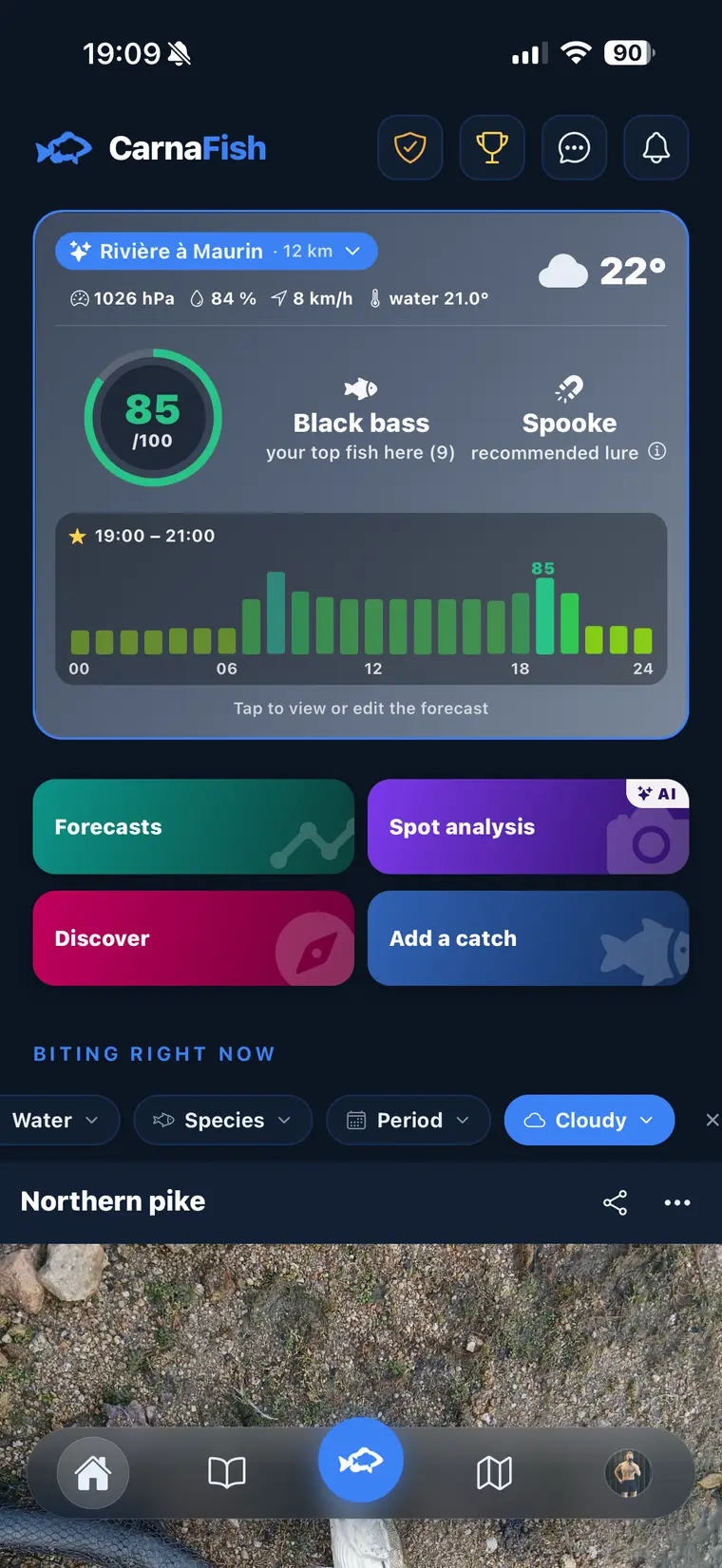
Not sure what to tie on?
Photograph your spot: CarnaFish reads the scene, cross-checks the conditions and gives you the zone, the lure and the retrieve. Free on iOS and Android.
Colours by light
- Clear water over vegetation: the brown and tan finish in the photo, which copies a real frog and does not over-contrast in bright light.
- Dirty water or late evening: a plain dark back, because from below a fish reads a silhouette before a colour.
- Overcast skies: a pale belly that stands out against the diffuse grey light and gives a clear aiming point.
A specialist frog, not an all-rounder
The Pop Frog is not the most versatile of its category, and that is deliberate: short, heavy and noisy, it is made for dense mats and for fish that react to sound. Over sparse weed or for a finer approach, a lighter Booyah Poppin Pad Crasher or a more conventional Spro Bronzeye Frog cover the ground better. Choosing a frog is mostly choosing a density and a noise.
Knowing where to drop the frog matters as much as the frog itself, and that is where CarnaFish comes in: one photo of the spot, and the AI suggests the zone, the depth and the presentation that fit the day, including when the surface is the right register. For tackle basics and reading water, our guide to getting started on bass fishing is still the best entry point.
Key takeaways
- Two actions in one lure: a loud pop on a sharp snap, a side-to-side walk on soft snaps with slack line.
- 6.3 cm for 17.7 g, so short and dense: excellent casting distance and in-place animation, but reserved for solid mats.
- An eyelet under the rear takes a blade, or a treble for open water fishing only.
- Count to two after the blow-up before setting the hook: it is the number one cause of misses on hollow frogs.
FAQ
Does the Molix Pop Frog really float?
Yes, the maker explicitly lists it as floating. That is a working condition for a hollow frog: it has to sit on top of the mat between animations.
Pop or walk the dog, which should I pick?
Start popping the holes and mat edges, where noise serves to locate the lure. Switch to a walking action over clear water, where the fish sees better and a steady travel triggers more.
What is the rear eyelet for?
Molix put it there for a small blade, which adds flash and extra slap, or for a treble hook when you fish open water. The treble improves hook-ups but removes every bit of weedless behaviour.
What tackle do I need for frog fishing?
A heavy power rod, a fast-retrieve reel and 0.30 to 0.40 mm braid, roughly 50 to 65 lb, tied straight through. Fluorocarbon has no place here: you need to pull the fish out of the mat in one go.
Why do I miss so many frog bites?
Almost always because the hookset fires too early. Wait until you feel the weight of the fish in the rod, roughly two seconds after the blow-up, then sweep hard and low to the rear.
Can you catch pike on this frog?
Yes, in the lily pads of shallow ponds and backwaters, but with more misses than on bass: a pike's bony mouth closes poorly on a hollow body. A short wire trace becomes essential as soon as pike are around.
The full bass lure guideSeason-by-season strategy: which family of lure, when, and why.Go from theory to fish
CarnaFish reads your spot from a photo and gives you the game plan: zone, lure, retrieve. Free on iOS and Android.