Deps Evoke Zero: the Japanese prop bait that plops on every turn
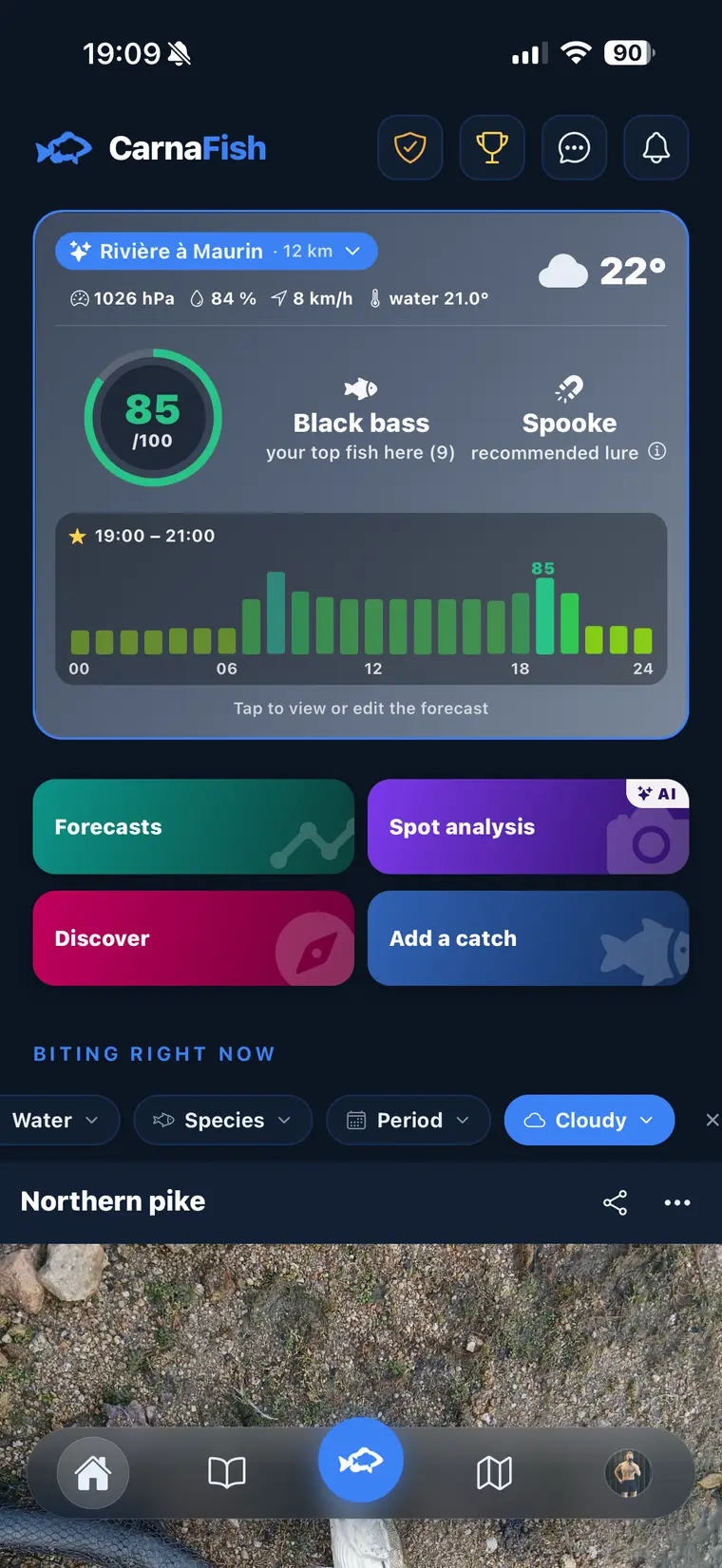
Before tying this one on, it helps to know if the spot actually calls for it. CarnaFish reads the scene from a photo.
There are summer mornings when the surface is so flat you hesitate to cast. Nothing moves, nothing swirls, and yet the fish are there, sitting tight under the bank. In that situation a subtle lure is useless: what you need is a repeating noise and a wake the fish eventually cannot ignore. The Deps Evoke Zero belongs to that family, the baits that are not trying to imitate anything but to irritate a fish into a mistake.
A round body, a prop, and that's it
The Evoke Zero comes in two sizes only, and Deps classes both as topwater: the Evoke Zero 120 measures 12 cm / 4.75 in for 28 g / 1 oz, the Evoke Zero 150 steps up to 15 cm / 6 in for 53 g / 1.875 oz. Those are heavy figures for a surface bait, and the weight has a purpose: a body that bulky needs mass to stay settled on the retrieve, and the rear prop needs resistance to bite the water instead of spinning free.
The profile is frankly bulbous, almost out of proportion. Deps owns that choice: the point is to offer a wide target, easy for a fish to line up from below in choppy or murky conditions. It is the opposite logic to a slim stickbait like the Heddon Super Spook, which trades on a streamlined silhouette and side-to-side movement. Here the bulk of the body is part of the argument.
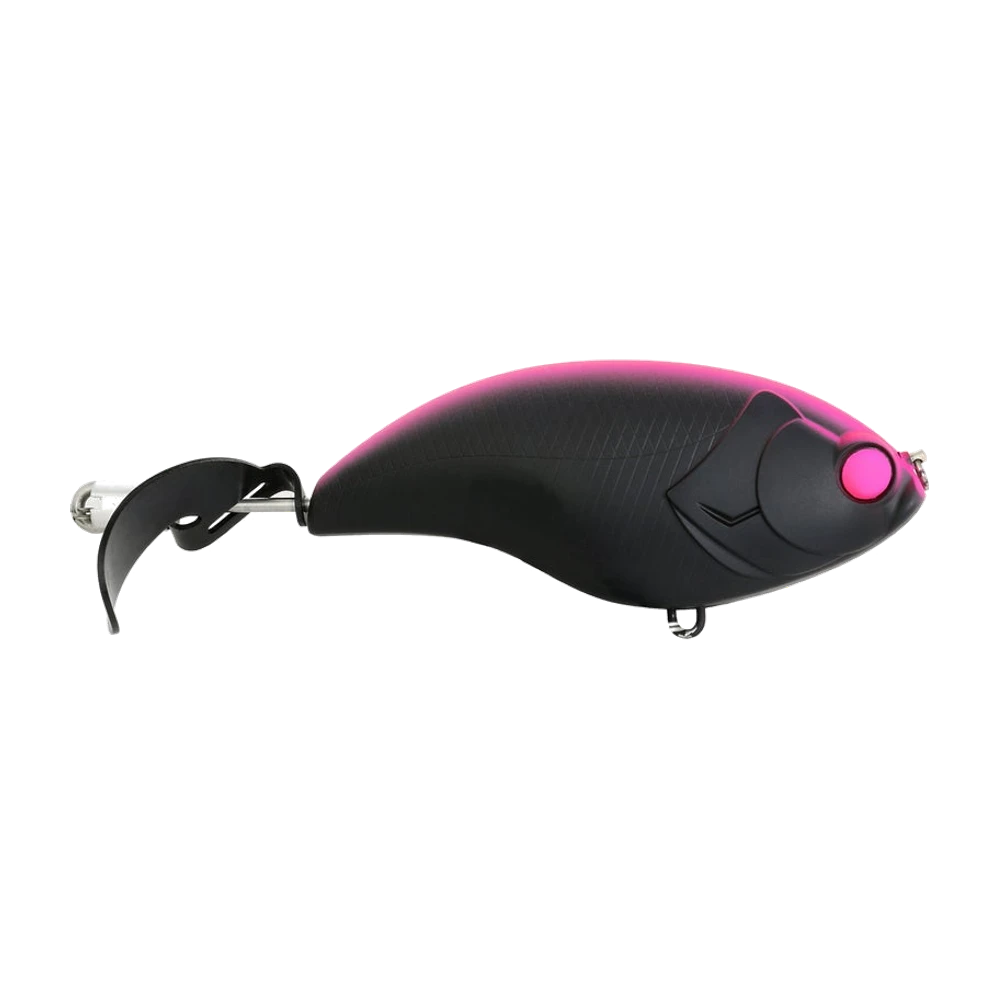
The metal prop mounted at the rear does the rest. On every rotation it throws water and produces a clean plopping note — the signature prop bait sound, which carries far further than a sharp pop because it repeats continuously. In the photo you can clearly see the shaft coming out of the body, the curved blade and the stop bead on the end.
Tuning the prop, the real talking point
This is what sets the Evoke Zero apart from most of its rivals: the prop can be bent in or out to change the pitch of the noise. Tuned in, it gives a tighter, higher note and offers less resistance on the retrieve. Opened out, it churns more water, slows the bait down and produces a deeper, more spaced-out plop.
That sounds like a footnote until you live through a day where fish refuse one pitch and come up on the other. The workable method is to start from the factory setting, make a dozen casts, then open the blade slightly if nothing shows. Make a mental note of the setting that produced the bite: on a given water it tends to repeat from one session to the next.
Bend the blade in tiny increments, with flat pliers and never by hand. A quarter of a millimetre is enough to shift the pitch, and a blade bent off true will make the whole bait roll through the retrieve. If it rolls, it is almost always the prop, not the knot.
Hardware worth understanding before you buy
Deps fits two different types of hook, which is unusual. At the rear, a slick-coated Ryugi treble. At the front, a swivelling Ryugi quad hook — four points on an axis that turns freely under the bait. The thinking is straightforward: on a surface bait this bulky, plenty of strikes end in contact without a hook-up, and multiplying the points up front raises the odds that one finds purchase. The quad swivelling also limits the leverage a fish has to throw the bait during the fight.
One detail the photo makes obvious: the bait is shown bare, with both belly hook hangers empty. That is a catalogue shot, not the state it fishes in. Check the hardware when you open the box, and above all make sure the quad swivels freely before the first cast — a point rubbing against the body is a lost hook-up.
How to work it
The Evoke Zero is first and foremost a straight-retrieve bait, fished slowly, at the minimum speed that keeps the prop turning steadily. That is the baseline and it is often enough. You set the speed by ear: as long as the plop is regular you are in the right band. The moment it goes irregular or stops, you are too slow.
From there, two variations are worth the trouble. The first is to drop in one-second stops every three or four metres: the prop stalls, the bait floats in place, and the restart creates an audible jolt that often triggers the strike. The second is a burst of speed over the last two metres before an obstruction — a piling, a laydown, a weed edge — imitating prey panicking as it reaches shelter.
The classic mistake
Setting the hook on the sound. With a surface bait this loud, the urge to strike the instant you hear the explosion is almost irresistible, and it pulls the bait out of the fish's mouth eight times out of ten. Wait until you feel the weight in the rod, then set by leaning into it rather than snapping. A rod with a slightly softer tip helps enormously here, because it absorbs that extra tenth of a second.
The other mistake, quieter but just as costly, is fishing too fast out of fear of losing the rotation. A prop bait pulled too quickly leaves a messy wake and stops the fish lining up its rise. If in doubt, slow down.
Not sure what to tie on?
Photograph your spot: CarnaFish reads the scene, cross-checks the conditions and gives you the zone, the lure and the retrieve. Free on iOS and Android.
Where and when to use it
This is a bank bait and a low-light bait. The first two hours after sunrise and the last before dark are its natural windows, along with overcast or breezy days when the surface is rippled. It shines along a weed line, over a shallow flat, down a bank littered with timber, and loses most of its interest out in open water with no structure.
Deps positions the Evoke Zero for bass, and that is the fish it was drawn for. But in Europe, a 15 cm / 6 in surface bait weighing 53 g / 1.875 oz and making that kind of noise is of serious interest to pike, provided you run a wire or titanium leader — without one, the first proper bite costs you an expensive lure. The 120 remains the better pick for bass and for waters holding average-sized fish.
Colour by light
- Overcast skies, dawn, dusk: dark backs with bright flanks, like the black and hot pink in the photo. On top it is the silhouette seen from below that counts, and a dark dominant reads better against a grey sky.
- Clear water and full sun: natural silver tones, which return light without overdoing it and avoid spooking a wary fish in shallow water.
- Stained or coloured water: a white or chartreuse back, to give a visual reference to a fish that cannot see beyond a metre.
A surface bait is only worth as much as the spot you drop it on, and that is exactly what CarnaFish sets out to simplify: a photo of the bank, and the app suggests a zone and a retrieve suited to the conditions of the moment. If you are eyeing the 150 for pike, our guide to choosing a pike lure places this kind of prop bait among the other families worth knowing.
Key takeaways
- Two sizes only, both classed topwater by Deps: 120 (12 cm / 4.75 in, 28 g / 1 oz) and 150 (15 cm / 6 in, 53 g / 1.875 oz).
- The rear prop bends in or out to change the pitch of the plop — the first adjustment to try when nothing is biting.
- Mixed hardware: Ryugi treble at the rear, swivelling Ryugi quad hook up front, built to convert badly aimed strikes.
- Never set the hook on the sound: wait until you feel the weight in the rod.
FAQ
Should I pick the Evoke Zero 120 or the 150?
The 120 (12 cm / 4.75 in, 28 g / 1 oz) covers most bass situations and casts on sensible tackle. The 150 (15 cm / 6 in, 53 g / 1.875 oz) needs a powerful rod and targets big fish, or pike in Europe with a wire leader.
How fast should I retrieve it?
At the slowest speed that keeps the prop turning steadily. You tune it by ear: a continuous plop means you are in the right band, a sound that keeps cutting out means you are too slow.
Why is the prop adjustable?
Because it changes the pitch of the noise. Bent in, the note is higher and the bait pulls more easily; opened out, it churns more water and gives a deeper plop. On any given day fish often show a clear preference for one or the other.
My Evoke Zero rolls on the retrieve, what should I check?
Look at the prop before you blame the knot. A blade bent slightly off true unbalances the whole bait. Straighten it with flat pliers, in very small corrections, checking the swim after each one.
Do I need a wire leader?
Only where pike share the water, which is common in Europe on the kind of venue where a big surface bait like this makes sense. On a pure bass fishery, heavy fluorocarbon is enough and stays more discreet.
How does it differ from a plopper-style tail bait?
A River2Sea Whopper Plopper 130 uses a hinged soft tail that slaps the water, whereas the Evoke Zero works with a metal prop on a shaft, drier in tone and adjustable. The Deps Buzzjet occupies yet another niche, halfway between a buzzbait and a hard bait.
The full bass lure guideSeason-by-season strategy: which family of lure, when, and why.Go from theory to fish
CarnaFish reads your spot from a photo and gives you the game plan: zone, lure, retrieve. Free on iOS and Android.