Jackall Pompadour: the topwater with metal wings and a prop
Before tying this one on, it helps to know if the spot actually calls for it. CarnaFish reads the scene from a photo.
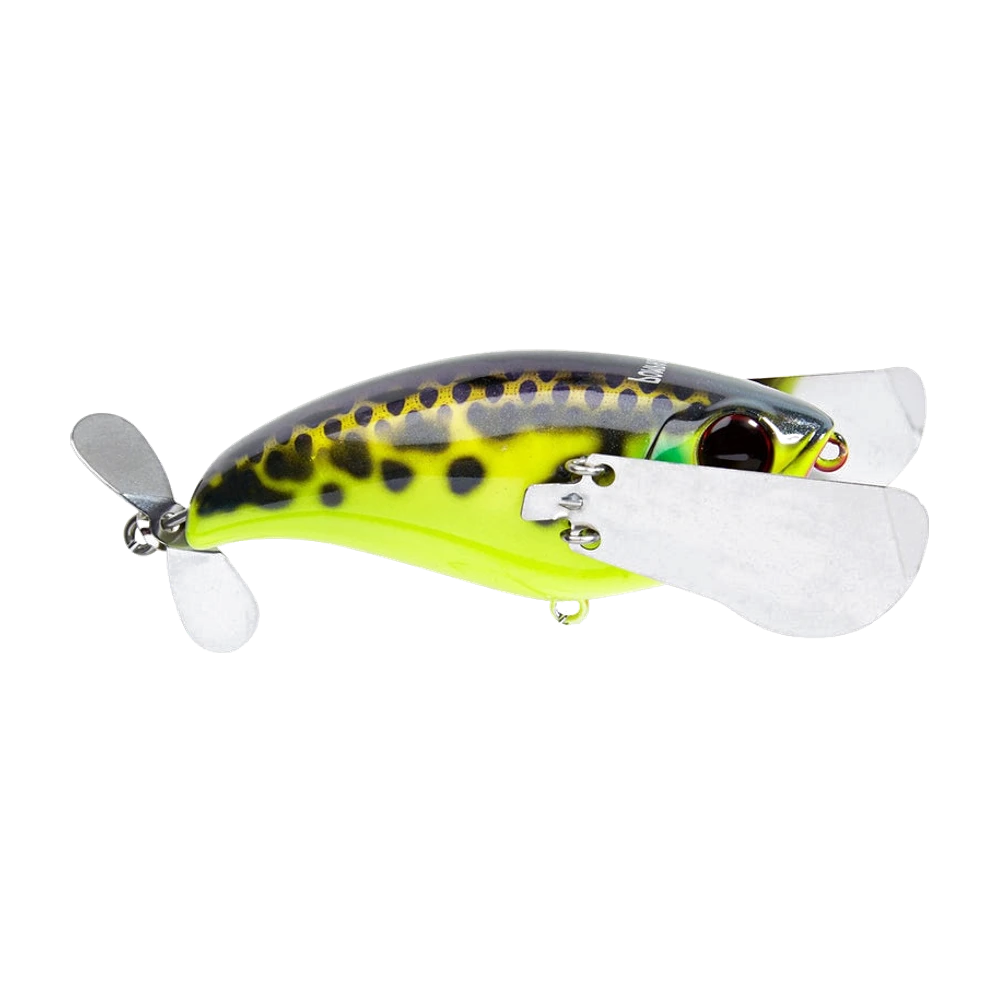
Topwater fishing often comes down to a detail of noise. A popper that makes too much racket on flat water pushes fish away; a stickbait too quiet for a wind-rippled surface goes unnoticed. Between the two there are few clear options — and that is exactly where the Pompadour sits, with a system nobody else uses: metal wings that fold against the body in flight and flare out the instant it lands.
Wings that fold on the cast and open on the water
That is the visible peculiarity of the bait and the reason for its shape. During the cast the wings fold against the body: the lure becomes compact, flies without helicoptering and holds a decent distance despite its deployed surface area. The moment it touches down, they swing out into working position.
From then on, every rod stroke makes those wings flap, slapping the surface and throwing water sideways. The result is neither a popper's bloop nor a stickbait's wake: it is a broad, irregular chop with a metallic clack behind it. On flat water you hear it twenty metres away. For a fish sitting under a low branch or along a bank, that signal carries much further than a conventional topwater of the same size.
The downside is worth knowing: moving metal wings are parts that bend. One cast into a branch, one fish thrashing in the net, and a wing can go out of true. Check them for symmetry regularly and straighten them gently by hand — an asymmetric bait veers to one side instead of holding its line.
Prop blade and rattle chambers: three noise sources in one bait
At the rear, the Pompadour carries a prop blade. It spins as soon as the bait moves, even very slowly, and produces the gurgle typical of prop baits: a low, continuous sound, quite unlike the sharp clack of the wings. The maker also lists two rattle chambers inside the body.
So the bait stacks three acoustic registers that do not overlap: the clack of the wings on each stroke, the prop's gurgle while it travels, the rattle of the beads throughout. That layering is the model's central argument, and it explains its use: the Pompadour is a calling lure, built to pull in a fish that has not seen it, not to fool a fish already sitting there.
What the description does not say
Retailers list the model as a walking bait, but Jackall nowhere describes a side-to-side dog walk. The technical copy talks about flapping wings, splash, a distinctive sound and a gurgling prop — not a bait that darts left then right. If you buy it expecting the walk of a Heddon Zara Spook, you will be disappointed. Take it for what it is: a loud topwater that works largely in place and on a slow crawl.
On perfectly flat water at first light, start by landing the lure and doing nothing for ten seconds. The wings finish opening, the rings close, and your first stroke lands in complete silence. That is almost always the one that triggers.
The free-swinging hook holder, a detail that counts on the set
At the back, the treble is not rigidly fixed: it hangs on a free-swinging holder. Jackall explains the intent, and it is purely mechanical. When a bass jumps with a hard bait across its mouth, it uses the lure as a lever: the weight of the body pivots the hook and tears the point free. A free holder removes that leverage, because the body no longer transmits its inertia to the hook.
In practice it does not replace a good hookset, but it shifts the odds across a run of fish. It is also a reason not to swap the factory arrangement for a plain rigid split ring out of a reflex to upgrade the bait.
Not sure what to tie on?
Photograph your spot: CarnaFish reads the scene, cross-checks the conditions and gives you the zone, the lure and the retrieve. Free on iOS and Android.
How to work it, where and when
At 7.6 cm for roughly 21 g, the Pompadour is dense for its size: it casts a long way, which matters on a calling lure you use precisely to cover a bank from a distance. Jackall rates it explicitly as Topwater.
The baseline retrieve is a series of short rod-tip strokes, rod low, separated by two to four second pauses. The bait moves little — twenty to thirty centimetres per stroke — and that is deliberate: it has to stay inside a holding fish's detection zone for a long time. On rippled water you can chain strokes without pauses and keep it working almost continuously, the wind masking the excess noise.
Typical spots are banks with relief: low branches, laydowns, docks, reed stems, pad edges in open water. The Pompadour is not a weed bait — the wings and prop collect everything floating. Keep it for open water right next to the cover.
In Europe this kind of loud topwater also draws pike, which willingly rise to a prop bait in late summer and autumn. If you fish it that way, thick fluorocarbon is not enough on a known spot: move to supple titanium, discreet enough not to choke the bait's surface behavior.
The classic mistake
Retrieving it on a straight crank. Plenty of anglers see a prop and reel steadily as they would a whopper plopper. The Pompadour then loses the whole point of its wings, which no longer have time to flap and stay pinned in the flow. The bait was designed for a jerky retrieve with dead time, and it is during that dead time — as the wings settle and the water calms — that most strikes come.
Colors by water
- Stained water or poor visibility: the pattern in the photo, dark spotted back and chartreuse belly. The pale belly is what the fish sees from below, and chartreuse stays readable in loaded water.
- Clear water: a natural silver tone, more believable when the fish has time to inspect the bait during the pauses.
- Backlight, dawn and dusk: a black model. Seen from below it is the cut of the silhouette that counts, and black gives the sharpest contrast against a bright sky.
A calling lure is useless if you send it to the wrong place: that is the whole challenge of reading a bank, and exactly what CarnaFish offers — one photo of the spot, and the AI suggests the zone, the depth and the lure type that match the day's conditions. To know when to pull out topwater and when to forget it, our season-by-season predator fishing guide lays out the full calendar.
Key takeaways
- The metal wings fold on the cast and open on impact: they slap the water on every stroke and give the bait its signature chop.
- Three stacked noise sources — wings, rear prop, two rattle chambers — make the Pompadour a calling lure, not a finesse one.
- Despite the retail label, Jackall credits it with no side-to-side walk: work it in short strokes broken by pauses, never on a straight retrieve.
- 7.6 cm for roughly 21 g, rated Topwater: dense enough to cast far, but best kept to open water near cover rather than weed beds.
FAQ
Does the Pompadour really walk side to side?
Jackall's technical copy never mentions a side-to-side walk: it describes flapping metal wings, splash, a distinctive sound and a rear prop. Treat it as a loud calling lure that works largely in place, not as a dog-walking stickbait.
What are the metal wings for?
They fold against the body on the cast to limit wind resistance, then flare out on impact. After that, every rod stroke makes them flap: they slap the surface, throw water and produce a metallic clack that carries a long way on calm water.
Can you fish it in weed?
No, and that is its real weakness. The wings and prop pick up everything floating and catch on the smallest stem. Keep it for open water along the cover, and switch to a frog as soon as vegetation closes the surface.
What rigging avoids choking the bait?
A loop knot or a small quick snap, so the nose stays free to pivot on every stroke. Above all, keep the factory free-swinging hook holder: it removes the leverage a fish uses to throw the hook.
Is it any good for pike?
Yes in Europe, where predators willingly rise to a loud topwater from late summer into autumn. Fit a supple titanium leader in that case: thick fluorocarbon does not protect enough, and rigid wire disturbs the bait's surface behavior.
How does it differ from a classic prop bait?
A classic prop bait like the 6th Sense Scramble leans mostly on its blade, and a topwater like the Deps Buzzjet on its own disturbance system. The Pompadour stacks three distinct acoustic registers, which makes it louder but also easier to overdo on flat water and on educated fish.
The full bass lure guideSeason-by-season strategy: which family of lure, when, and why.Go from theory to fish
CarnaFish reads your spot from a photo and gives you the game plan: zone, lure, retrieve. Free on iOS and Android.