Deps MT Wake: the jointed wakebait that drags a Colorado blade
This lure shines under specific conditions. CarnaFish tells you in 10 seconds if today is one of them.
A wake is an underrated signal. A lure that never breaks the surface but works ten centimetres under it leaves a continuous trail behind, visible from a distance, that a fish will sometimes follow for several metres before committing. The Deps MT Wake pushes that logic further than most wakebaits: it is jointed, it squeaks, it rattles, and it drags a Colorado blade behind it. That is a lot of signals for one lure, and it is exactly the point.
One size only, and an unusual weight-to-length ratio
Worth saying straight away because it shapes everything else: Deps catalogues a single MT Wake, 9.5 cm / 3.75 in for 48 g / 1.7 oz, classed as topwater. There is no range, no finesse version and no oversized swimbait version — one model.
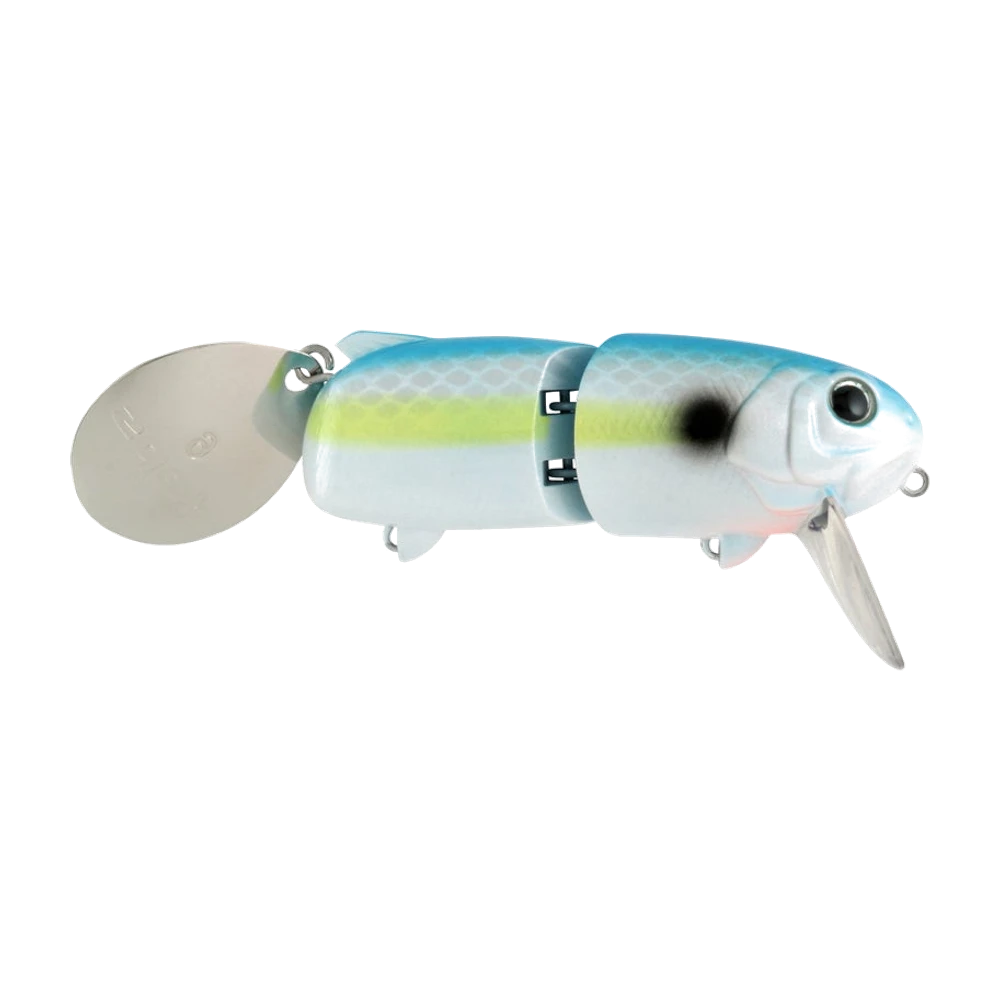
Those 48 g on 9.5 cm deserve a pause. It is a very unusual ratio: a crankbait of the same length weighs three to four times less. The explanation lies in what the bait carries — three body segments, two metal hinges, a wide lip and above all a large metal Colorado blade at the rear — and in the stated length, which covers the body without the blade. What you hold in your hand is therefore considerably bulkier than the catalogue 9.5 cm suggests.
The practical consequence: this is not a lure you cast on light casting gear. You want a rod comfortably rated past 50 g / 1.75 oz, heavy braid, and an acceptance that casting distance will stay modest because of the drag the blade creates in flight.
Four signals working together
The lip is wide and its stated job is clear: push water and pull fish out of cover. It is not there to make the bait dive. On a normal retrieve it holds the lure just under the surface and generates a side-to-side roll — the body tips from one flank to the other every half turn of the handle, throwing alternating flashes of light.
The joints do two things. First they allow movement: a three-segment body undulates where a rigid body merely rolls. Second they make a sound, which is rarer. Deps notes that the hinges rubbing as the bait swims create a subtle squeak, layered on top of the internal rattle chamber. So you have two acoustic sources of different character: the sharp metallic click of the rattle, and a duller friction noise.
The Colorado blade on the tail closes the list. A Colorado is the widest and roundest blade shape, the one that produces the most resistance and the heaviest pulse. It slows the lure down — which is intended, since a wakebait has to stay slow — and it adds a low-frequency pressure wave the lateral line picks up well before the fish sees anything at all.
Before the first cast, check that the blade turns freely on its attachment. A blade rubbing against the last segment turns a regular pulse into parasitic noise and, worse, makes the lure track off to one side. A flick of a fingernail tells you: it should keep spinning on its own.
How to work it
The baseline is a slow, constant straight retrieve. You are looking for the minimum speed at which the wake stays well defined and you can feel the blade pulsing in the rod. In practice that is slower than instinct suggests. Once you have found that speed, hold it through the whole retrieve without accelerating, following a precise line: a weed edge, the shade line of an overhanging tree, a row of pilings.
The second retrieve is the one Deps highlights: short, crisp rod-tip twitches during the wind. The lure answers by veering off, left then right, with a gliding movement that breaks the regularity of the wake. That is the trigger to use when a fish has followed without striking, or just before an obstruction.
The classic mistake
Retrieving too fast. With a heavy lure that pulls this much, the instinct is to wind in order to "feel it working". Past a certain threshold the lip pulls the bait a few centimetres deeper, the wake disappears, and the whole point of a wakebait goes with it. If you can no longer see a trail on the surface, you are too quick.
The twin mistake is striking too early. As with any surface or sub-surface lure, the take is visual and spectacular. Wait until you feel the weight, then lean into it. With 48 g flying through the air, a strike into thin water is as unpleasant as it is useless.

Not sure what to tie on?
Photograph your spot: CarnaFish reads the scene, cross-checks the conditions and gives you the zone, the lure and the retrieve. Free on iOS and Android.
Where and when to use it
The wakebait is a bank lure and a mild-temperature lure. It makes most sense in spring and early summer, when bass move up onto shallow flats, and again in autumn over the same ground. Low-light windows remain the most productive, but a wakebait also fishes in broad daylight under cloud and a light breeze — rippled water makes the wake less readable to the fish, which then leans more on sound and vibration, and that is exactly where the MT Wake's four sources become an advantage.
The spots to favour are those where a fish sits under shelter and has to come out to strike: weed edges, the low branches of a leaning tree, a line of lily pads, a dock. It is the same ground as a Clutch Wake Gill Wakebait, with a far busier acoustic signature.
A word of caution for Europe: on a mixed fishery, a jointed lure this size leaving a wake also attracts pike. Run a wire or titanium leader if you know they are present — a set of teeth cuts fluorocarbon like sewing thread, and this lure is not cheap.
Colour by water clarity
- Clear to lightly stained water: baitfish patterns, like the blue back and chartreuse band in the photo. The nickel blade already brings plenty of flash, so there is no need to pile on with an over-bright body.
- Low light, dawn and dusk: a plain dark back, which stands out from below against a sky that is still pale.
- Coloured water: pale belly and bright flanks, to give a close-range visual reference at the moment the fish rises to the wake.
A wakebait is only worth as much as the line you make it follow, and that is exactly what CarnaFish sets out to simplify: a photo of the bank, and the app suggests which edge to run and what retrieve suits the day's conditions. To know when in the year this kind of surface presentation becomes the right call, our guide to predator fishing season by season lays out the calendar.
Key takeaways
- One catalogue item only: 9.5 cm / 3.75 in for 48 g / 1.7 oz, with the blade not counted in the stated length.
- Four simultaneous signals — a lip pushing water, the roll of a jointed body, a rattle plus squeaking hinges, and the pulse of a rear Colorado blade.
- Very slow straight retrieve to keep the wake visible, short rod-tip twitches to make the lure glide left and right.
- Too fast and the bait sinks in, taking the wake with it: the mistake that cancels everything this model is for.
FAQ
Does the MT Wake come in several sizes?
No. Deps catalogues a single item, given as 9.5 cm / 3.75 in and 48 g / 1.7 oz, classed as topwater. There is neither a finesse version nor a larger one.
Why is it so heavy for its size?
Because the stated length covers the body alone. On top of that come two metal hinges, a wide lip and a large metal Colorado blade at the rear, all of which add weight and bulk. Plan on a rod comfortably rated past 50 g / 1.75 oz.
How deep does it swim?
Just under the surface, leaving a visible wake. It is not a diver: the lip is there to push water, not to take the lure down. If the wake disappears, you are retrieving too fast.
How does it differ from a standard wakebait?
Most wakebaits settle for the wake and the roll. The MT Wake adds a jointed body, a rattle chamber, squeaking hinges and a Colorado blade. A Daiwa Morethan Crosswake instead plays the subtlety and casting-distance card.
Do I need a wire leader?
Yes as soon as pike share the spot, which is common in Europe on the kind of water where this lure makes sense. On a pure bass fishery, heavy fluorocarbon will do.
Can it be fished at night?
That use fits its acoustic signature: rattle, squeak and blade pulse carry far better than any paint job in the dark. An Arbogast Jitterbug Wakebaits is still easier to manage after dark, being lighter and far more forgiving on speed.
The full bass lure guideSeason-by-season strategy: which family of lure, when, and why.Go from theory to fish
CarnaFish reads your spot from a photo and gives you the game plan: zone, lure, retrieve. Free on iOS and Android.