Imakatsu Bebikira: the 7 cm finesse wakebait with a belly blade
Rather not fish it blind? Photograph your spot — CarnaFish cross-checks the conditions and points you the right way.
Some days the fish comes up to look and goes back down without touching. You see the wake close in behind the lure, the water bulge, then nothing. Nine times out of ten the problem is neither the area nor the speed: it is the bulk. A standard 11 or 12 cm wakebait brings fish up, but it also gives them all the time in the world to count the hooks. The Bebikira answers that with a drastic cut in size — 7 cm, 3.9 g — while keeping the surface signal that makes fish rise.
Seven centimetres, under four grams
Imakatsu's table is short and unambiguous: 70 mm, 3.9 g, floating. Those three figures alone define how this lure is fished. A 7 cm body weighing only 3.9 g, metal blade included, is very little for a jointed hard bait — you are squarely in BFS or well-tuned finesse spinning territory, not on an ordinary casting setup. If your rod does not load under 5 g, you will spend the day throwing the lure fifteen metres instead of thirty.
The floating rating has a direct consequence too: at rest the Bebikira rises and sits on the surface. You can therefore stop the retrieve for as long as you like without losing the lure in the water column, then restart the action with a single turn of the handle. That is exactly what a sinking wakebait cannot do, and it is what makes the pause usable on a following fish.
Jointed up front, soft at the back
The build deserves a moment, because it is not that common. The Bebikira is a hard body with a single joint, terminating in a soft plastic tail. Two materials, two jobs. The rigid section carries the nose, the lip and the 3D eye, and it sets the path. The single joint allows a clear lateral movement without turning the lure into a glide bait: it wobbles, it does not slide from side to side.
The soft tail does the rest of the work. It vibrates at speeds where a rigid tail would stay dead, and above all it keeps moving through deceleration, when the body itself is already settling. That lag is what makes the lure look alive on the stop, and that phase is often where the fish commits.
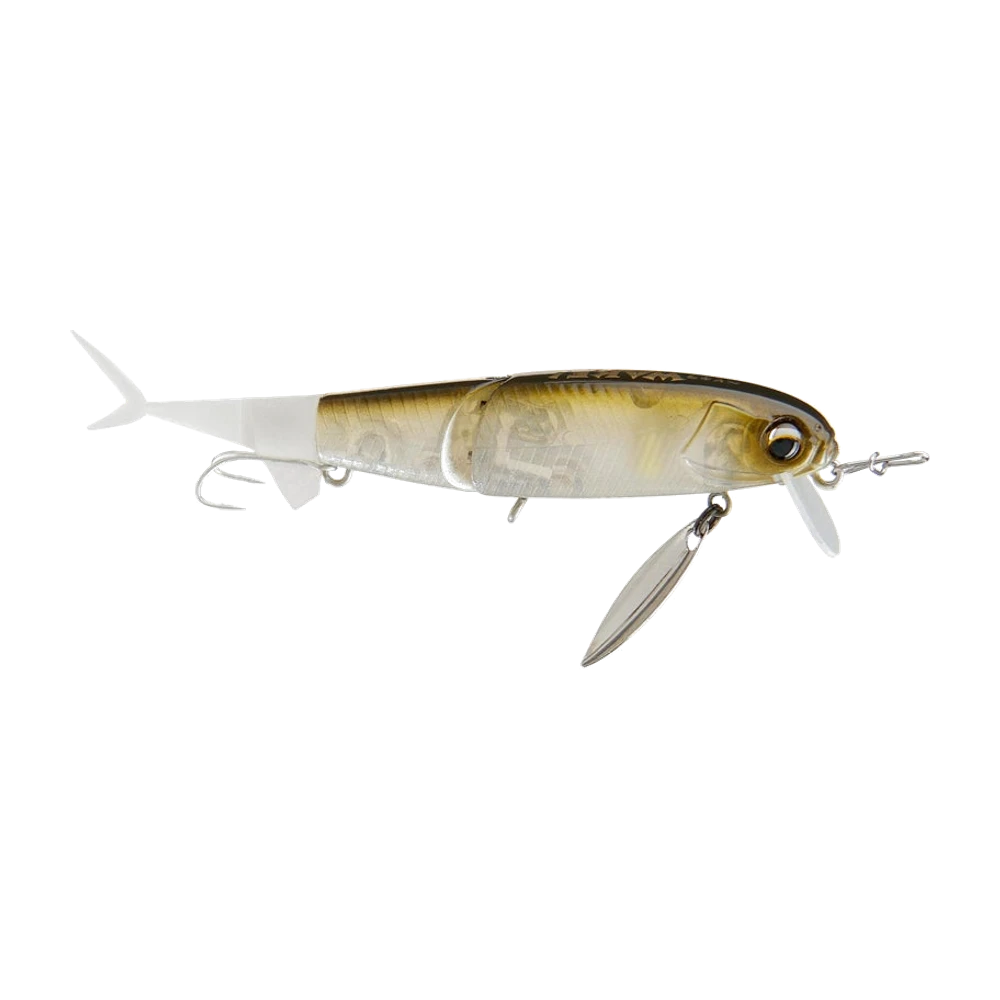
Imakatsu notes that the nose carries a lip described as durable, which adds a slithering movement to the whole. In the photo that lip is small, clear and steeply angled: it is not there to make the lure dive, but to anchor it just under the surface and stop it from skipping out when you speed up.
The belly blade, one part with two jobs
The most unusual feature is the small underspin blade hanging under the belly, visible in the photo on a split ring. Imakatsu gives it two functions, and both matter.
The first is attraction: a spinning blade adds a flash and a high-frequency vibration that neither the body nor the tail produces. On a wakebait that is an extra signal in a band fish pick up from a distance, including in slightly coloured water.
The second is more technical and it is the one I find more interesting: the blade helps the lure track true. A small jointed bait retrieved fast naturally tends to leave its axis and roll onto its side. The drag created by the blade, set under the centre of the body, acts like a keel and stabilises the action at speed. That is why the Bebikira tolerates being burned, which most wakebaits this size do not.
Before each session, spin the blade between two fingers. If the split ring has gone slightly oval after a few fish, the blade locks up and the lure immediately slews sideways as soon as you accelerate. Thirty seconds of checking saves you an hour wondering why your lure no longer tracks.
Two opposite retrieves, both valid
Burned under the surface
Fast retrieve, rod low, keeping the lure twenty or thirty centimetres under the surface. The wake stays subtle — a long way from the churn of a big wakebait — the blade spins at full speed and the soft tail vibrates continuously. This is the presentation for sweeping a bank quickly or cutting through a school of baitfish.
Crawled very slowly
At the other end, Imakatsu claims the same effectiveness on a very slow retrieve, almost at a crawl. The lure then sits just under the film, the tail undulates softly and the blade only turns now and then. This is the clear-water, seen-it-all presentation, and it is where the small profile pays off most.
The classic mistake
Trying to work the Bebikira with the rod like a jerkbait. The body is too light and the joint too loose: a rod stroke pops it off the film, it lands crooked and it needs several turns to settle again. Keep the rod low and work from the reel. The only useful variations are speed changes, not jerks.
Where and when to use it
This is a shallow-water lure for pressured fisheries: reed edges, rocky points, undercut banks, backwater ends. It makes most sense when fish are present but refuse bulk — late summer on a busy lake, the middle of a bright day, or after a run of boat traffic.
Imakatsu aims it at bass and that is its primary target. In Europe this 7 cm, 3.9 g class also falls squarely into perch territory, and perch are exactly the fish a bladed finesse wakebait makes sense for: treat that as a European extension of use, as the maker does not claim it.
Not sure what to tie on?
Photograph your spot: CarnaFish reads the scene, cross-checks the conditions and gives you the zone, the lure and the retrieve. Free on iOS and Android.
Rigging and hooks
Imakatsu fits the Bebikira with a treble and a double under the belly, alongside the blade. The photo on this page shows the double mounted under the rear of the hard body and the front belly hanger left bare, with the blade occupying the ring: that is a catalogue image, not necessarily the delivered state.
For tackle, a light rod rated 2 to 8 g with a sensitive tip, thin braid in 0.06 to 0.08 mm and 50 cm of fluorocarbon in 0.18 to 0.22 mm. Braid floats and does not pull the lure down, which matters on a 3.9 g bait. Finish with a loop knot or a very supple snap: a rigid connection restrains the joint and cuts the wobble.
If you are fishing water that holds pike, add a suitable leader before the first cast — a Japanese 3.9 g lure cleanly bitten off is a lesson you only need once.
Colours by light
- Clear water, hard light: the translucent baitfish finish of the photo, striped olive back and pearly flanks. Translucency lets light through and avoids the hard outline a pressured fish picks out.
- Low light, dawn, dusk: a solid dark back. Just under the surface the fish is looking at a shadow against the sky, and the sharpness of the outline counts more than the pattern.
- Stained water: a pale belly, white or chartreuse, still readable at a metre where the flank pattern has already vanished.
Where it stands among other wakebaits
The Bebikira occupies a very narrow slot. A 6th Sense Speed Wake or a Deps MT Wake play volume and visible churn: they call fish from a distance, but they need a committed fish. The Clutch Wake Gill takes the sunfish-silhouette angle. The Bebikira does the opposite: the smallest possible signal that is still a surface signal. Within the same brand, the Javallon shows the house logic well, that of a lure working high in the column without shouting.
The right lure never replaces reading the spot, and that is exactly what CarnaFish makes easier: a photo of the spot, and the AI suggests the zone, the depth and the type of presentation that fit the day's conditions. For everything to do with small profiles and medium-sized fish, our guide to perch fishing with lures runs through the families worth knowing.
What to remember
- 70 mm for 3.9 g, floating: a finesse-class wakebait that calls for a BFS or light spinning outfit.
- A single-jointed hard body extended by a soft tail that keeps vibrating as the body slows down.
- The belly blade stabilises tracking at speed as much as it adds flash.
- Two opposite speeds work: burned under the surface or crawled slowly, with nothing in between being compulsory.
FAQ
What are the exact dimensions of the Bebikira?
Imakatsu lists 70 mm and 3.9 g, and rates the lure as floating. That is very light for a jointed hard bait of this length, metal blade included.
Do you need a special outfit to cast it?
Yes. At 3.9 g you are at the lower limit of finesse spinning and right in the middle of BFS territory. With a rod that does not load under 5 g, you lose half your distance and all your accuracy.
What is the blade under the belly for?
Two things: it adds a flash and a vibration the body does not produce, and it acts as a keel, stabilising the action when you retrieve fast. That is what lets you burn this lure without it rolling onto its side.
Does the Bebikira really float at rest?
Yes, Imakatsu rates it explicitly as floating. You can therefore pause for as long as you like: the lure rises back to the surface and starts working again on the first turn of the handle.
Should you retrieve it fast or slow?
Both work, and that is the point of the model. Burned just under the film to cover water quickly, crawled slowly on a located fish or in very clear water. Just avoid the steady middle pace, which is the one fish tire of fastest.
Can you work it with the rod like a jerkbait?
That is not its logic. At 3.9 g with a loose joint, a rod stroke lifts the lure off the film and it lands crooked. Work from the reel and play with speed rather than with jerks.
The full bass lure guideSeason-by-season strategy: which family of lure, when, and why.Go from theory to fish
CarnaFish reads your spot from a photo and gives you the game plan: zone, lure, retrieve. Free on iOS and Android.