LiveTarget Sunfish Hollow Body: the topwater built for the thick stuff
This lure shines under specific conditions. CarnaFish tells you in 10 seconds if today is one of them.
Seven in the morning, mist still hanging over the pad field, and you can see small dimples against the stems. Not the hard crack of a bass busting bait, just quiet swirls, repeated, always in the same spot. Those aren't frogs getting eaten, they're sunfish grazing between the leaves and getting picked off one by one. The LiveTarget Sunfish Hollow Body answers exactly that scene: it goes everywhere a frog goes, but with the tall, round silhouette of the forage that's actually there.
A frog that isn't a frog
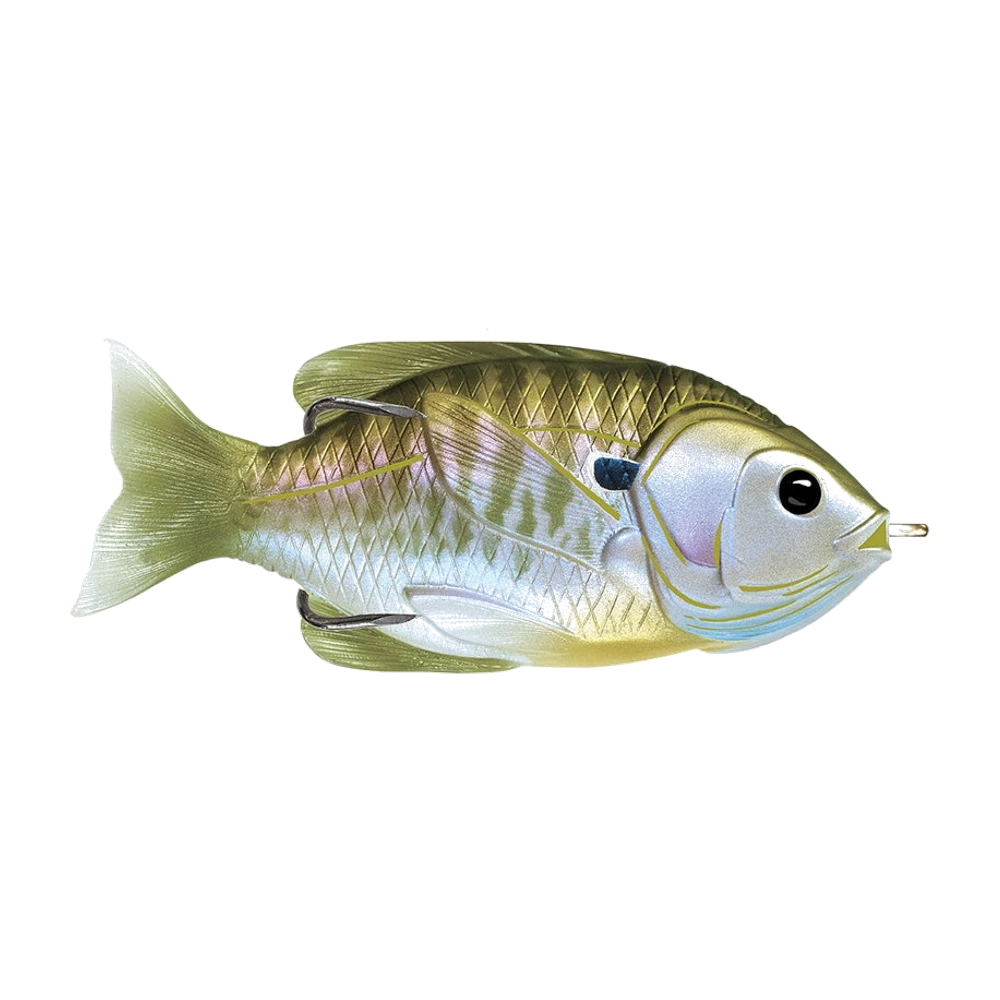
There's nothing mysterious about hollow body construction: a soft plastic shell, empty inside, that collapses under a fish's jaws and frees the hook points that were lying flat against the body. What LiveTarget changes here is the outline. Instead of the wide, low profile of a frog, you get a tall, laterally compressed body — a sunfish, a bluegill, call it what you like. The maker specifies a custom Trokar double hook that the body is built to collapse around, and the lure in hand backs up the claim: the two points don't rise side by side off the back the way they do on a standard frog. One runs along the back, the other under the belly, each tucked into the hollow of a soft fin.
That vertical hook orientation isn't a styling choice. On a body this deep, a double with twin points on the back would leave the entire lower half without any steel in it, and a bass that eats from below would come away with a mouthful of plastic and nothing else. By putting one point up top and one underneath, LiveTarget covers the whole slice of the lure a fish actually closes on, whatever angle it comes from. The shell and the hook were designed together, not bolted together.
Then there's the forage question. In Europe, pumpkinseed and other sunfish have spread through ponds, backwaters and reservoir arms, and they live in the same scenery as the bass: cluttered margins, stumps, weed. A frog crosses a pad field twice a day; a sunfish spends its life in it — and when fish refuse the standard frog, changing the silhouette without changing the technique often pays better.
The 180-degree swing
The spec sheet is precise on one point that matters: with a steady twitch, the lure delivers a 180-degree swing. In plain terms, it turns around on the spot with every rod tap — nose right, nose left — without covering more than a few centimetres. That's the behaviour you want over a hole in the vegetation: you've got two square metres of open water and you want to stay in it for thirty seconds rather than cross it in two turns of the handle.
The second listed retrieve is the exact opposite: a quick wind, which leaves a trail of bubbles behind the lure. The hollow shell traps air, and that string of bubbles rising in the wake adds a visual signal few topwaters produce. The maker presents both speeds as equally valid, and the order to use them in is clear: cover water fast to find the fish, then come back and twitch in place wherever something moved.
Two sizes, with a bigger weight gap than you'd expect
The maker lists two versions, both rated topwater:
- 7.6 cm / 3 in for 12.4 g / 7/16 oz: the reference size, matching the year-old sunfish that 1 to 2 kg bass eat without thinking.
- 8.9 cm / 3.5 in for 17.7 g / 5/8 oz: 17 % more length, but 43 % more weight. That gap isn't a catalogue error — on a deep body, length gains are paid for in volume across all three dimensions.
The rig, and what not to tinker with
Braid straight through, 30 to 40 lb, no hesitation: you're fishing vegetation and the fish buries itself the moment it feels the hook. If pike share the spot — which happens fast on European pond weed — add a short heavy fluorocarbon or soft wire leader. The hollow body may not survive the encounter, but at least you get the lure back.
Count to two before you set. On a hollow body, setting on the sound pulls the lure out of the fish's mouth before it has properly closed. Wait until you feel the weight in the rod — feel it, not see it — then sweep up and keep reeling. The time you lose waiting, you win back tenfold in fish that actually stay on.
Where and when to pull it out
The obvious window is warm water and dense cover: pads, duckweed, submerged weed pushing to the surface, brush along the bank. From late spring through the end of summer, as long as the water is above 18 °C, it's a first-choice bait on those spots. But the second window is often the better one, and almost nobody uses it: clean margins over cluttered bottom, early morning, when sunfish hold in open water along the banks.
The classic mistake
Fishing it too fast from the very first cast. The reflex when you pick up a new topwater is to string quick twitches together and see what happens. On this model the fast retrieve exists and works, but it has a precise job: finding fish. The slow swing is what triggers them. Alternating both within a single cast — twenty metres fast, then three deliberate twitches over the last patch of open water — produces far more than either one on its own.
Not sure what to tie on?
Photograph your spot: CarnaFish reads the scene, cross-checks the conditions and gives you the zone, the lure and the retrieve. Free on iOS and Android.
Colours by water clarity
LiveTarget advertises a range of panfish colours without publishing the list in this description. So it's worth reasoning in families of finish rather than catalogue names:
- Clear water: the natural bluegill finish, the one in the photo — olive back, pearl flanks shading to lavender, black spot behind the gill plate. It's a literal copy of the forage, and that's what you want when fish can see well.
- Stained water, low cloud or late in the day: gold finishes with an orange belly, or simply a dark back. On the surface a fish reads a silhouette against the light before it reads a colour, and a black or very dark green back cuts out better than a pale one.
Choosing it over a standard frog
Against a Spro Bronzeye Frog or a Deps Slither K Hollow Body Frog, the Sunfish Hollow Body isn't better in the abstract: it does something different. The frog keeps the edge on the heaviest mats, where its low profile slides through more easily. The sunfish takes over as soon as fish have seen too many frogs go past, and above all when sunfish are the dominant forage in that water. If you want the same silhouette below the surface, the LiveTarget Sunfish Swimbait covers the same imitation in the middle of the column.
Choosing between the two means knowing what lives in your water and where the fish are holding, which is exactly what CarnaFish is for: one photo of the spot, and the AI suggests the zone, the depth and the lure type that match the day's conditions. To build the groundwork on tackle and typical spots, our guide to getting started with bass fishing is still a solid entry point.
Key takeaways
- The double hook sits vertically, one point on the back and one under the belly, putting steel across the full depth of a very tall body.
- Two advertised retrieves that pull in opposite directions: a quick wind with a bubble trail to search, a 180-degree swing on a twitch to trigger.
- Two sizes, 7.6 cm / 12.4 g and 8.9 cm / 17.7 g: the weight gap is far wider than the length gap.
- Braid straight through and a delayed hookset: on a hollow body, setting on the sound costs more fish than anything else.
FAQ
Should I pick the Sunfish Hollow Body over a standard frog?
Not automatically. On a very dense mat, a frog's low profile slides through better. The sunfish takes the advantage when sunfish are the dominant forage in that water, and when the fish have already seen plenty of frogs come past.
Which size should I start with?
The 7.6 cm / 12.4 g covers most situations and twitches without tiring you out. The 8.9 cm / 17.7 g casts further and sorts for better fish, but it needs a rod that handles both the cast and the extraction from vegetation.
Can I fish it anywhere other than lily pads?
Yes, and it's often underused. The 180-degree swing works just as well over two metres of open water as it does over twenty centimetres of mat. Clean margins above a cluttered bottom, early in the morning, are excellent ground for it.
Why am I missing so many strikes?
Almost always a hookset that comes too early. The hollow body has to collapse inside the fish's mouth before the points can clear. Wait until you feel the weight in the rod before setting, then keep reeling through the fight.
What line should I use?
Braid straight through, 30 to 40 lb. Monofilament and fluorocarbon stretch too much to drive points through the plastic and handle stem abrasion badly. Add a short heavy leader if pike use the same spot.
The full bass lure guideSeason-by-season strategy: which family of lure, when, and why.Go from theory to fish
CarnaFish reads your spot from a photo and gives you the game plan: zone, lure, retrieve. Free on iOS and Android.