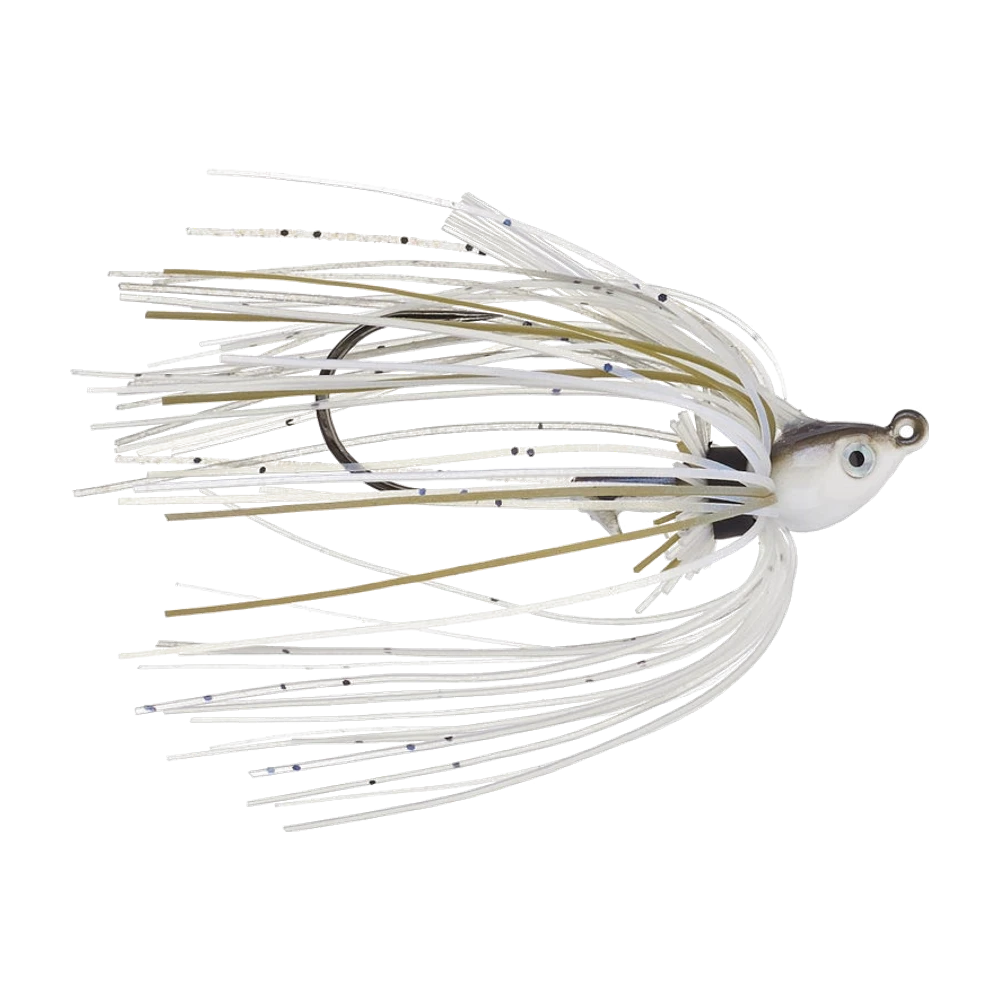
Dirty Jigs Finesse Swim Jig: bullet head and a 50-strand half-cut skirt
Not sure this lure fits YOUR spot today? CarnaFish tells you in 10 seconds, from a photo.
There are two schools of swim jig fishing. The southern one, built around thick jigs you rip out of flooded timber on heavy braid. And the northern one, born on the big grass lakes, which works with slim, understated jigs retrieved steadily just above the vegetation. The Dirty Jigs Finesse Swim Jig belongs squarely to the second, and the maker says so outright by calling it a Northern-style swim jig.
The half-cut skirt is the key part
A conventional jig carries a skirt made of strands folded double around the collar. Every strand therefore counts twice in bulk, and the skirt flares like a parachute the moment the lure slows. That is exactly what you want on a bottom jig, where a flaring skirt slows the fall and widens the silhouette.
On a finesse swim jig you want the opposite. Dirty Jigs fits a 50-strand half-cut skirt here: the strands do not fold back forward, they all sweep rearward. Apparent bulk is halved, the silhouette stretches out, and instead of belling open the skirt pulses tight, along the axis of the lure.
The result is a profile consistent with a small baitfish, not with a crawfish or a big meal. That is precisely what you need when fish are locked onto a school of fry and refuse anything with volume.
The trade-off has to be accepted: less water resistance means a faster fall and a lure that holds its depth less well at slow speeds. If you want a jig that glides, you want a full skirt, not this one.
The bullet head, and why it matters in grass
The second structural decision is head shape. Dirty Jigs uses a bullet head here, drawn for better movement through vegetation.
A flat or wedge-shaped head pushes water ahead of it and, more importantly, offers a surface for grass blades to lie down on. A bullet parts the stems instead of collecting them: the line slides off the point, the grass passes along the sides, and the jig comes out clean. That is what lets you bring the lure back through mid-depth grass without picking it clean every three casts.
Combined with the skirt's lean profile, the whole thing slips through where a conventional swim jig bogs down. In exchange, a bullet does not climb a branch as well as a wedge head: over dense timber, the other geometry keeps the advantage.
The most useful measurement with this jig: count how many casts you make before you have to strip a wad of grass off it. If it is every second cast, you are running too deep. Come up a quarter turn of the handle or drop one weight — a swim jig grazing the top of the grass catches vastly more fish than one ploughing through it.
How to work it without ruining it
This lure was not designed for violent sweeps. The reference retrieve is steady and medium-paced, rod at nine or ten o'clock, letting the jig work just over the tops of the vegetation.
All the subtlety is in the hang-ups. When the jig touches a stem, do not pull straight away: let it load for half a second, then free it with a sharp flick of the wrist. The jig tears loose, darts off sideways, and that is when the bite comes — not during the straight retrieve. Grass is not an obstacle to avoid, it is the trigger.
Hold the rod at a constant angle throughout the retrieve, too. A tip that rises and drops swings the jig's running depth by tens of centimetres without you noticing, and in a technique that lives on grazing the top of the weed, that swing is enough to turn a good retrieve into ploughing.
The trailer: stay inside the lure's logic
Hanging a big craw off this jig cancels all the profile work the maker did. Stay in the same family: a small slim swimbait such as a Keitech Shad Impact 3 or a Zman Slim SwimZ, which stretches the silhouette without thickening it and adds a restrained tail pulse.
If you want to slow the jig down to fish higher, pick a soft split-tail trailer rather than one with big appendages: you gain lift without inflating the bulk.
The classic mistake: treating it as a search bait
The Finesse Swim Jig is slim, so it casts shorter and sinks faster than it looks. Plenty of anglers pull it out to cover water, find it does not carry, and put it away.
It is not a long-range search bait. It is a second-pass lure: you have found an edge, a specific grass line, a bait school on the electronics, and you come back over it with something understated. Used that way, it saves days when the standard swim jig has stopped triggering anything.
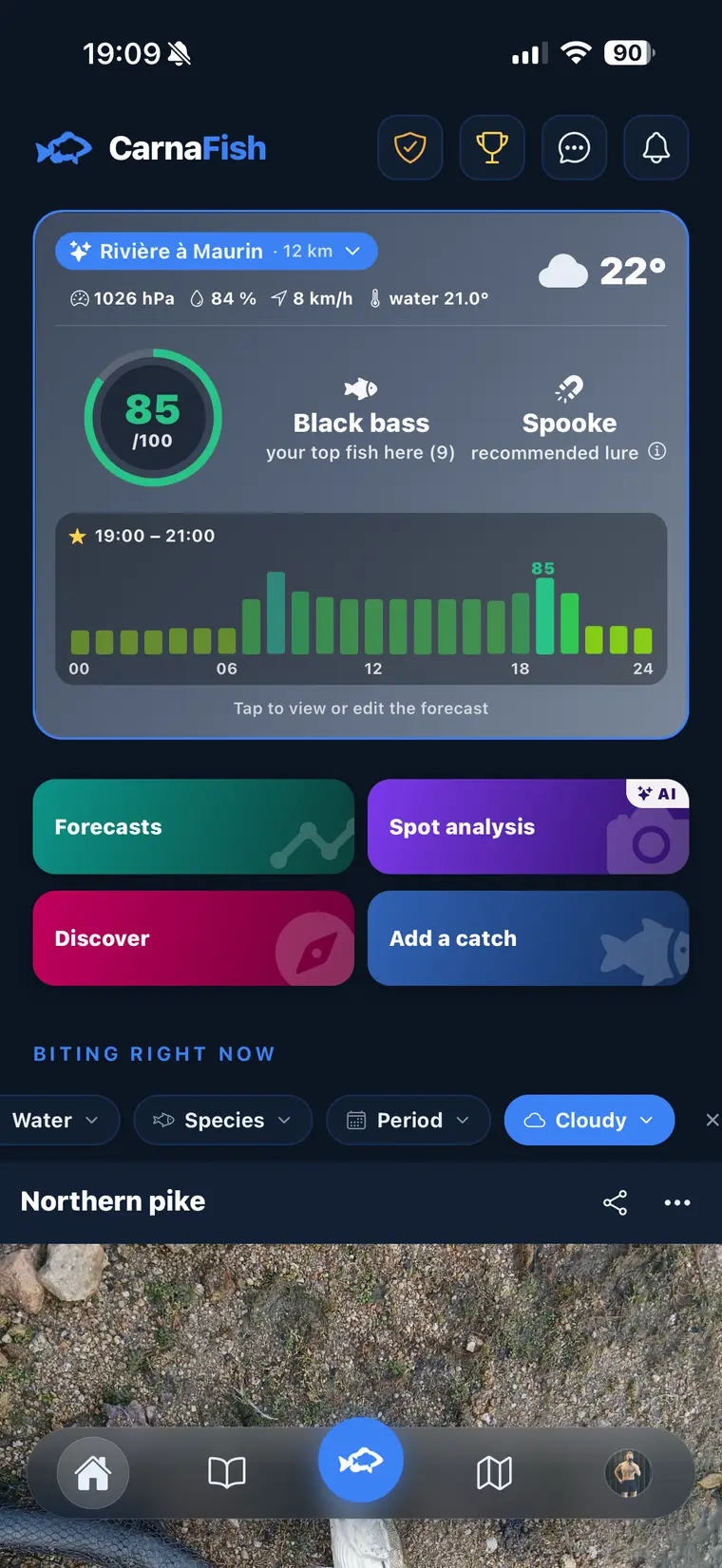
Not sure what to tie on?
Photograph your spot: CarnaFish reads the scene, cross-checks the conditions and gives you the zone, the lure and the retrieve. Free on iOS and Android.
Hook and setup
Dirty Jigs fits a VMC hook without stating the size in its description. That is information to read off the packaging, along with the exact weight of the reference: the maker mentions a variety of proven colours but does not publish a size grid.
On line, the lure's own logic points to a compromise: thin braid for the connection and for cutting grass, extended by a short fluorocarbon leader in the 10-14 lb range in clear water. Straight braid costs the lure part of its discretion, which is the whole reason you tied it on.
Colors by forage and light
- Fish on fry, clear water: speckled pearl white, like the finish in the photo. It is the obvious choice when you are copying a silver baitfish a few centimetres long.
- Dense vegetation, lightly stained water: green pumpkin, which blends into the grass and only stands out the instant the jig tears loose.
- Low light, heavy cloud, end of the day: black and blue. It is not a colour anyone sees, it is a silhouette that gets detected.
A finesse swim jig is not cast at random: it asks you to know in advance which edge is worth the effort. That is exactly what CarnaFish offers: one photo of the spot, and the AI gives you the zone, the depth and the presentation that suit the day's conditions. For the wider framework, our beginner's guide to bass fishing covers the basics of structure and tackle.
Key takeaways
- The 50-strand half-cut skirt halves apparent bulk: the silhouette copies a baitfish, not a crawfish.
- The bullet head parts the stems instead of collecting them, so you can swim the jig through grass without constantly cleaning it.
- The bite comes as the jig tears off a stem, not during the straight retrieve: load it, then free it with a flick.
- Neither weight, nor length, nor hook size is detailed by Dirty Jigs: the packaging stays the only reliable source.
FAQ
What exactly is a half-cut skirt?
It is a skirt whose strands all sweep rearward instead of being folded double around the collar. Apparent bulk is halved, the silhouette stretches out, and the skirt pulses tight rather than flaring open like a parachute.
Why a bullet head on a swim jig?
Because it parts grass stems instead of gathering them. The jig comes clean out of mid-depth vegetation, where a flatter head brings back a wad of weed every two or three casts.
Does this jig suit perch?
Yes, and that is one of its better uses in Europe. The very slim profile and reduced format stay inside what a good perch will happily attack, especially when she is keyed on fry along a weed edge.
Which trailer should I use?
A small slim swimbait, to extend the silhouette without thickening it. A big craw or a bulky creature bait cancels all the profile work the maker did and turns the lure into an ordinary swim jig.
Braid or fluorocarbon?
A compromise works well: thin braid to cut grass and set the hook, extended by a short fluorocarbon leader in clear water. Straight braid costs discretion, which is a shame on a lure chosen for exactly that quality.
How does it differ from the Compact Swim Jig in the same range?
The Dirty Jigs Compact Swim Jig bets on a lead-forward head and a heavy-duty build to break and roll under an aggressive retrieve. The Finesse Swim Jig wants the opposite: a straight, slim, understated swim that crosses vegetation without drawing attention.
The full bass lure guideSeason-by-season strategy: which family of lure, when, and why.Go from theory to fish
CarnaFish reads your spot from a photo and gives you the game plan: zone, lure, retrieve. Free on iOS and Android.