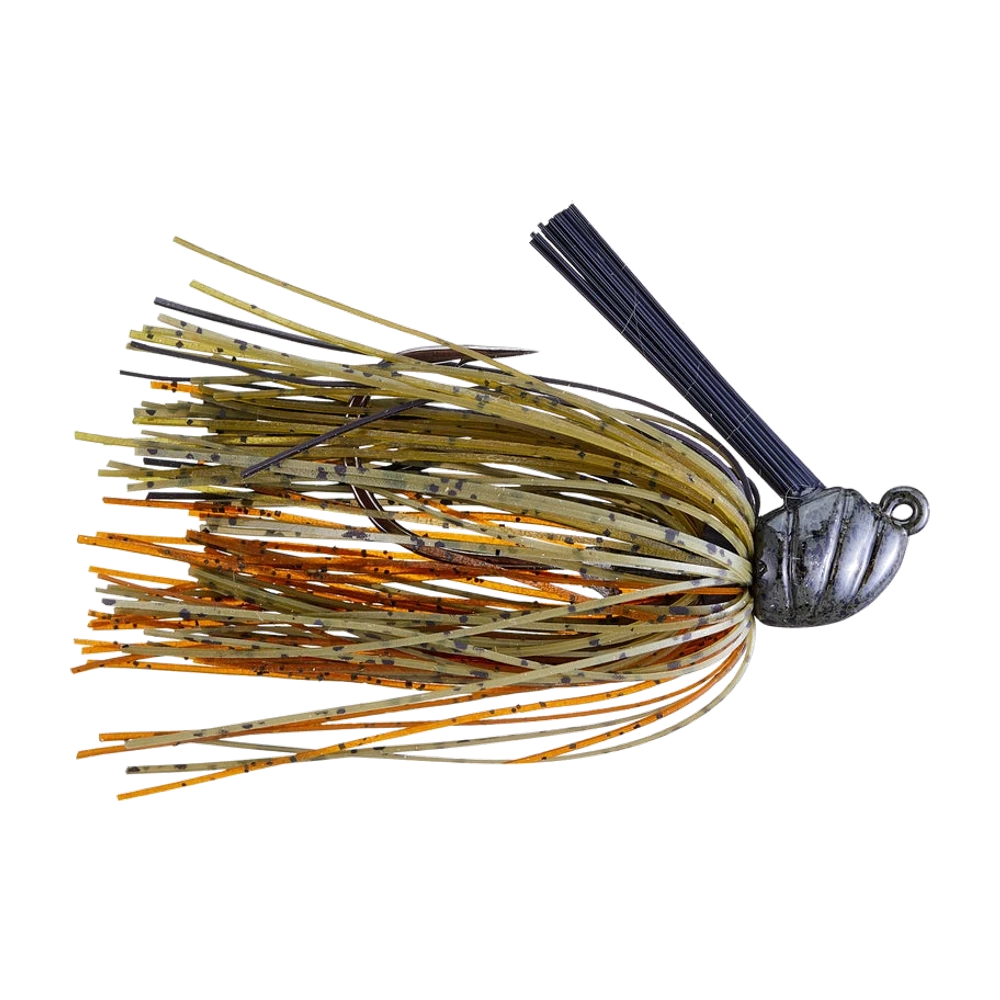
Dirty Jigs Scott Canterbury Flippin' Jig: one jig, three presentations
Rather not fish it blind? Photograph your spot — CarnaFish cross-checks the conditions and points you the right way.
Most serious bass anglers carry three boxes of jigs: one model for wood, one for grass, one for rock. Scott Canterbury asked Dirty Jigs for a jig that handled all three and that could also be swum on a straight retrieve without changing baits. The point is not to beat a specialist model on its own ground: it is never having to re-tie because the cover changed fifteen metres down the bank.
Why an all-purpose jig makes sense
On a varied lake you go from a line of stumps to a weed bed to a rocky edge in ten minutes. Each lure change costs two minutes, a knot, and sometimes the fish that was about to commit. A jig built to handle all three settings removes that friction.
The trade-off is real, and worth stating plainly: a do-everything jig will not drop into a tight hole in vegetation as cleanly as a Luke Clausen Compact Pitchin' Jig, and it will not swim through grass as neatly as a true bullet-head swim jig. But it does both properly, and that is the point. If you fish one single setting all day, take a specialist; if you fish on the move, this jig will save you more time than it costs you in precision.
There is still a point where you should drop the all-purpose logic: when one type of cover starts producing clearly more than the others. If three fish in a row come out of stumps and none out of grass, you no longer need a jig that does everything, you need the best jig for stumps. The all-rounder exists to find the cover that works; once it is identified, the specialist takes the advantage back.
The hook is this model's real argument
The description is explicit on one point: the hook is a heavy wire Gamakatsu rated 3X strong, with a line tie angled at 30 degrees. Those two features belong together.
3X wire is your insurance against an opened hook when you winch a fish out of a stump on braid. That matters in flipping: most lost fish in heavy cover come not from a poor hookset but from a hook working under sideways load while the fish wraps itself up.
The 30-degree angle is subtler. A steeply angled eye, like the 60 degrees of the Luke Clausen Finesse Jig, favours upward penetration on a vertical set, typical of finesse fishing directly above the bait. A 30-degree eye keeps the pull axis closer to horizontal, which suits setting from a distance, under load, or while the jig is being retrieved. That is consistent with a bait you also want to swim.
On finish, Dirty Jigs states a three-layer colour-matched paint job and what it calls high-definition skirts. The product photo also shows a black fiber weedguard folded upward, even though the description does not detail it.
What the description leaves out
Neither head weight, nor length, nor exact hook size appears in the manufacturer's text. So you will find no invented numbers here: check the packaging before ordering, especially since weight is the real adjustment on an all-purpose jig. The higher and slower you want to swim it, the lighter you go; the faster you want it to drop into a deep stump, the heavier.
Not sure what to tie on?
Photograph your spot: CarnaFish reads the scene, cross-checks the conditions and gives you the zone, the lure and the retrieve. Free on iOS and Android.
Three ways to fish it
Flipping and pitching in heavy cover
The classic routine: drop the jig at the base of an obstacle, follow the fall on a tight line, and set as soon as the line does anything other than sink straight. Two or three rod lifts on the spot, then move to the next piece of cover. Good flipping means a lot of targets covered quickly, not one target fished for a long time.
In dead wood, do not aim for the visible gap. Lay the jig on a branch twenty centimetres above it, then let it slide and tumble in on its own. The entry is quieter, and the fish sees an object falling off the structure rather than one dropping out of the sky.
Swimming it like a swim jig
This is the extra use the description claims, and it changes how fast you cover water. Cast parallel to an edge and retrieve steadily at mid depth, letting the jig tick grass or branches. Fit a paddle tail trailer to steady the swim. You will not replace a dedicated swim jig like the No-Jack Swim Jig, but you will cover far more ground than with flipping alone.
The classic mistake
Keeping the same trailer whatever the presentation. A big-clawed trailer, excellent for slowing a flipping fall, makes the bait spin the moment you retrieve it straight. Carry two bags: a craw for the fall, a paddle tail shad for the swim. Changing trailers takes fifteen seconds; changing jigs takes ten times that.
Colours by cover type
- Clear water, grass or gravel: Green Pumpkin, the neutral tone that never gets refused and lets the trailer carry the contrast.
- Rock and dead wood, lightly coloured water: Brown Craw, matching a real crawfish in those settings.
- Dirty or rising water: Black and Blue, because in a metre of visibility the silhouette is what counts, not the colour.
What the lure will not solve is which edge to attack first when you arrive on unfamiliar water. That is exactly what CarnaFish does — a photo of the bank, and the app suggests the zone, the depth and the kind of presentation that suits the moment. To build the method behind that read, our guide to reading a fishing spot details the markers to look for.
Key takeaways
- The model is explicitly built for three uses — flipping, pitching and straight retrieve — in grass, rock and wood.
- The 3X strong heavy wire Gamakatsu with a 30-degree line tie is the central argument, and it fits a bait you also set on under load.
- The description gives no weight, no length and no hook size: check the packaging.
- Change trailers with the presentation, not jigs: a craw for the fall, a paddle tail for the swim.
FAQ
Is an all-purpose jig as good as a specialist one?
Not on the specialist's own ground. A compact jig slips into a tight hole better, a dedicated swim jig swims more cleanly. In exchange, the all-rounder saves you from re-tying every ten minutes as cover changes, and that saved time often weighs more.
What does a 3X strong hook mean?
It is a wire gauge designation: the hook is made from markedly thicker wire than standard for its size. It resists opening under heavy load, at the cost of needing a firmer hookset to drive home.
Why a 30-degree eye rather than 60?
The angle sets the pull axis on the hookset. A shallow angle suits sets made under load, from a distance or on the retrieve, which is flipping and swimming; a steeper angle is built for a vertical set in slow finesse fishing.
Will it come through dense grass?
The description claims grass, rock and wood, and the product photo shows a fiber weedguard. For a genuinely matted canopy, a punching model remains better suited, because there the question becomes weight rather than protection.
Which trailer should I start with?
A medium craw for flipping and a paddle tail shad for the retrieve cover most of it. Keep the trailer in the same colour family as the skirt in clear water, and allow yourself a contrasting claw in stained water.
Do I need braid with this jig?
In wood and grass, yes: 50-60 lb, so you can winch without waiting. Along a rocky edge in clear water, 20-25 lb fluorocarbon stays more discreet and abrasion resistant, which suits a dragged presentation better.
The full bass lure guideSeason-by-season strategy: which family of lure, when, and why.Go from theory to fish
CarnaFish reads your spot from a photo and gives you the game plan: zone, lure, retrieve. Free on iOS and Android.