Dirty Jigs Weekender Casting Jig: the do-everything jig on a budget
The right lure in the wrong spot still catches nothing. CarnaFish spots the zone that works, from a single photo.
There is a moment, when you start fishing jigs, where you balk at spending ten euros on a lure you will probably leave in a branch on the third cast. That is exactly the Weekender's slot: Dirty Jigs presents it as its go-anywhere jig, built on the same thinking as its Tour Level models but at a price that lets you lose one without ruining the day. The question is what was kept and what was simplified.
A low rounded head, and two consequences
The copy describes a low, rounded head and credits it with two effects. The first is deflection: a round head has no edge to catch, so it glances off a branch or a rock and keeps going. That is the opposite of a conical punching head, which is trying to penetrate, or an Arkey head, which is trying to stand up. Here you are simply trying to get through.
The second claimed effect is casting distance: a compact head offers the wind less to push against than a wide one, and the jig carries further into a headwind. That is a real difference on open water where you fish from the bank and every metre of cast counts.
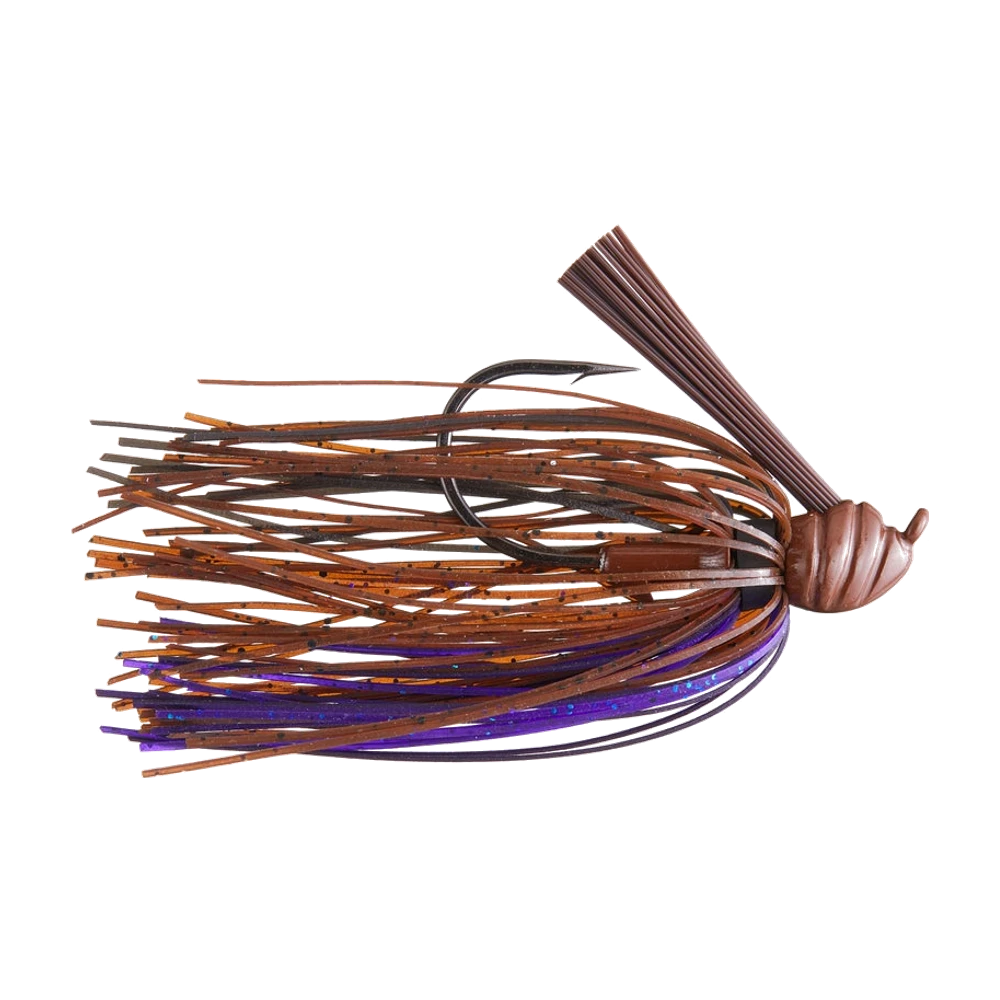
Dirty Jigs also mentions moulded grooves in the head, said to boost sensitivity. You can see them clearly in the photo, which shows a plain brown body ribbed with channels. Be clear-eyed about this one: it is a manufacturer claim, not a measured figure, and sensitivity depends above all on your braid, your leader and your rod tip. The grooves probably help the lead vibrate on contact with the substrate, but if you fish mono on a soft rod you will not notice the difference.
Before the first cast, fan the weedguard fibres out with your thumb. Straight out of the packet it is compressed and behaves like a rigid block that fights your hookset. Thirty seconds of adjustment, and your hooking percentage changes.
What is different from the Tour Level models
The most concrete difference is not the paint, it is the hook. The Weekender is built on a 4/0 VMC, where the Tour Level models carry Gamakatsu hooks. A 4/0 VMC is an excellent hook, very sharp, but it is not working to the same brief as the beefed-up No-Jack wire meant to drag a fish out of a brush pile. In practice: perfect for general fishing, something to watch if your playground is genuinely heavy cover.
The finish is a powder coat described as durable, and the photo does show a single-color head, without the multi-tone paint of the higher ranges. The skirt, on the other hand, stays premium free-flowing silicone, supplied full length — that is clearly where the brand chose not to economise, and it makes sense, since it is the part the fish sees.
The weedguard is described as stout fibre, there to protect the point. That is a sound compromise on an all-purpose jig, but a stout weedguard left unfanned costs you fish: it is the most profitable adjustment you will make on this lure.
What the manufacturer leaves out
No length, no weight, no weight range. That is a constant across Dirty Jigs' pages in this series, and it remains a nuisance: a jig's weight sets its fall rate, the depth it reaches and the rod you need. Read the package. If you are starting out, a mid-range weight will cover most situations between one and four metres, and you can fill in later towards light for clear water and heavy for current.
Three ways to fish it
In contact with the bottom. The simplest and often the most productive: cast, let it sink, drag slowly over a few dozen centimetres, pause two or three seconds, repeat. You read the bottom through the rod and you pick out the substrate changes, which are almost always fish-holding zones.
Falling alongside cover. Cast tight to a laydown or a dock wall and let it drop on a controlled slack line with no action at all. Watch the line: the bite shows up as line moving sideways. This presentation leans directly on the round head's ability to slide down a vertical surface without hanging up.
Stroking over hard bottom. When fish are sluggish, a sharp lift that jumps the jig fifty centimetres off the bottom, followed by an immediate free fall, often triggers a reaction where a slow drag produces nothing. It is worth trying systematically before you change lures.
The classic mistake
Leaving the skirt alone on a budget jig because you assume it does not matter. In fact the full-length skirt slows the fall a great deal, and on an all-purpose jig you are using to cover water, that can cost you entire passes. If you want to get down fast on a break, cut the front strands level with the hook bend: you gain speed and tighten the profile without touching the rear volume.
Not sure what to tie on?
Photograph your spot: CarnaFish reads the scene, cross-checks the conditions and gives you the zone, the lure and the retrieve. Free on iOS and Android.
Colors by water and bottom
- Mixed bottom, lightly stained water: the brown with orange flake plus purple strands from the photo, a crawfish combination that works over nearly every substrate.
- Dark water or an overcast day: black and blue, the most readable silhouette as the light drops.
- Clear water over hard bottom: green pumpkin, quiet, for fish that have time to study what they are looking at.
Who it is for, and what sits beside it
If you are new to jigs, this is a good entry point: you learn contact fishing without dreading the loss. If you are already equipped, it keeps a place as a search lure, the one you throw where you are not sure there are fish. For more specialised work, look to the Dirty Jigs Tour Level Pitchin' Jig and its Arkey head on riprap, or the Dirty Jigs Tour Level Finesse Football Jig in clear deep water. In the same budget bracket, the Booyah Boo Jigs cover very similar ground, and a trailer such as the Strike King Rage Craw completes the set without blowing the bill up.
An all-purpose jig only becomes genuinely all-purpose once you know where to throw it. That is what CarnaFish is for: you photograph the spot, and the AI suggests the zone, the depth and the presentation that fit the day's conditions. And to build the foundations before you start, our beginner's guide to bass fishing covers the tackle and the spot types to look for.
Key takeaways
- Low round head: it deflects off cover instead of wedging in it, and it casts a long way into a headwind.
- A 4/0 VMC hook, very sharp, but not the beefed-up wire of the brand's top models — worth remembering in heavy cover.
- Moulded grooves claimed to improve sensitivity: that is a manufacturer claim, not a measured figure.
- Fan the fibre weedguard out before you fish, it is the most profitable adjustment on this lure.
FAQ
What is the difference between the Weekender and the Tour Level models?
Essentially the hook and the finish. The Weekender gets a 4/0 VMC and a single-color painted head, where the Tour Level jigs carry purpose-chosen Gamakatsu hooks and more elaborate finishes. The premium silicone skirt is kept on both.
Is this jig suitable for a beginner?
Yes, and that is really its main appeal. It lets you learn contact fishing — reading bottom, managing the fall, setting at the right moment — without every snag hurting. The habits you build transfer directly to a more specialised model later.
Do I need a trailer on this jig?
Not strictly, but it is strongly advised. The trailer sets the fall rate and completes the silhouette: broad claws to slow things down and add movement in warm water, a compact body for a straight drop in cold water. It is the adjustment with the most effect after weight.
Do the grooves in the head actually do anything?
The manufacturer presents them as a sensitivity gain. It is plausible in principle — more surface in contact with the substrate, so more vibration transmitted — but it is not a measured figure. Your braid, your fluorocarbon and your rod tip weigh far more heavily in what you feel.
What weight should I choose?
Dirty Jigs publishes no weight range, so you have to read the package. As a rule, take the lightest weight that still lets you feel the bottom given the wind, the drift and the depth. A jig that is too heavy arrives too fast and throws away the value of the fall.
Does it come through vegetation?
Through light to moderate vegetation, yes, thanks to the stout fibre weedguard and a head that deflects well. Through a dense mat, no: it is not designed to punch from above, and a conical-head punching jig will be far more effective in that specific case.
The full bass lure guideSeason-by-season strategy: which family of lure, when, and why.Go from theory to fish
CarnaFish reads your spot from a photo and gives you the game plan: zone, lure, retrieve. Free on iOS and Android.