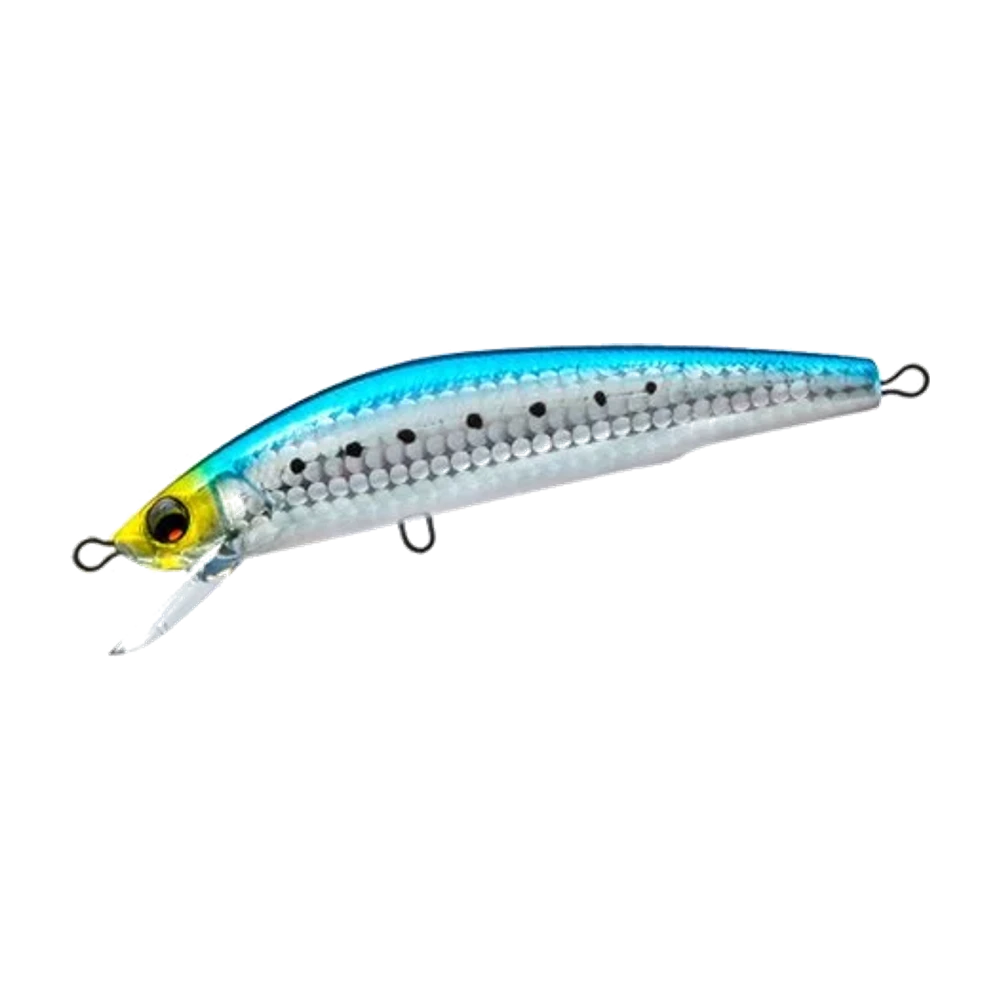
Duel Aile Magnet: reaching the far bank with 5 grams
One lure, endless conditions. CarnaFish reads your spot from a photo so you are not just guessing.
The problem with ultralight fishing is not finesse: it is range. On a river forty metres wide, on a reservoir where the interesting margin sits thirty metres out, or simply into a force 4 headwind, a 5 g minnow flies fifteen metres and drops flat. You can see exactly where the fish are and you cannot reach them.
The Aile Magnet exists for that. Its name states the mechanism: a weight that locks at the rear during the flight and releases on contact with the water. That is not marketing decoration, it is the difference between fishing half a riverbed and fishing all of it.
How the magnetic lock works
In a classic mass-transfer minnow, one or more balls slide freely in a tube. On the cast they run to the rear and stabilise the flight; but nothing really holds them there, and any rotation of the lure in the air can bring them back early. The lure then turns broadside and loses its trajectory.
The magnetic system adds a holding point: the ball is held at the rear throughout the flight, then released by the shock of impact and by the first pull on the line.
In practice, on a 5 g lure:
- The flight stays straight, even in a crosswind. That is the main gain, more so than the weight itself.
- You typically gain 8 to 12 m over a minnow of equivalent weight without a holding system.
- The lure starts swimming immediately, from the first half turn of the handle, because the ball returns cleanly to position instead of floating between the two.
The retrieve: two uses depending on the fish
For trout on a wide river:
- Cast across and slightly upstream, at 45 degrees.
- Retrieve just fast enough to feel the roll, letting the current swing the lure round in an arc.
- Slow down when the lure enters the slower water at the end of the swing: that is where a brown trout sits.
- Add a single twitch as the lure passes in front of an obstacle — a stump, a boulder, a bridge pillar. One only, sharp, then straight back onto the retrieve.
For perch on a lake or reservoir:
- Cast to the margin you have spotted, at maximum range.
- Retrieve in sequences: five steady turns, a one-second pause, two twitches, back on the retrieve.
- Work the last five metres before drowned trees or boulders hard.
- If you see followers that do not commit, accelerate hard rather than slowing down: a perch decides on the escape.
On the water: in long-range ultralight fishing, the knot kills more fish than a break-off. With 35 m of line out, a big sweeping hookset barely reaches the lure at all — the stretch and the curve of the line absorb everything. Switch to fine braid of 0.06 to 0.08 mm with a metre of 0.16 to 0.20 mm fluorocarbon as a leader, and set the hook by pulling sideways, rod low, rather than lifting. You will double your hookup rate on long casts without changing anything else.
Choosing the size
| Size | Indicative weight | Use |
|---|---|---|
| 5 cm | 3.5 to 5 g | Small river, average-sized trout, clear water |
| 6 cm | 5 to 6.5 g | Wide river, moderate wind, perch along the margins |
| 7 cm | 7 to 8 g | Windy lake, long range, big perch |
A simple rule: go up a size as soon as the wind exceeds what your rod can handle, before you go up in line diameter. A heavier lure solves the range problem without costing you subtlety, whereas thicker line costs you both.
The gear that goes with it
A 5 g lure that has to fly 35 m demands a coherent outfit, otherwise the gain from the weight system is lost elsewhere in the chain.
- A 2.10 to 2.40 m rod, rated 3-14 g, with a semi-parabolic action. A short, stiff rod does not load enough to propel something this light; a long rod follows the cast through and gains several metres on its own.
- A size 1000 to 2000 reel, with a well-filled spool. Underfilling easily costs 10 % of your distance, which cancels out the point of the lure.
- Correctly sized guides on the first third of the blank: fine braid leaving the spool in wide coils needs room to funnel down.
One detail that often gets missed: check that the weight returns properly to position after each cast. If you can hear the ball rattling when you shake the lure horizontally but the swim starts sluggishly, the front split ring has been bent out of shape and is pulling the lure down.
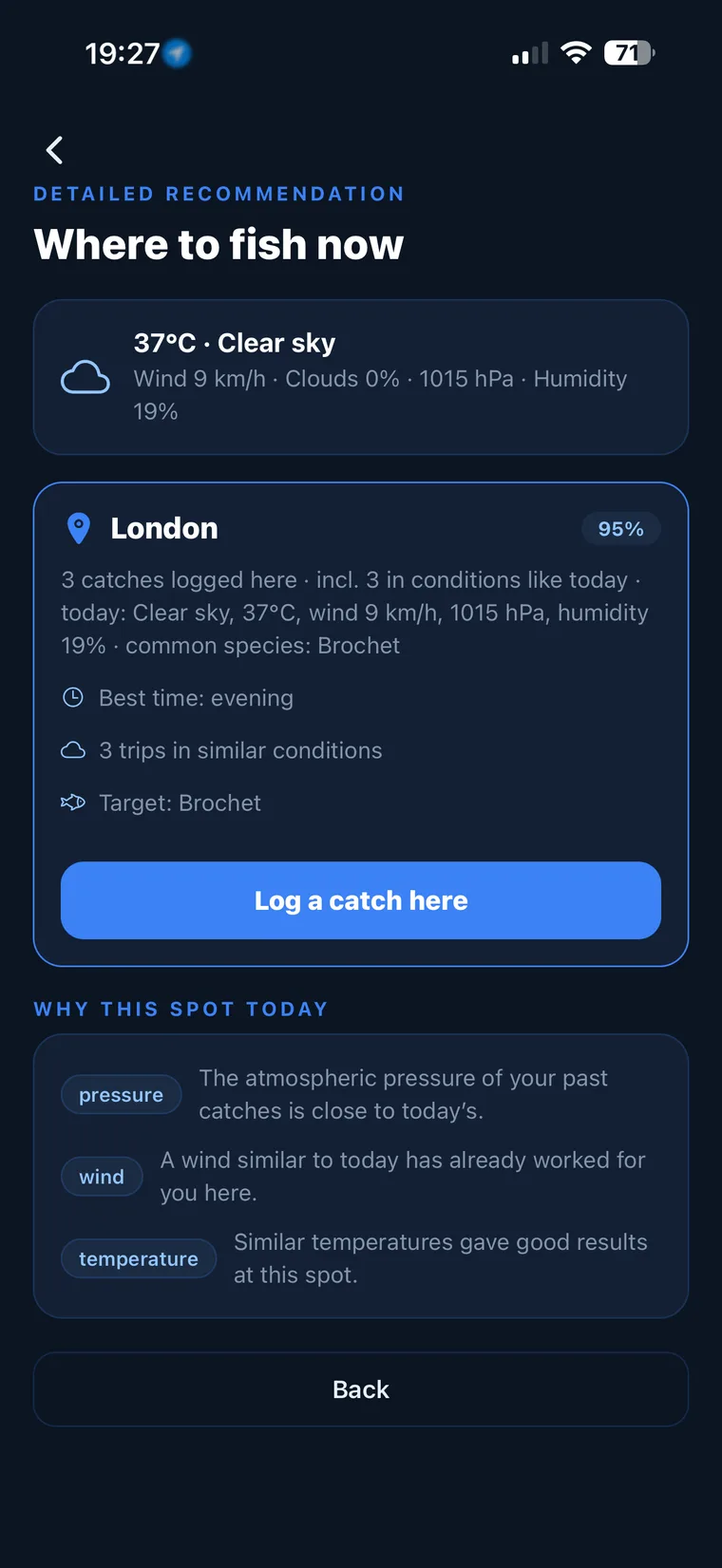
Not sure what to tie on?
Photograph your spot: CarnaFish reads the scene, cross-checks the conditions and gives you the zone, the lure and the retrieve. Free on iOS and Android.
Where it has no place
- Narrow, cluttered streams. On six-metre casts under branches the transfer system does nothing, and its inertia makes the lure less manageable.
- Very cold water and slow fishing, where you want a lure that can hold still for a long time.
- Deep fishing. It will not go below 1.2 m, and that is not negotiable.
- Very educated trout in gin-clear, still water, which often refuse a lure with such a regular swimming action.
Aile Magnet or a precision UL minnow
The Zipbaits Rigge 56 is the other benchmark in this size, built on the opposite logic. The Rigge is about finesse: a highly worked action at slow speed, a subtle response to the smallest movement of the rod tip, the ability to hold a precise layer of water. It is a lure for a known spot, not for reaching out — and it casts distinctly worse into the wind.
The Illex Tiny Fry 50 occupies yet another niche: very short, built around nervous twitching and reaction bites in shallow water, deadly on perch at close range but with no pretensions to distance.
The Aile Magnet replaces neither. It earns its place when the limiting factor is distance or wind, not subtlety. Plenty of wide-river anglers carry all three and switch according to the width of the bed. Our guide to trout fishing in rivers covers that sequence spot by spot. And if you are torn between attacking the far seam or the margin at your feet, CarnaFish analyses a photo of the spot and answers.
Key takeaways
- The magnetic weight is locked at the rear in flight: a straight trajectory and 8 to 12 m of extra distance.
- It starts swimming from the first half turn of the handle, so you do not waste the first metres of the cast.
- For trout, swing it round in an arc plus a single twitch in front of each obstacle.
- Fine braid plus a fluorocarbon leader, and a sideways hookset: essential beyond 30 m.
- Pointless in cluttered streams, in slow cold-water fishing, and below 1.2 m.
FAQ
How does the Aile Magnet's magnetic system work?
An internal weight is held at the rear of the lure throughout the flight, which stabilises the trajectory, then released on contact with the water. The lure flies straight and picks up its swimming attitude immediately.
How many metres do you gain over a classic minnow?
Typically 8 to 12 m on a 5 g model, especially in a crosswind. The gain comes as much from the straight trajectory as from the weight itself.
What line should you use for long-range ultralight fishing?
Braid of 0.06 to 0.08 mm with a metre of 0.16 to 0.20 mm fluorocarbon. Straight monofilament stretches too much to transmit an effective hookset beyond thirty metres.
How deep does it swim?
Between 0.4 and 1.2 m depending on size and retrieve speed. It will not go deeper, even on fine line: to fish below that you need a different family of lure.
Does it work for perch?
Yes, especially along lake and reservoir margins that are out of reach of smaller lures. Retrieve in sequences broken up with twitches and accelerate hard when you see a follower: a perch decides on the escape.
Aile Magnet or Zipbaits Rigge?
It depends on the limiting factor. If it is distance or wind, the Aile Magnet comes first. If it is a refined action on a known spot within casting range, the Rigge is still better.
The full trout lure guideSeason-by-season strategy: which family of lure, when, and why.Go from theory to fish
CarnaFish reads your spot from a photo and gives you the game plan: zone, lure, retrieve. Free on iOS and Android.