Lucky Craft Slender Pointer: a minnow to wind in, not to jerk
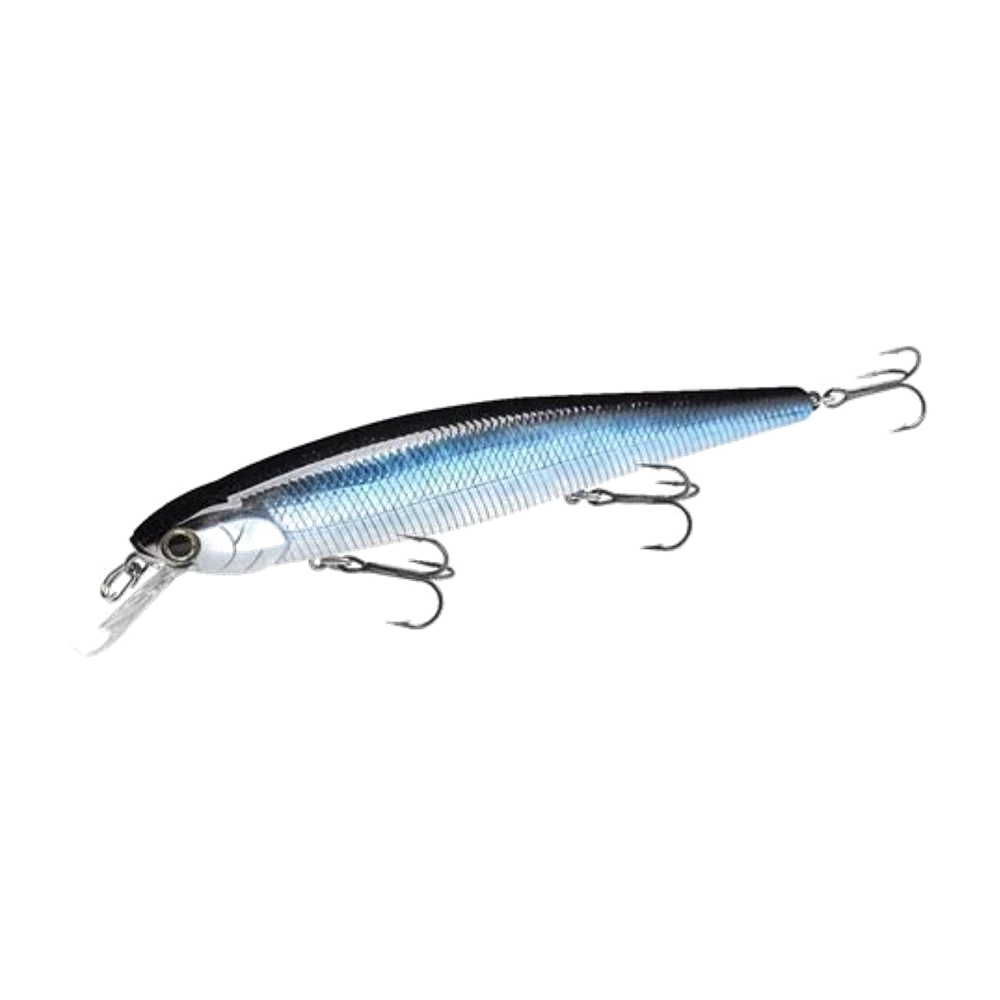
One lure, endless conditions. CarnaFish reads your spot from a photo so you are not just guessing.
There is one costly mistake with this lure, and it comes from the name. At Lucky Craft, "Pointer" means a family of jerkbaits: lures you work with the rod tip, that dart hard to one side then the other, and that hang still during the pauses. The angler who buys a Slender Pointer naturally applies the same recipe — and gets a mediocre result.
The Slender Pointer is not a jerkbait. It is a slim minnow with a rolling action, built to be wound in continuously. It is not looking for a side dart: it rolls on its axis with very little amplitude, holding an almost dead straight line. On perch and river trout, that is exactly what you want. Give it a hard jerk and it rears up and falls out of its action.
A thin profile, a tiny amplitude
Look at it head on: the body is narrow and deep, almost a blade. Compare it with a standard Pointer, which is chunkier and whose volume and lip are sized to generate a big lateral kick with every stroke.
That slim design produces a very particular signature:
- An action measured in centimetres. The lure does not zigzag, it shivers as it moves forward. Seen from above, its path is a slightly blurred straight line.
- A high frequency. Little amplitude, lots of cycles: the vibration it puts out is high pitched, closer to a small baitfish than to a wounded one.
- Very little resistance on the retrieve. You can wind it almost as slowly as you like without it falling over. That is the quality that matters most in cold rivers and on apathetic perch.
- It holds in current. The thin profile offers little lateral purchase, so the lure does not turn broadside in a fast seam.
The trade-off is that it displaces very little water. On fish you have to find across a big area, or in stained water, it does not announce itself.
How to fish it: three retrieves and that is all
- The straight retrieve. Reel only, constant speed, rod at nine o'clock pointed at the lure. This is the baseline. The right rhythm sits between half a turn and one turn of the handle per second. Too fast and the lure rises and loses its frequency.
- The punctuated retrieve. Same thing, with a clean one second stop every eight to ten turns. The lure settles, then picks its action up again. On perch, the bite almost always comes on the restart.
- The river swing. Cast 45 degrees upstream, wind just enough to come tight, and let the seam turn the lure over. You control the path by moving the rod tip sideways, not by winding faster.
What not to do: sharp jerkbait twitches. On this thin, light body a hard stroke spins the lure on itself and it takes several turns of the handle to find its axis again.
On the water: in a river, slow down until you feel the lure "disappear" in the rod, then add half a notch of speed back. That threshold, just above the point where it stops working, is where the Slender Pointer produces its maximum frequency for minimum travel — and it is where trout sitting behind a rock come out. Most anglers retrieve twice too fast.
Choosing the size and the water layer
| Version | Typical use | Depth | Target species |
|---|---|---|---|
| Small, 6.5 to 8 cm | Narrow rivers, streams, margins | 0.3 to 0.8 m | Trout, average perch |
| Medium, 8 to 9 cm | Medium rivers, canals, stillwaters | 0.6 to 1.2 m | Perch, good trout |
| Large, 10 to 11 cm | Big rivers, lakes, long casting | 1 to 1.5 m | Big perch, lake trout |
For line, fluorocarbon of 0.16 to 0.22 mm depending on size. This is a light lure and very sensitive to anything that restrains it: on the small versions even a fine snap is enough to kill the roll, so tie direct. On the bigger sizes a micro snap remains acceptable.
The stock hooks are fine wire and sharp. Do not swap them for heavier models "to be safe": you add weight up front, you change the attitude, and with this kind of action the effect is immediate.
Not sure what to tie on?
Photograph your spot: CarnaFish reads the scene, cross-checks the conditions and gives you the zone, the lure and the retrieve. Free on iOS and Android.
Its water, and where it is no use
It is excellent on:
- Clear rivers with moderate current, on the classic trout lies: riffles, pool tails, seams behind obstructions.
- Perch along the margins, beside jetties, reed beds and rock armour, when they are feeding on small fry.
- Late summer in low, clear water, when bulky lures scare off everything in front of you.
It is unsuited to:
- Stained or coloured water: too discreet, the fish will not find it.
- Depth: it will not go past a metre and a half, and there is no way to compensate.
- Strong wind or long casting: the small sizes weigh only a few grams.
- Pike: without a leader you lose it on the first contact; with a leader its fine action is smothered.
Slender Pointer, Pointer 78 or Pointer 100
The shared name hides three different uses, and it is the commonest source of confusion.
The Lucky Craft Pointer 78 is a genuine compact suspending jerkbait: it kicks hard sideways on every twitch and then stops dead. You fish it in twitch-and-pause sequences, on holding fish that are not very active. It is a trigger lure.
The Lucky Craft Pointer 100 does the same thing bigger, with more casting range and a wider target list: adult bass and pike.
The Slender Pointer answers a different question: covering water on a continuous retrieve, with a discreet, high frequency signature. It is not meant to trigger a frozen fish with a ten second pause; it is meant to swim past a lot of fish looking like a fry going about its business. On perch and trout that register often wins, especially in clear, low water.
Summary: Pointer when you know where the fish is and you have to make it decide, Slender Pointer when you are searching and want to stay discreet. Our guide to river trout fishing covers how to read the lies that go with it. And if you are torn between a straight retrieve and an animated one when you reach a riffle, CarnaFish analyses a photo of the spot and answers.
Key takeaways
- It is not a jerkbait despite the name: wind it in continuously, with no sharp twitches.
- Low amplitude, high frequency rolling action, on an almost dead straight path.
- Slow down to the point where it nearly stops working, then add half a notch: that is the useful window.
- Tie direct on the small sizes, 0.16-0.22 mm fluorocarbon, keep the stock hooks.
- Clear water, shallow, perch and trout. Unusable in stained water, at depth or for pike.
FAQ
Is the Slender Pointer a jerkbait?
No, despite the shared name with the Pointer range. It is a slim minnow with a rolling action, built to be wound in continuously. Sharp twitches spin it on itself and it takes several turns of the handle to find its axis again.
What is the difference with the Pointer 78?
The Pointer 78 is a compact suspending jerkbait that kicks hard sideways and hangs still during pauses: it is a trigger lure for holding fish. The Slender Pointer puts out a fine, steady vibration on a continuous retrieve: it is a discreet searching lure.
How fast should I retrieve it?
Between half a turn and one turn of the handle per second. The best marker is to slow down until you can barely feel it in the rod, then add half a notch of speed. Too fast and it rises up the water column and loses its frequency.
Should I use a snap?
On the small sizes, no: even a fine snap restrains the roll of this light body. Tie direct to the fluorocarbon. On versions of 10 cm and up, a micro snap is acceptable.
Is it any good for perch in stillwaters?
Yes, especially along the margins and in clear water, when perch are feeding on small fry. Over deep zones or in stained water it lacks depth and signal: a weighted soft plastic or a lipless will take over.
Can I fish it where there are pike?
At your own risk. Without a wire leader you lose the lure on the first hit; with a leader its fine action is smothered. If the area is known for pike, pick a tougher lure and accept the loss of finesse.
The full perch lure guideSeason-by-season strategy: which family of lure, when, and why.Go from theory to fish
CarnaFish reads your spot from a photo and gives you the game plan: zone, lure, retrieve. Free on iOS and Android.