DUO Mid Roller 40F: the micro squarebill for tough days
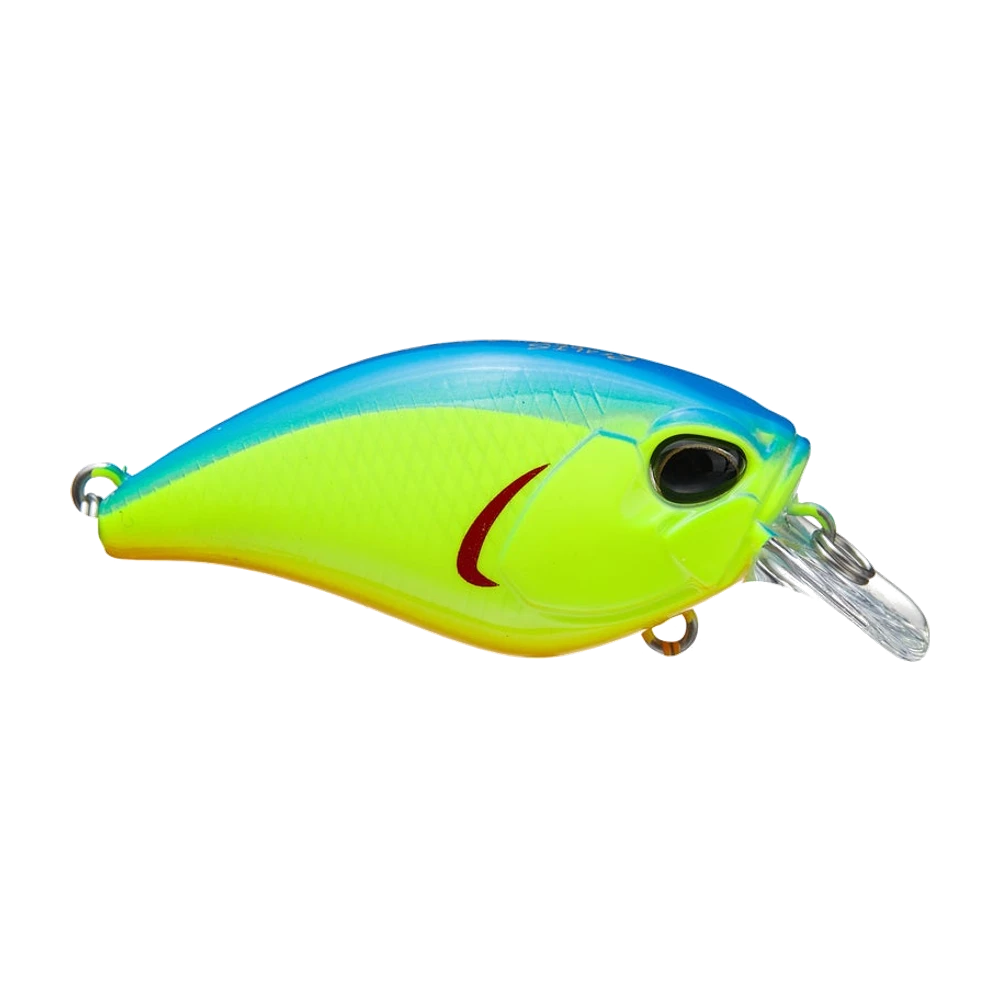
This lure shines under specific conditions. CarnaFish tells you in 10 seconds if today is one of them.
Late August on a busy pond, the water is low and the bass have seen every crankbait in the shop go past. You know they're there, tucked under the low branches, but nothing happens. On days like that the answer is almost never a bigger or louder bait: it's a smaller one, quieter, closer in size to this year's fry. The Mid Roller 40F exists for exactly that situation.
A deliberately tiny crankbait
The maker's spec table lists 1.37 in, roughly 3.5 cm, for 3/16 oz, that is 5.3 g. That's well below the usual squarebill format: where a standard shallow crank weighs 10 to 14 g / 3/8 to 1/2 oz, this one fits in half your palm. The trade name carries the number 40, which suggests 40 mm, but the only dimension published in the table is 1.37 in. We'll stick to that figure, since it's the manufacturer data.
The small size isn't a shortcut, it's the whole point. When fish are educated or feeding on fry a couple of centimetres long, a bulky lure becomes suspect straight away. The Mid Roller drops below that suspicion threshold while keeping a real square bill and a real crankbait swim, which neither a slim minnow nor a lightly rigged soft plastic can do.
There's a catch worth knowing: 5.3 g isn't much to cast. On a medium rod with 30 lb braid you won't go far and you'll suffer in the wind. A light outfit, soft tip, 8 to 10 lb fluorocarbon, changes the experience completely.
The staggered roll, and why it matters
For this bait DUO describes an internal fixed weight system — not a moving transfer system — that contributes to a staggered, irregular roll. It's a deliberate design choice: most crankbaits chase absolute regularity, a metronomic beat a fish can track with its eyes. Here the body rolls with slight breaks, which makes the path less predictable.
On an unpressured fish that changes nothing. On a fish that has learned to follow a lure without eating, the irregularity shortens its inspection window: it no longer gets to analyse a perfectly cyclical swim. It's the same logic that makes a random pause work on a jerkbait.
The best place for this bait is within a metre of hard cover. Cast so the crank genuinely collides with the stump, the piling or the rock, and let it deflect. The strike comes within a second of the knock, almost never out in open water.
Square bill: a mechanism to exploit
The square bill isn't a styling detail. On hitting cover, it rolls the bait onto its side rather than jamming it, and the body then picks its swim back up. That's deflection, and it's the number one trigger on bass along the bank.
The bill's line tie, carefully positioned according to the maker, sets the angle at which the bait meets cover. In practice the Mid Roller goes through places where a round-billed crank hangs up, which lets you fish straight into the laydown instead of edging past it a metre away.
Where to cast it first
Cluttered margins over 1 to 2 m / 3 to 6 ft of water: fallen trees, docks, riprap, isolated stumps on a flat. The bait is rated at 4 to 6 ft, that is 1.2 to 1.8 m, which puts it exactly in the pond and small-river margin band. Beyond that it no longer gets down and loses the bottom contact that makes most of its value.
In autumn it's also a very good perch bait over gravel flats, when schools are herding fry near the surface: the size matches the forage of the moment precisely.
The classic mistake
Putting this bait on an outfit that's too powerful. A 5.3 g crank on a 10-30 g rod casts badly, swims badly and loses fish. The other mistake is a steady straight retrieve at a decent clip: you miss the deflection, which is the only reason to pick a squarebill over a soft plastic.
When the small size becomes a handicap
Be honest about the limits. A 5.3 g lure doesn't search water: on a big, windy lake you'll spend the day casting twenty metres while the angler next to you covers twice that with a standard crank. The Mid Roller isn't a search tool, it's a conversion tool, to be tied on once you already know where the fish are.
Second limit, the hooks. Two small trebles on a short body hold a big fish poorly when it runs into the laydown. If the spot holds good-sized bass in heavy cover, a weedless Texas rig on a heavy-wire hook remains the more sensible choice, even if it draws fewer bites.
Third limit, seasonal. In spring, when fish are after a bulky meal before the spawn, downsizing is often counterproductive. The Mid Roller gives its best from late summer into autumn, the stretch when this year's fry dominates the menu.
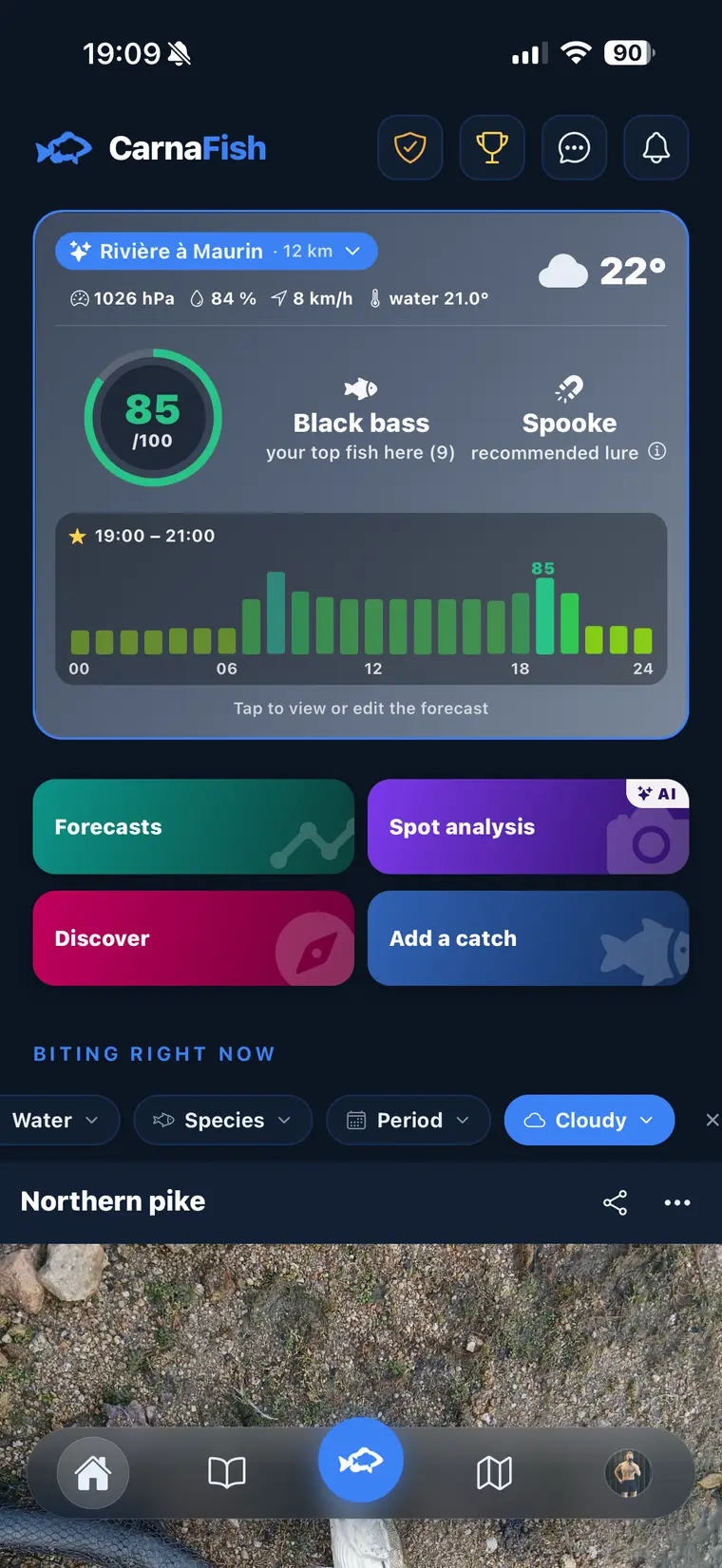
Not sure what to tie on?
Photograph your spot: CarnaFish reads the scene, cross-checks the conditions and gives you the zone, the lure and the retrieve. Free on iOS and Android.
One figure the description doesn't give
The maker's spec table gives length, weight and depth, but it carries no buoyancy note — neither "floating" nor "sinking." The 40F suffix in the trade name suggests a floater, but a model name isn't technical data, so we don't assert it here. If that point matters to how you fish — rising on the pause to clear cover, for instance — test the bait in a bucket before the first session, it takes ten seconds.
Colour by water clarity
- Stained water or overcast sky: the blue-chartreuse of the photo, with its red gill slash, visible without shouting.
- Clear water: a roach or bleak tone, natural and discreet, for a fish that has time to look.
- Bright light, clear water: a plain dark back, read as a silhouette by a fish holding beneath the lure.
A small squarebill is only worth anything if you put it in the right place, within twenty centimetres. That's where CarnaFish earns its keep: a photo of the spot, and the app suggests the zone to work, the depth and the lure type that suit the day's conditions. For a method of reading margins, our guide to reading a fishing spot spells out the markers to look for.
Next to a Strike King KVD Squarebill or a 6th Sense Crush Mini 25X, the Mid Roller plays a different game: smaller, quieter, built less to cover water fast than to convince a fish you've already located and that has already been worked over.
Key takeaways
- 3.5 cm / 1.37 in and 5.3 g / 3/16 oz per the spec table: a squarebill well under the usual size, aimed at educated fish.
- Internal fixed weight and a deliberately irregular roll, to shorten the fish's inspection window.
- Rated depth of 1.2 to 1.8 m / 4-6 ft: a margin bait, not a deep search tool.
- The maker doesn't state buoyancy: check it yourself if it matters to your fishing.
FAQ
How big is the Mid Roller 40F exactly?
The maker's spec table lists 1.37 in, roughly 3.5 cm, for 3/16 oz (5.3 g). The number 40 in the trade name is not a published dimension.
Does the Mid Roller 40F float?
The technical description doesn't say: it contains neither a "floating" nor a "sinking" note. Rather than assert it, test it once in a bucket before your first session.
What outfit do I need to cast 5 g?
A light rod, roughly 3-15 g / 1/8-1/2 oz, with a soft tip, and 8 to 10 lb fluorocarbon. A heavier outfit casts this weight badly and tears hooks out of fish pinned on the edge of the jaw.
How deep does it run?
Between 4 and 6 ft per the maker, that is 1.2 to 1.8 m. It's a margin bait: past 2 m / 6 ft it loses contact with the bottom, which is where most of its effectiveness comes from.
Is it any good for perch?
Yes, especially in autumn when schools are chasing small fry. The size then matches the target forage exactly, where a 10 cm / 4 in crank misses entirely.
How does it differ from a standard squarebill?
In size and in swim regularity. A Strike King KVD Squarebill is a fast search bait; the Mid Roller is smaller, rolls on a staggered beat, and targets a located fish that's refusing the usual presentations.
The full bass lure guideSeason-by-season strategy: which family of lure, when, and why.Go from theory to fish
CarnaFish reads your spot from a photo and gives you the game plan: zone, lure, retrieve. Free on iOS and Android.