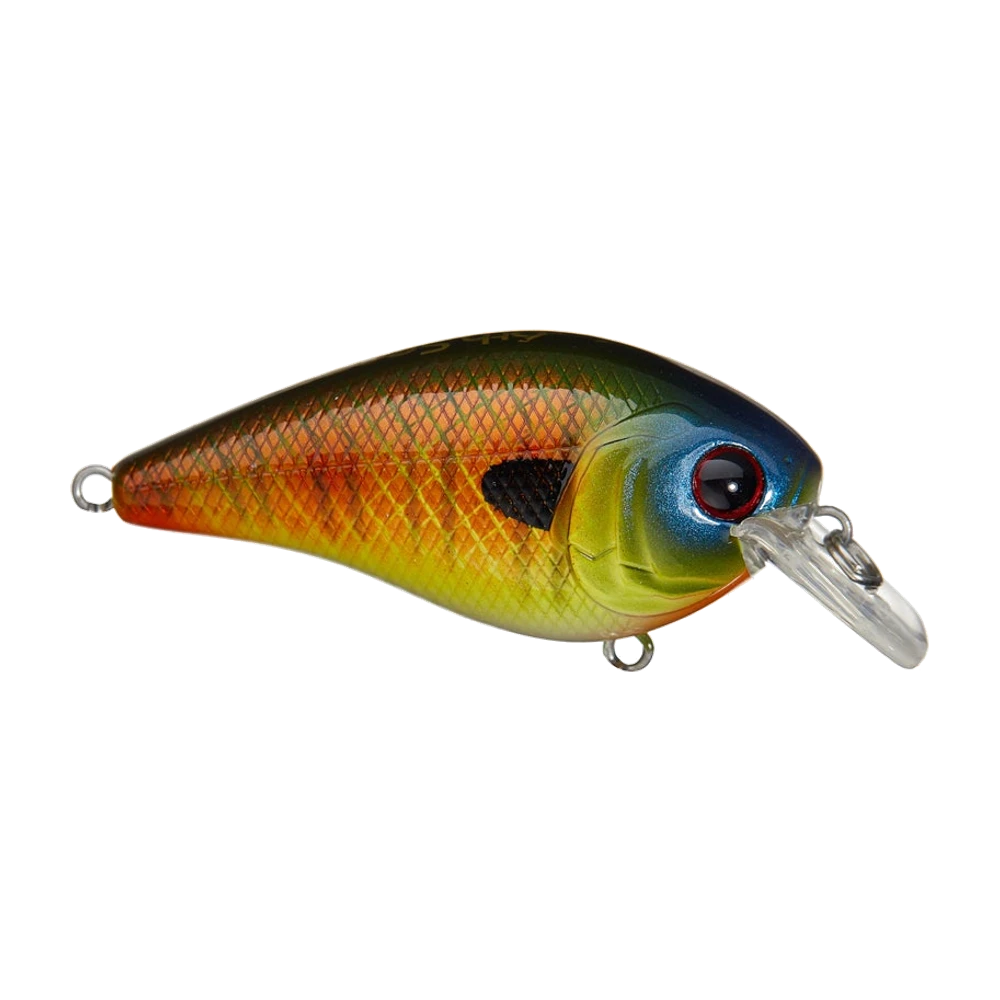
6th Sense Crush Mini 25X: the small crank for educated fish
The right lure in the wrong spot still catches nothing. CarnaFish spots the zone that works, from a single photo.
A Sunday in October on public water, three anglers ahead of you along the same bank. The water is clear, the bass are visible on the drop-offs and they slide away as the lure arrives. You have two options: change spots, or change scale. The Crush Mini 25X exists for the second one. It is a shallow crankbait shrunk to two inches, built for a single situation: fish that have already seen everything.
Downsizing changes the fish's answer, not just the silhouette
There is a habit of assuming a small lure catches small fish. On pressured water that is simply wrong. What a downsized profile changes is the fish's decision time. Faced with a three-inch crankbait coming through at speed, a wary bass has time to run the analysis: wrong volume, vibration too strong, path too regular. It declines. Faced with a two-inch prey item, the analysis costs more than the strike, and reflex usually wins.
That is the whole point of finesse cranking, an approach born on over-fished American lakes and transferring cleanly to European ponds and small rivers. You are not trying to make more noise than everybody else, you are trying to present something believable.
The hunting action, and why it matters more than size
The Crush Mini 25X does not swim straight. 6th Sense tuned the buoyancy and the ballast position to produce what is called a hunting action: on a steady retrieve the lure wanders off to one side on its own, then rights itself, without you touching the rod. Over a fifty-foot pass it breaks sideways three or four times.
That behaviour is valuable because it injects the unexpected into a mechanical retrieve. A crankbait that tracks perfectly straight is, paradoxically, a suspicious crankbait: no baitfish holds a perfect line. Every wander of the Crush Mini imitates a hesitation, and the bite very often happens on that exact break.
Two conditions let the hunting action express itself. First a steady retrieve: if you are constantly varying speed, you mask the lure's own wanders. Second a free connection at the nose, a fine snap or a loop knot, because a knot cinched against the eye chokes precisely the degree of freedom that produces the break.
A rattle that does not take over
The Mini 25X carries a deliberately faint rattle system. The intent is clear: call fish at short range without warning them too early. On water where everybody throws lipless baits and loud cranks, that restraint is a genuine argument.
It also means accepting a limit. In very murky water, or water loaded after rain, sound is the main detection channel, and a deliberately quiet lure loses ground. In those conditions, go back to something bulkier and louder like the Crush Flat 75X.
With a crank this size the real adjustment is not color, it is speed. Make three casts to the same place at three different speeds before you move. Nine times out of ten, every bite comes at the same speed, and it is almost never the one you started with.
Where and when it makes the difference
The stated depth range, 2 to 4 ft, maps its ground well: banks, shallow flats, the back of a pond, the first few feet of a drop-off. In autumn it shines behind schools of small baitfish, the period when the size matches the forage exactly.
In Europe it is also an excellent perch lure. Two inches for a quarter ounce is precisely the class a good perch attacks without hesitating, and the hunting action triggers it better than a straight-tracking crank. On canal riprap or a bridge piling, it often out-fishes a small inline spinner.
The classic mistake: oversized rod and line
A quarter-ounce lure thrown on a medium-heavy rod with 20 lb line is a lure that does not go far, does not reach its depth, and whose action is smothered by the stiffness of the whole setup. Switch to a medium-light rod, 8-10 lb fluorocarbon and a small casting or spinning reel to match. The gain in distance and depth is immediate.
Second common error: setting the hook hard. The trebles on a small crank are fine wire and the fish is often pinned on the edge of the jaw. Just hold the rod and keep reeling when you feel weight.
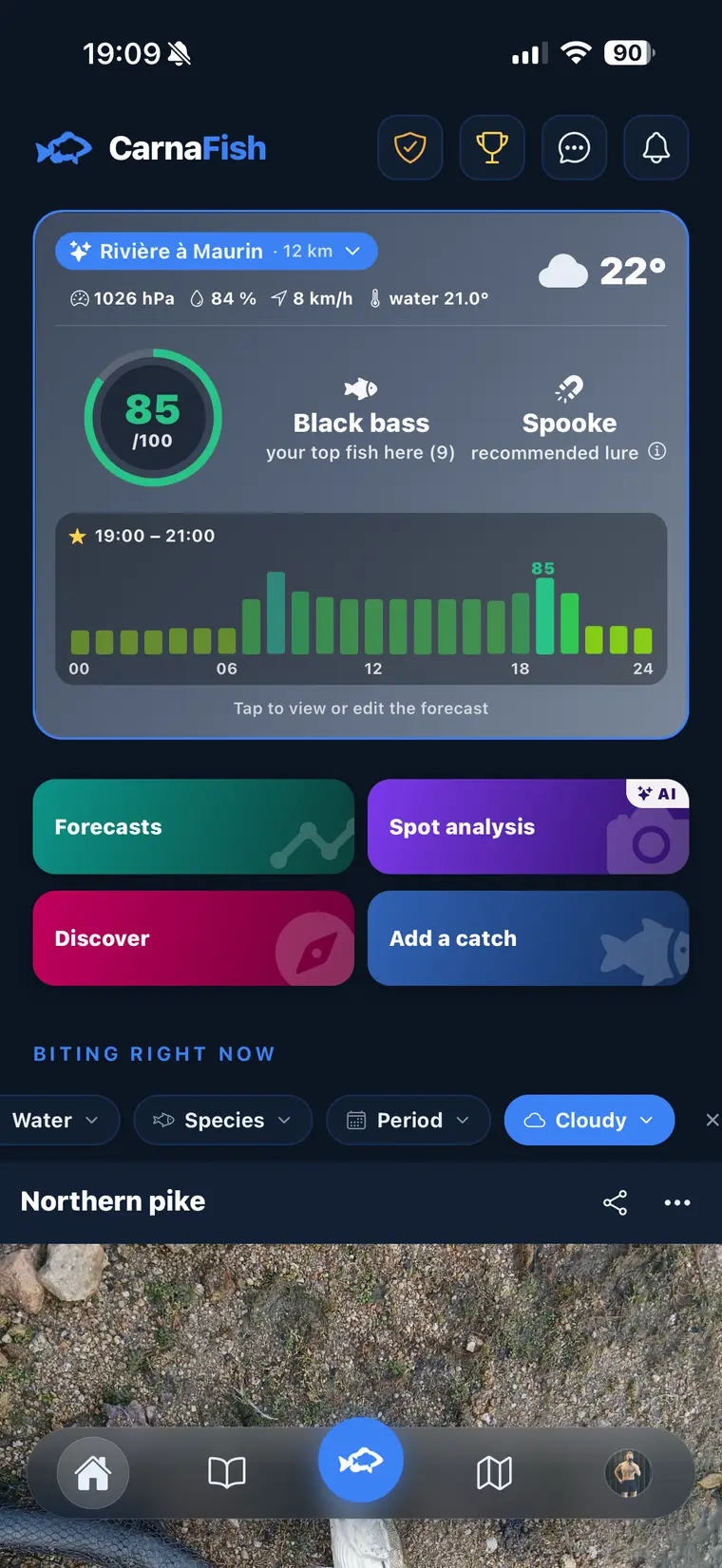
Not sure what to tie on?
Photograph your spot: CarnaFish reads the scene, cross-checks the conditions and gives you the zone, the lure and the retrieve. Free on iOS and Android.
Colors by conditions
- Clear water: silver roach, the most neutral and believable finish when the fish sees the lure from a distance and has time to examine it.
- Stained water: black-back chartreuse, the classic shallow-crank compromise, findable without being loud.
- Gravel or riprap bottom: brown craw, particularly in spring and early autumn when crayfish are active.
Its place among the other small cranks
The small-crankbait slot is well occupied. Against an Illex Chubby 38, the Crush Mini 25X is slightly longer and heavier, so easier to cast a long way, but the Chubby still has the edge in genuinely fine presentation. Against a Mann's Baby 1-Minus it runs a little deeper and offers a more erratic track. And if you need to get below six feet, the lure to reach for is a Duo Realis Crank M65, not this one.
Choosing the right crankbait size mostly comes down to knowing what depth and what bottom type you are fishing. That is exactly what CarnaFish is for: photograph the spot and the AI suggests a zone, a depth and a lure family that fit the day's conditions. If perch is your main target, our guide to lure fishing for perch covers the other families worth knowing.
The short version
- Downsizing is not about catching small fish, it is about shortening a wary fish's decision time.
- The hunting action wanders off track by itself: keep a steady retrieve so it can happen.
- The faint rattle is an asset on pressured water and a limitation in very murky water.
- Medium-light rod and thin fluorocarbon, or you lose distance, depth and action amplitude.
FAQ
How deep does the Crush Mini 25X actually run?
Between 2 and 4 ft depending on cast length, speed and line diameter. With thin fluorocarbon and a long cast you will be at the deep end of the range; on a short cast, noticeably less.
Why does this lure work on fish that refuse everything?
Because a small profile combined with an irregular track leaves the fish less time to analyse. The reduced volume reads as believable, and the wander off course triggers a reflex rather than a decision.
Is it a good perch lure?
Yes, it is one of its best uses in Europe. Two inches for a quarter ounce matches what a good perch attacks without hesitation, especially on riprap and bridge pilings.
What rod should I use?
A medium-light with a moderate action, casting or spinning depending on what you are used to. Too stiff a rod kills the action, cuts casting distance and pulls hooks out of fish pinned on the edge of the jaw.
Should I vary retrieve speed?
Not within one cast: steadiness is what lets the hunting action show. Do test three different speeds over three successive casts to the same place to find the one that triggers.
Is the Crush Mini 25X any use in murky water?
Less so than louder models, because its rattle is deliberately very faint. In loaded water a bulkier, noisier crankbait will do better.
The full bass lure guideSeason-by-season strategy: which family of lure, when, and why.Go from theory to fish
CarnaFish reads your spot from a photo and gives you the game plan: zone, lure, retrieve. Free on iOS and Android.