Lucky Craft Silent Fat BDS1: the silent squarebill for 50 cm of water
Rather not fish it blind? Photograph your spot — CarnaFish cross-checks the conditions and points you the right way.
There's one spot almost nobody fishes seriously: the margin in fifty centimetres of water, the strip you walk past on your way to where you actually intend to cast. Yet it holds the most accessible fish in the lake, because that's where crayfish and fry hide among the rocks and dead wood. The Lucky Craft Silent Fat BDS1 is drawn for exactly that band of water, and for one particular case: when the fish have already heard every rattling crankbait in the area.
The four numbers in the table
The maker's spec table runs to one line, and its header deserves attention: it lists length, weight and depth, not length, weight and buoyancy class. The values are 1-7/8 in, 1/4 oz and 1 to 2 ft, that is 4.8 cm, 7.1 g and 0.3 to 0.6 m.
That depth range is the real information. Thirty to sixty centimetres is extremely shallow for a crankbait, even a squarebill. Plenty of so-called shallow squarebills run between 1 and 1.5 m, which is already too deep for a rocky margin. Take the BDS1 for what it is: a very shallow tool that keeps bottom contact where others pass over the top.
What the table doesn't say
The table has no class column, so it neither confirms nor contradicts buoyancy. The maker's text, on the other hand, is explicit: it speaks of an air floating concept, of optimised buoyancy thanks to an intricate internal structure, and claims the lure behaves like a balsa wood crankbait. That's a prose claim, not a tabulated figure, and it should be read as such: the stated intent is clearly a floating bait with strong rise, but the spec table doesn't back it up. If that characteristic is decisive for how you fish, test it in a bucket before betting on it.
Silent, and why that's the main argument
Most modern crankbaits carry loose balls that click. The BDS1 does the opposite: its weighting is fixed, and the maker advertises a completely silent presentation. This isn't a stripped-down version of a noisy model, it's the starting point of the design.
Why it matters. On heavily fished water, fish associate a repeated noise with a bad experience very quickly. A silent crankbait enters their perception as vibration alone — the body rolling — without the acoustic signature they've learned to avoid. On a public pond fished every weekend, that difference often turns a blank into a decent session.
Fixed ballast has a second, less obvious effect. Loose balls shift inside the body at every impact, which momentarily unbalances the lure. Fixed weighting keeps the centre of gravity constant, and that's exactly what the maker emphasises: the ability to recover its swim immediately after deflecting off cover. On a rocky margin where you hit something every two metres, a lure that runs true after every knock is fishing all the time, where one that wobbles is fishing half the time.
The square bill with rounded corners
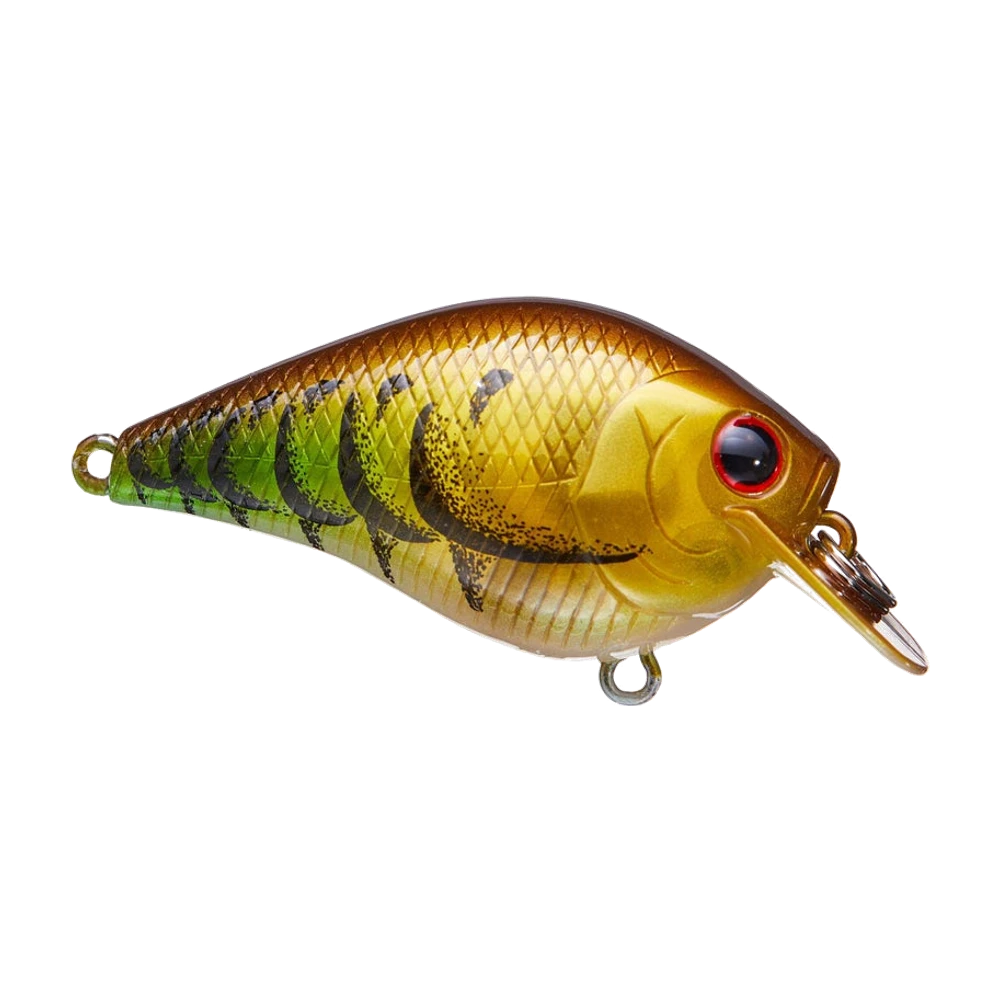
A classic square bill has sharp corners. That's what gives it its erratic behaviour on contact, but it's also what wedges it in the forks of branches. Lucky Craft softens those corners, and the photo shows it clearly: the corners of the amber bill are distinctly rounded.
Don't retrieve this lure on a steady straight line. Its whole point is the impact: aim at the cover, let the bill hit it, then slack off for half a second. The lure rises slightly and runs again. The bite comes during that recovery, almost never during the smooth part of the retrieve. If you finish a session without having knocked into anything, you've missed the point.
Where to use it, and on which species
Its natural ground is hard margin: rock piles, riprap, slab, stumps, dock pilings, driftwood jammed against a bank. Anything under a metre deep with angles in it. In spring, when bass move onto the flats to spawn, that's a priority zone; in summer it's a morning and evening pattern along shaded banks.
At only 4.8 cm, this lure reaches beyond strictly bass fishing. In Europe it's also an excellent perch size: the stubby outline and high running line match exactly what a margin perch attacks, and hard-edged shallow water is its usual ground. For pike it's too small and the hooks too fine; for zander the stated depth is beside the point.
The classic mistake
Rigging it on heavy fluorocarbon with a tight knot cinched straight onto the ring. On a crankbait this small, a knot pulled hard against the eye cuts the swimming amplitude dramatically, and heavy fluorocarbon drags the nose down and takes the lure below its stated range. Light monofilament, or braid with a light leader, plus a loop knot or small snap: the swim changes immediately.
Not sure what to tie on?
Photograph your spot: CarnaFish reads the scene, cross-checks the conditions and gives you the zone, the lure and the retrieve. Free on iOS and Android.
Colours by water clarity
The maker advertises its usual broad palette without publishing the list. So reason it through:
- Clear water: the pattern in the photo, copper-brown back, gold flanks and a chartreuse lower flank barred in black with a red eye. That reads as a perch wherever the species is present, and the chartreuse gives a visual anchor without breaking the natural look.
- Stained water: craw tones, orange-brown with a red belly. In very shallow water, crayfish are the dominant forage over hard bottom, and this stubby profile suggests one better than an elongated lure.
- Low cloud or coloured water: a dark back and a high-contrast flank. In fifty centimetres of water a fish often looks upward and reads a silhouette before a colour.
Note finally that the lure is photographed without hooks, both hangers left empty. Check what's fitted on the one you buy: on a 7 g lure, treble gauge has a direct effect on buoyancy and on the depth actually reached.
Against other squarebills
A Strike King KVD 1.5 Squarebill or a Bomber Square A are bigger, run deeper and cast further: those are searching lures. The BDS1 is a precision tool, to be pulled out once you've identified a piece of cover and want to hit it three times in a row. The 6th Sense Crush Silent Squarebill 50S shares its silent approach but not its depth range. The three are complementary rather than competing.
That still leaves spotting the right cover, and that's exactly what CarnaFish does: one photo of the spot, and the AI suggests the zone, the depth and the lure type that match the day's conditions. To make the most of this lure's perch-sized profile, our guide to lure fishing for perch details the spots and the rigs.
Key takeaways
- Spec table: 4.8 cm, 7.1 g and a 0.3 to 0.6 m range. This is a very shallow tool, not an all-round squarebill.
- No rattle and fixed ballast: a decisive argument on pressured fish, plus immediate recovery of the swim after an impact.
- Buoyancy is asserted in the maker's prose, not in the table, which has no class column at all.
- Softened bill corners trade a little deflection violence for far better passage through wood.
FAQ
How deep does the Fat BDS1 run?
The maker states 1 to 2 ft, that is 0.3 to 0.6 m. That's extremely shallow even for a squarebill, and it's precisely what makes it useful on the hard margins ordinary crankbaits fly over.
Does it float?
The maker's text speaks of optimised buoyancy and behaviour close to a balsa crankbait, but the spec table has no class column to confirm it. So we rely on the description's claim, not on a tabulated figure: test it in a bucket if that point is decisive for you.
Why choose a crankbait with no rattle?
Because on heavily fished water, fish associate a repeated noise with a bad experience. A silent model arrives as vibration alone, without the acoustic signature they've learned to avoid. Fixed ballast also allows a cleaner recovery of the swim after an impact.
Does it suit perch?
Yes, and it's one of its best uses in Europe: 4.8 cm and a stubby body match exactly what a margin perch attacks, on the same kind of hard, shallow spot.
What rigging works best?
A split ring on the bill line tie, then a small snap or a loop knot. A knot cinched straight onto the ring chokes the swim of a crankbait this small, and fluorocarbon that's too heavy pulls the nose down and takes it below its stated range.
Does it come with hooks?
In the photo of this model the lure is shown without hooks, both hangers empty. Check what's fitted on the one you buy: on a 7 g lure, treble gauge directly affects buoyancy and the depth actually reached.
The full bass lure guideSeason-by-season strategy: which family of lure, when, and why.Go from theory to fish
CarnaFish reads your spot from a photo and gives you the game plan: zone, lure, retrieve. Free on iOS and Android.