DUO Press Bait: reaching the bass beyond the sandbar
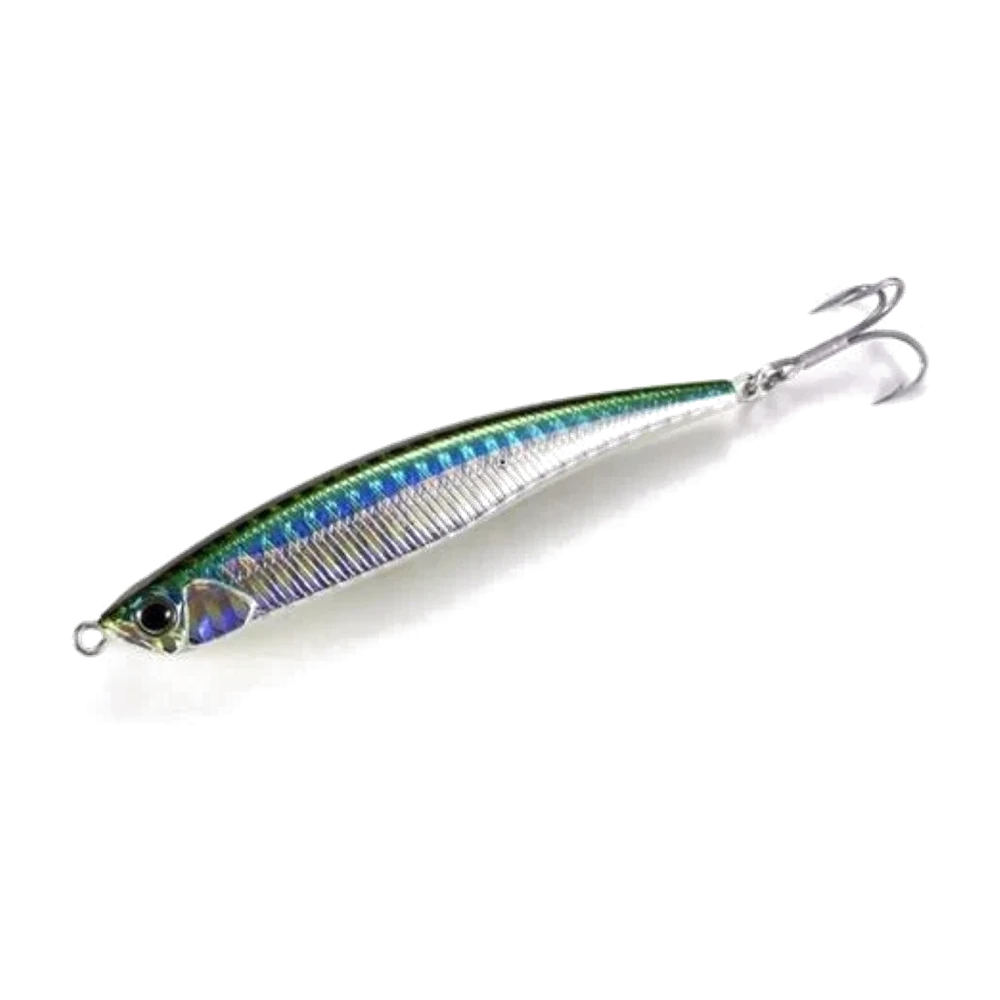
Before tying this one on, it helps to know if the spot actually calls for it. CarnaFish reads the scene from a photo.
On a beach, distance is not a matter of pride. It is a matter of geography: the sandbank is forty metres out, the gutter behind the bar starts at fifty-five, and the bass work that gutter. As long as your lure lands at thirty-five metres, you are fishing water with nothing in it.
Add the onshore headwind, which blows in off the sea almost every late afternoon, and an eighteen-gram floating lure becomes unusable: it balloons up, turns broadside and drops short.
A dense sinking minnow changes that one parameter on its own. The Press Bait belongs to the family of saltwater lures where the mass is packed into a compact body, not to win a casting competition, but to put a zone within reach that rarely was.
Density is a strategy, not a spec
A lure that is heavy for its volume behaves differently at four moments in the retrieve, and each one counts.
- On the cast, it cuts the wind instead of suffering it. A fifteen-knot headwind costs far fewer metres than it would with a floater of equivalent volume.
- Going through the bar, it passes under the breaker instead of being thrown back at you. A floating lure pops out of the surf and comes back at you; a sinker carries on.
- In a cross current, it stays on its line. A light profile drifts and presents its flank to the current; a dense body holds its course.
- On the stop, it sinks flat, which gives you an extra move a floater simply does not have.
The trade-off is obvious and you have to accept it: this lure sinks. On a rock shelf with forty centimetres of water, you will lose it in three casts.
The retrieve: straight, but with breaks
- Cast at an angle, not straight out from the shore. You lengthen the time the lure spends in the gutter and you cover the bar obliquely.
- Count it down from the splashdown, line semi-tight. On a beach, two to four seconds is usually enough.
- Retrieve steadily, medium speed, rod low and pointed slightly away from the current.
- Break the rhythm every six or eight seconds: two fast turns, then a one-second stop. The lure accelerates, then sinks flat. It is that break which turns a following bass into a taking bass.
- Work the last few metres. In the wash, right in front of you, bass root about in thirty centimetres of water. Do not recast too early — raise the rod and keep the lure working right to your feet.
On the water: on a beach, the best hour is not high tide but the two hours before it, when the water covers the top of the strand. Bass come in behind the waves to root through freshly flooded sand, often in less than a metre of water. At that point, stop reaching out and fish the first metre in front of you, parallel to the shore.
Setting the depth
| Count after splashdown | Swimming layer | Situation |
|---|---|---|
| 0 to 1 second | 20 to 40 cm | Choppy water, little depth, feeding bass |
| 3 seconds | 50 to 80 cm | Default setting on a beach |
| 6 seconds | 1 to 1.3 m | Gutter behind the bar, high water |
| 10 seconds or more | down to the bottom | Harbour, breakwater, deep quay |
That count only holds for an immediate retrieve. If you count six seconds then retrieve slowly, the lure climbs back up as it comes: on a long retrieve, add a one-second pause every ten seconds so it drops back into its layer.
The gear is non-negotiable
A dense lure is wasted on a short rod. To actually use the distance you need a rod of 2.70 m to 3 m, rated for around thirty grams, with an action progressive enough to load on the cast.
The braid must be fine — an excessive diameter cancels out the point of the lure by dragging in the air and in the current. A 0.35 to 0.45 mm fluorocarbon leader of a metre and a half handles abrasion without restricting the action.
Rinse the lure in fresh water after every session and check the trebles: on a beach, sand gets into everything, and a corroded split ring will let go on exactly the one good fish of the day.
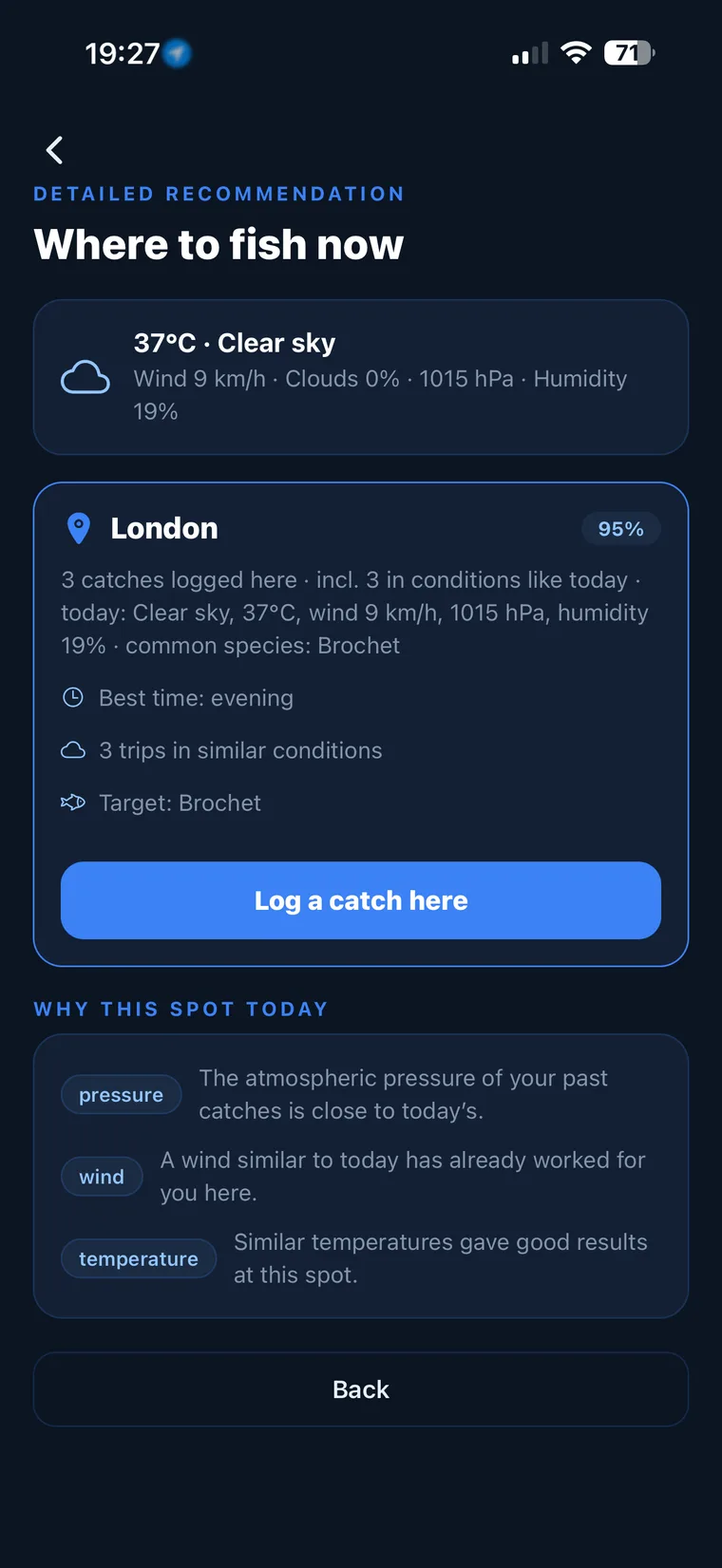
Not sure what to tie on?
Photograph your spot: CarnaFish reads the scene, cross-checks the conditions and gives you the zone, the lure and the retrieve. Free on iOS and Android.
Where it is the wrong choice
- Shallow rock and weed: it sinks, so it snags. That rules it out.
- Calm, very clear water in broad daylight: its action is that of a searching lure, not a finesse lure.
- Small precise spots: you lose everything it offers on a fifteen-metre cast.
- Fish pinned to the bottom in deep water: it sinks, but not fast enough to compete with a weighted soft plastic.
Press Bait or a floating shallow runner
The Tackle House Feed Shallow answers the opposite problem: it floats, it holds a band of twenty to fifty centimetres, and it is built for the rock shelf where any sinking lure buries itself. On that ground, the Press Bait has no business being there.
Against the DUO Tide Minnow Slim, the difference comes down to density and purpose: the Tide Minnow Slim offers a wider, lighter action, ideal at short and medium range in calm water; the Press Bait is the tool for wind, surf and sixty metres.
The right reflex is to think in terms of ground rather than model: shallow rock and flat water on a floater, sand, wind and a far gutter on a dense sinker. Our guide to sea bass fishing with lures sets out that logic on the water. And if you are torn between the two when you arrive at an unfamiliar beach, CarnaFish analyses a photo of the spot and answers.
Key takeaways
- A dense body: it cuts through wind, passes under the bar and holds its line in a cross current.
- The count after splashdown fixes the swimming layer; three seconds as a default setting.
- Break the rhythm every six to eight seconds — the hit comes on the one-second stop.
- Do not neglect the last few metres: bass root about in thirty centimetres of water in front of you.
- Unsuited to shallow rock, to weed and to short-range spots.
FAQ
Why choose a sinking minnow over a floater in the sea?
For three concrete reasons: casting distance into a headwind, getting through the surf line without being thrown back, and holding a line in a cross current. A floater is still better as soon as the bottom is cluttered or very shallow.
What is the best tide for beach bass fishing?
The two hours before high water are generally the most productive, when the water covers the top of the strand and bass move in to root through the sand. The start of the ebb works too, often with fish further out.
How long should you let it sink?
Three seconds as a default on a beach, up to six or eight seconds to reach a gutter behind the bar. In very rough or shallow water, start working it from the splashdown with no count at all.
What rod for long-range lure fishing?
A rod of 2.70 m to 3 m, rated for around thirty grams, with an action progressive enough to load on the cast. On a short rod, the density of the lure never converts into metres.
Do you need a fluorocarbon leader?
Yes, 0.35 to 0.45 mm over a metre to a metre and a half. It absorbs the lunges of a fish caught in a wave and resists abrasion on sand and shell, which braid alone does not.
Can you fish it at night?
Yes, and it is often a very good window on beaches. Slow the retrieve down markedly, lengthen the pauses and favour dark colours that cut a clean silhouette against the residual light at the surface.
The full sea bass lure guideSeason-by-season strategy: which family of lure, when, and why.Go from theory to fish
CarnaFish reads your spot from a photo and gives you the game plan: zone, lure, retrieve. Free on iOS and Android.