Tackle House Feed Shallow: swimming 30 cm above the rock
Before tying this one on, it helps to know if the spot actually calls for it. CarnaFish reads the scene from a photo.
Rising tide, a rock slab under thirty to sixty centimetres of water, and bass hunting over it, sending sand eels skipping. The situation is obvious, the fish are visible, and yet you will probably go home empty-handed — because the saltwater minnow you tied on runs at a metre twenty and plants itself in the rock on the third turn of the handle.
That leaves you two bad options: a topwater, which misses fish hunting thirty centimetres under the film, or a rod-high retrieve that distorts your minnow's action. The right answer is a lure designed from the start never to go deeper than that.
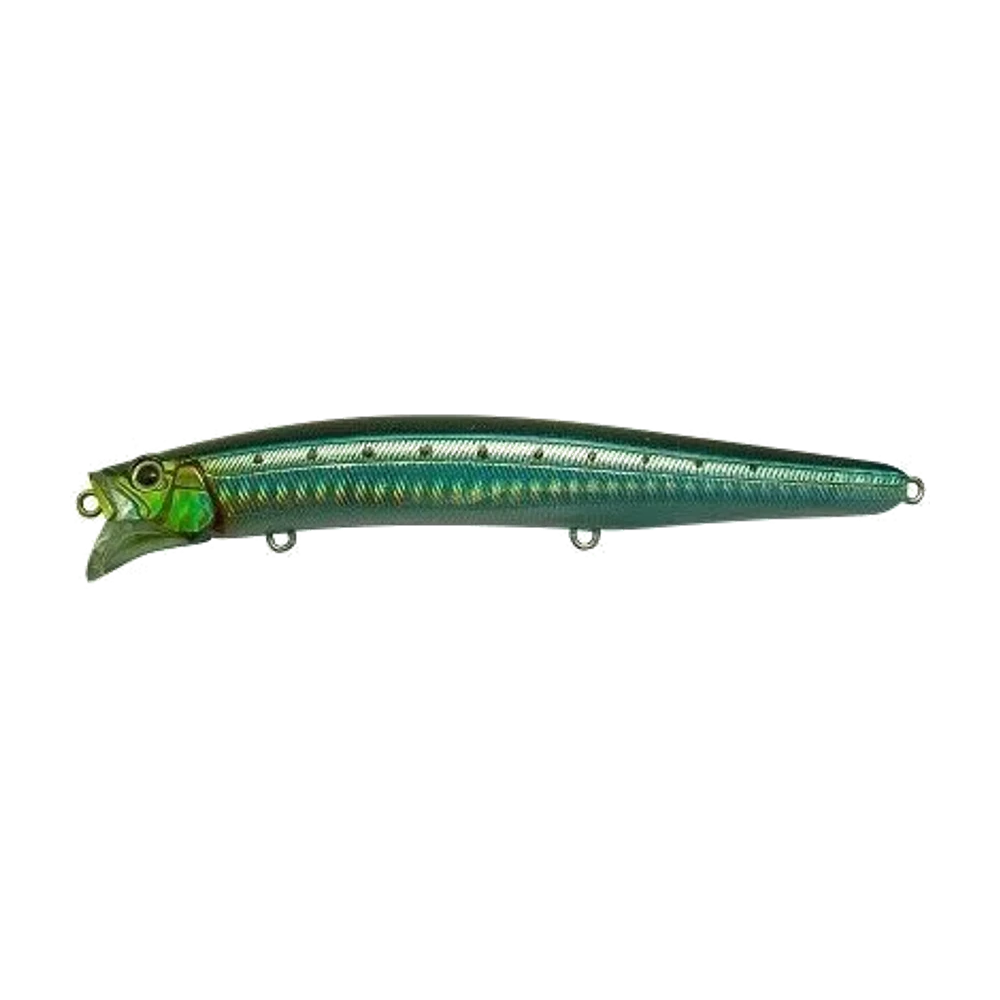
The Feed Shallow works in exactly that band. It is not a minnow held back; it is a minnow whose entire geometry is calculated to hold around thirty centimetres under the surface at normal speed, without you correcting anything.
A short, steeply angled lip, not a trimmed-down one
The difference between a true shallow runner and a classic minnow with a shortened lip shows in stability, not in depth.
A short lip angled steeply forward generates little downward lift but plenty of resistance to blowing out. That trade-off is what lets the lure stay in its band even when you speed up, whereas a held-back minnow lifts off and goes sideways the moment current pushes it.
In practice, on the water, that gives three useful behaviours:
- The lure keeps its depth at every reasonable speed. You can wind faster to get through a current line without watching it come out of the water.
- The attitude stays slightly head-up, which stops the lip hitting rock while the body still passes over it.
- It returns to its action immediately after a wave or a jolt in the line, with no spinning phase.
Fixed ballast, and why it matters here
Plenty of saltwater minnows use a transfer ball that runs back on the cast then returns to position on the retrieve. That is effective for distance, but it introduces a delay: until the ball has come back, the action is wrong.
On a slab where you only have eight or ten metres of usable retrieve before the dead zone, that delay costs you a third of your pass. The Feed Shallow relies on fixed ballast and a dense profile: casting distance comes from mass and a slim body, not from a mechanism. As a result, the lure swims true from the first turn of the handle.
That has an honest downside: on the cast it is more sensitive to a quartering tailwind than a transfer-ball model. Correct by dropping the rod at the end of the trajectory to flatten the cast.
The retrieve: straight, but not just anyhow
- Cast beyond the feeding zone, never into it. A lure landing in the middle of hunting fish puts them down for thirty seconds.
- Drop the rod to horizontal, tip fifty centimetres off the water the moment the lure lands. Rod high and you make it climb and blow out.
- Wind slowly and steadily, just fast enough to feel the roll in the blank. That is your only indicator of a correct action.
- Give it a one-second dead stop every five or six turns. The lure rises a few centimetres and picks its action back up: that micro-hitch draws plenty of bites from following fish.
- Do not strike on contact. In saltwater, on a slowly swum lure, the bass turns with it. Keep winding until you feel the weight, then lean into it.
On the water: on a slab, do not fish parallel to the shore. Cast at forty-five degrees out to sea and bring the lure back diagonally towards the rock. The bass sits facing the current, on the break: a lure coming in from open water towards the rock follows the path of a prey swept off course, whereas a lure running along the edge passes behind it.
Setting the depth without changing lures
You can vary the working band from twenty to eighty centimetres with three parameters only.
| What you change | Effect on depth | When to use it |
|---|---|---|
| Rod tip 50 cm off the water, slow speed | 30 to 40 cm | Default setting on a slab |
| Rod tip raised to 45°, slow speed | 15 to 25 cm | Rock breaking the surface, dense weed |
| Rod tip low, sustained medium speed | 50 to 80 cm | Deeper plateau, following current |
| 0.40 mm leader instead of 0.30 mm | Lifts it 5 to 10 cm | Very snaggy ground |
Leader diameter is the adjustment most anglers forget. Going from 0.30 to 0.40 mm on the last few metres is enough to lift a shallow runner noticeably, and it buys you abrasion resistance on the rock at the same time.

Not sure what to tie on?
Photograph your spot: CarnaFish reads the scene, cross-checks the conditions and gives you the zone, the lure and the retrieve. Free on iOS and Android.
Where not to expect it to work
The Feed Shallow is a top-layer lure, and it loses all interest the moment the fish are not there.
- Real depth or fish pinned to the bottom: you pass three metres above them. A sinking lure is the only answer.
- Strong cross current in an estuary: it holds its action, but it drifts too much to stay in the current line. A denser model works better.
- Marked headwind: its slim profile and moderate weight limit the distance. This is the classic case where a heavy sinking minnow takes the lead.
- Very murky water: its tight roll is a subtle signal. In coloured water, a wide-vibrating lure carries further.
Feed Shallow or a long-casting sinking minnow
The DUO Press Bait answers the opposite problem: it is dense, it sinks, it cuts through wind and it reaches fish sixty metres out. The Feed Shallow does not play on that ground — it plays on precision within a band of water the sinking model cannot hold without snagging.
Against a DUO Tide Minnow Slim the difference is finer: the Tide Minnow Slim runs deeper and offers a wider action, better suited to sandy bottoms and beaches. The Feed Shallow stays ahead over rock that breaks the surface and on flat water, where a tight roll works better than a wide action.
Our guide to lure fishing for sea bass explains how to read a slab before choosing. And if you are unsure which band of water to attack when you reach a spot, CarnaFish analyses a photo of the spot and answers.
Key takeaways
- Runs between 20 and 50 cm: built for rock breaking the surface and plateaus, not for searching deep.
- Fixed ballast: the action is true from the first turn of the handle, with no lag.
- Rod tip low and a slow steady retrieve; a high rod makes it blow out.
- Leader diameter sets the depth as effectively as speed does.
- Unsuited to headwind, very murky water and fish pinned to the bottom.
FAQ
How deep does the Feed Shallow really run?
Between 20 and 50 cm on a slow retrieve with the rod low, and down to 70 or 80 cm if you wind hard. That band is narrow and deliberately fixed: the lure is not built to go below it.
Can it be fished on the surface like a stickbait?
No. It does not throw spray and it does not walk. Retrieving with the rod very high you can work it at ten or fifteen centimetres, but it remains a subsurface lure, not a topwater.
What leader should I use?
Fluorocarbon of 0.30 to 0.40 mm over one to one and a half metres, joined to braid. The 0.40 serves as much to resist abrasion on rock as to lift the lure slightly in the snaggiest zones.
Do I need a snap?
A small round snap does not spoil the action and saves you time when you change models often on the same spot. Avoid large heavy snaps, which weigh down the front and make it nose over.
Which size should I choose for sea bass?
The 10.5 cm covers most shore situations, particularly on average-sized bass. Move to the 12.8 cm when the fish are hunting big sand eels, when there is wind, or when you want to sort out the better fish.
What do I do when it still snags?
That is the sign the band of water is even shallower than you thought. Raise the tip to 45 degrees, slow down, and move to a heavier leader. If it keeps snagging, the zone calls for a topwater, not a shallow runner.
The full sea bass lure guideSeason-by-season strategy: which family of lure, when, and why.Go from theory to fish
CarnaFish reads your spot from a photo and gives you the game plan: zone, lure, retrieve. Free on iOS and Android.