Evergreen SB Topwater Plugs: four pencil sizes, 7.6 to 15.2 cm
Not sure this lure fits YOUR spot today? CarnaFish tells you in 10 seconds, from a photo.
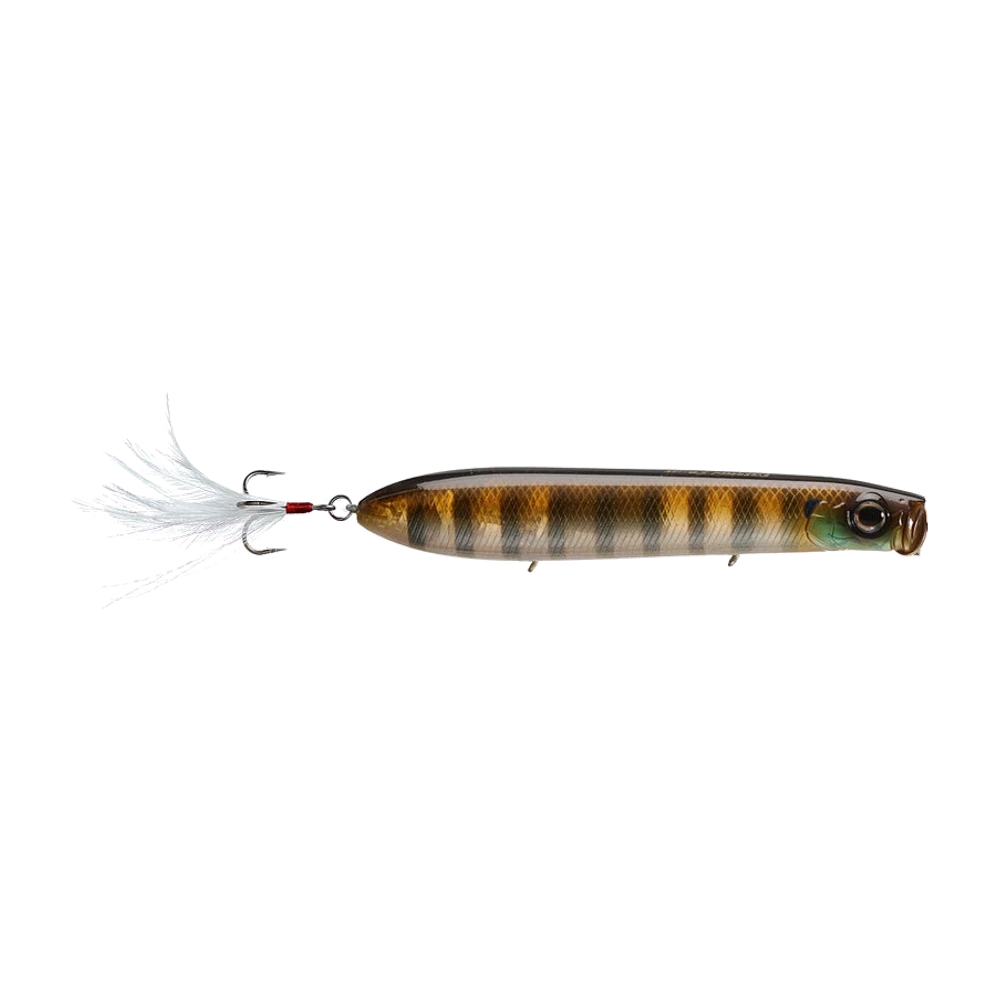
A surface lure that does two different things depending on how you hold the rod is worth a look. The Evergreen Shower Blows — sold as SB Topwater Plugs by US retailers, which confuses people on their first order — is a Japanese pencil popper designed by Morizo Shimizu. Depending on rod angle and how hard you pull, it spits water with a wet chug or slides sharply from side to side. And since it comes in four sizes from 7.6 to 15.2 cm, you still need to know which one to buy.
The spec table, size by size
The maker gives four lines, and that is the single most useful piece of information on the whole product page. Converted:
- Shower Blows 77: 3 in, or 7.6 cm, for 11/32 oz, which is 9.8 g. Class Topwater. Size 7 front treble and size 6 rear treble.
- Shower Blows 105: 4-1/8 in, or 10.5 cm, for 9/16 oz, which is 16 g. Class Topwater. Size 6 trebles.
- Shower Blows 125: 4-7/8 in, or 12.4 cm, for 15/16 oz, which is 26.6 g. Class Topwater. Size 4 trebles.
- Shower Blows 150: 6 in, or 15.2 cm, for 1-1/2 oz, which is 42.5 g. Class Topwater. Hook sizes not given by the maker.
Two observations. First, the number in the name is the length in millimetres, which gives an immediate reference on the shelf: 77 for 7.7 cm, 150 for 15 cm, and the inch figures in the table match to within a millimetre or two. Second, the weight progression is brutal: between the 77 and the 150 the length doubles but the mass is multiplied by more than four. These are not four variants of one lure, they are four tools for four different rods.
A third, quieter detail: on the 77 the rear treble is larger than the front one, size 6 against size 7. That is the opposite of what most makers do. On a pencil, mass at the back helps keep the tail-down attitude that makes the slide possible, so this is a rigging decision rather than a catalogue slip, and it is worth preserving if you change hooks. For the 150, the stock hook sizes are simply not listed: if you need them before buying, ask the retailer rather than trusting an estimate.
Internal tungsten: two jobs, not one
The copy mentions a built-in tungsten weight system. It does two things at once, and both matter.
The first is casting. A pencil popper is a long body that tumbles in flight unless something stabilises it: a shifting weight that slides back under acceleration pins the mass towards the tail, the lure flies straight and reaches distances a comparable hollow body never sees. On the 125 and the 150, at 26 and 42 grams, these are objects that punch through a crosswind without flinching.
The second is sound. Tungsten striking the inner wall produces a sharp knock, noticeably harder and lower in pitch than the rattle of a steel ball. That signal carries on water roughened by wind, which is exactly the situation where a silent surface lure goes unnoticed three metres from the fish.
The real difference between a pencil that catches and a pencil that entertains is rod position. Tip high, the pulls lift the nose and the lure throws water. Tip low, almost pointed at the water, the same pull becomes a wide lateral slide. Change the angle before you change the lure.
Two actions in one body
The chug
Rod high, short sharp pulls, line slightly tight. The raised nose catches water and throws it forward with a wet sound. This is the action for flat water and located fish: it makes noise on the spot without moving the lure three metres at every stroke. Along a weed edge or around a sunken tree, you can keep the lure in the strike zone for ten seconds.
Walking the dog
Rod low, soft regular pulls, a little slack in the line between strokes. The lure then zigzags widely, one side then the other. This is the searching action: it covers water, it is visible from a distance, and it suits days when fish are scattered over a flat. Rhythm matters more than amplitude — a steady, slightly monotonous cadence almost always beats an irregular sequence.
The appeal of the Shower Blows is precisely that you do not have to choose in the shop. A Lucky Craft Sammy 100 is a pure walking bait, a Cotton Cordell Pencil Popper is built first to spit; here both are available with one lure on the line.
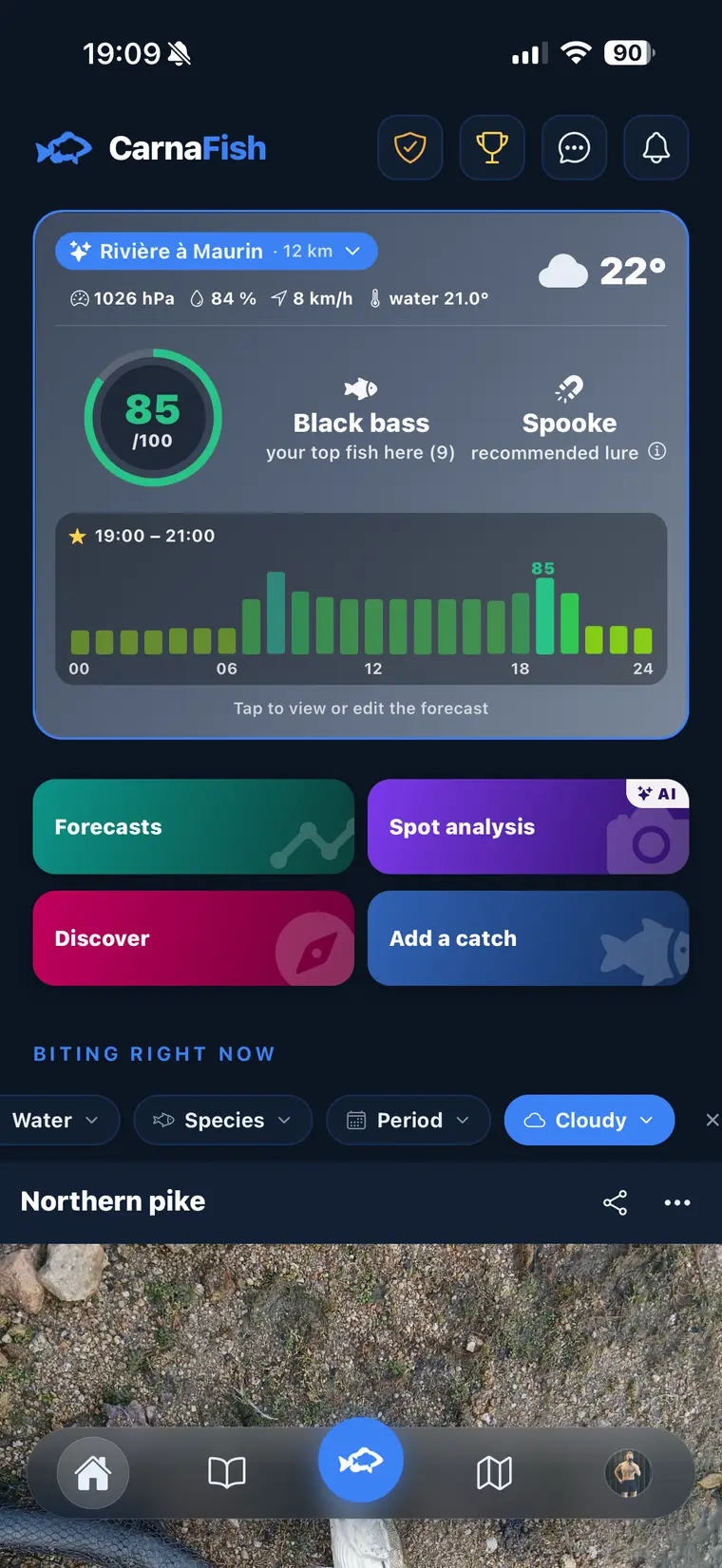
Not sure what to tie on?
Photograph your spot: CarnaFish reads the scene, cross-checks the conditions and gives you the zone, the lure and the retrieve. Free on iOS and Android.
Choosing a size by water and species
The 77 and the 105 are the classic bass formats: 9.8 and 16 g cast easily on a medium-heavy rod with 20-30/100 braid. The 77 is the choice for clear water and pressured fish, the 105 for everyday conditions.
The 125 and the 150 change category. At 26.6 and 42.5 g they demand a powerful rod and matching line, but they also open a use the maker never mentions, since the copy is written for a bass audience: in Europe, a 15 cm pencil with a wide slide is an entirely credible pike lure over a summer flat or along a lily edge. With one serious caveat: trebles on a surface lure and a pike's jaws mean a strong leader, and thinking about unhooking before you set.
The classic mistake
Setting the hook on the sound. A fish attacking a surface lure often misses its first attempt, and a hookset triggered by the splash rips the lure away before the mouth closes. The only rule that works: wait until you feel weight in the rod, then set by pulling rather than lifting. On the 125 and the 150 the weight of the lure itself is enough to hurt if you set into nothing and 42 grams come back at you at speed.
Colors by light
- Clear water and open sky: a natural barred pattern like the one in the photo, brown back and gold flanks, which stays believable to a fish that can see the lure outlined against the sky.
- Backlight, dawn or dusk: a plain dark back. Seen from below, a surface lure is only a black silhouette, and it is the outline that triggers the strike.
- Overcast or lightly stained water: a bright belly, white or pearl, easier for you to track with your eyes — which matters as much as what the fish sees when you have to manage a hookset at twenty metres.
The right surface lure is useless if you send it to the wrong place, and that is where CarnaFish helps: one photo of the spot and the AI suggests the zone, the depth and the lure type that fit the conditions of the moment. To lay the groundwork on topwater fishing and the standard holding spots, our guide to getting started with bass fishing is a solid entry point, and the Evergreen Shower Blows has its own detailed page on the site.
Key takeaways
- Four sizes in the table: 7.6 cm for 9.8 g, 10.5 cm for 16 g, 12.4 cm for 26.6 g and 15.2 cm for 42.5 g, all classed Topwater.
- The same lure spits or slides depending on rod angle: tip high for the chug, tip low for the walk.
- The tungsten weight serves both casting and sound, two advantages on wind-rippled water.
- On the 77 the rear treble is larger than the front one; the hook sizes for the 150 are not published by the maker.
FAQ
Are SB Topwater Plugs and Shower Blows the same lure?
Yes. SB stands for Shower Blows and is used by some retailers to group all four sizes under one listing. The maker's own copy calls the lure Shower Blows and details the 77, 105, 125 and 150 versions.
Which size should I start with?
The 105, 10.5 cm for 16 g, is the most comfortable compromise: heavy enough to cast a long way on a medium-heavy rod, compact enough not to spook a bass over a shallow flat.
How do I get the walk instead of the chug?
Drop the rod towards the water, leave a little slack between pulls and keep a steady cadence. With the tip high and the line tight, the same lure lifts its nose and starts spitting instead of sliding.
Is the Shower Blows suitable for pike?
The 125 and 150 are big enough for it, and in Europe a pencil of that size works over a summer flat. The maker writes for a bass audience, though: plan a suitable leader, because surface trebles and a pike's mouth do not mix without precautions.
What hooks does it come with?
A size 7 front and a size 6 rear on the 77, size 6 on the 105 and size 4 on the 125. For the 150 the maker does not publish the information. The rear treble is feathered, which extends the action during pauses.
What is the tungsten weight for?
Two things. It slides back on the cast and stabilises a long body in flight, which adds significant distance. And it produces a sharp knock, lower in pitch than a steel ball, that carries well when the surface is rippled by wind.
The full bass lure guideSeason-by-season strategy: which family of lure, when, and why.Go from theory to fish
CarnaFish reads your spot from a photo and gives you the game plan: zone, lure, retrieve. Free on iOS and Android.