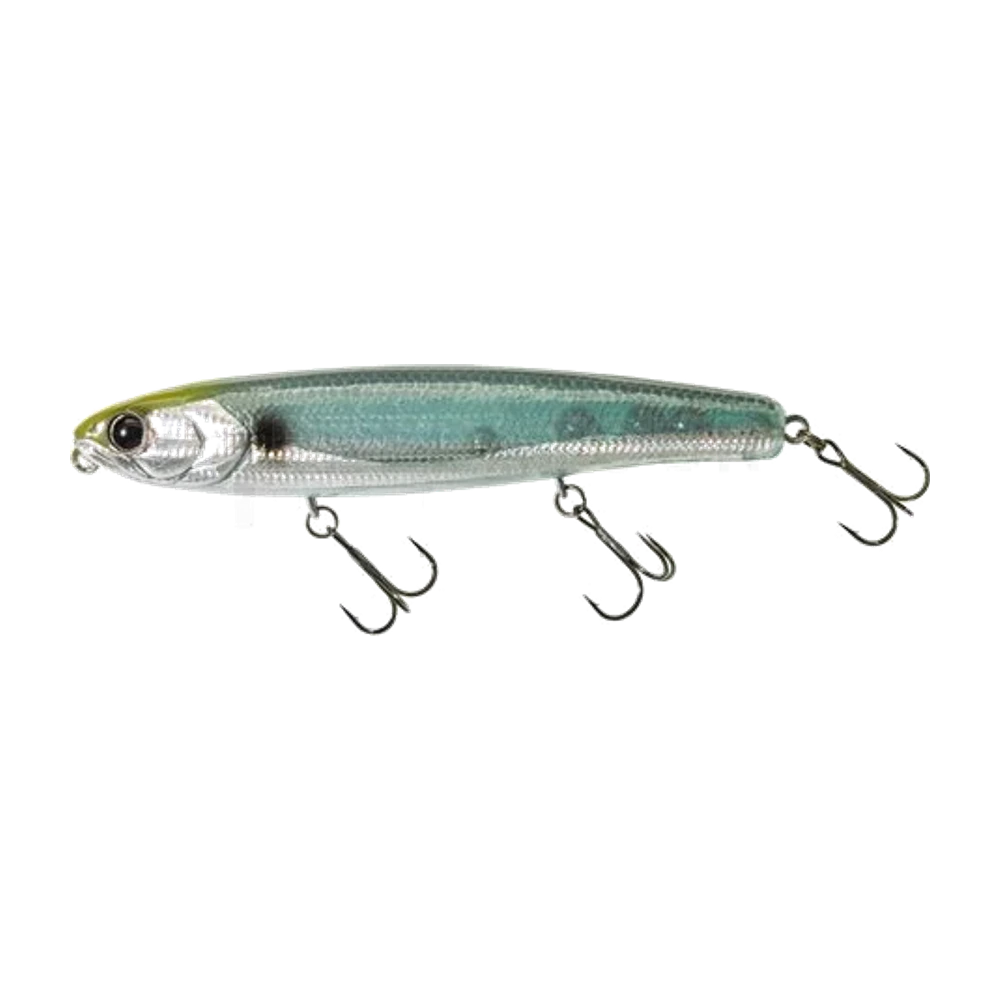
Illex Bonnie 128: walking the dog is a question of metronome
Rather not fish it blind? Photograph your spot — CarnaFish cross-checks the conditions and points you the right way.
Walking the dog has a bad reputation among beginners, and that is a misunderstanding. People believe it takes a precise, almost technical move with perfect amplitude. The result: they concentrate on the force of the twitch, pull too hard, and the lure shoots straight ahead, skipping instead of zigzagging.
The real secret is elsewhere. The zigzag does not depend on the power of the twitch, it depends on regularity. A stickbait like the Bonnie 128 behaves like a metronome: give it an impulse at a constant interval and it gives you back a constant glide. Break the rhythm and you break the zigzag.
This 12.8 cm lure is a good test bed for that. Its slim profile and its density make it glide easily, including when your cadence is not yet perfect, and it stays castable a long way, which counts as much on sea bass at sea as on a pike lake.
What separates a stickbait from a popper
A popper works by displacing water: noise, spray, a sound signal. A stickbait works by moving itself: no cupped mouth, no plop, just a silhouette sweeping the surface from left to right.
Three practical consequences.
- It covers far more ground. Where a popper stays almost on the spot, the zigzag advances on every impulse: you sweep a wide band of water on a single cast.
- It is more discreet, so better suited to fish that have already been worked over, to clear water and to calm surfaces.
- It is more visible from a distance, paradoxically, because the repeated lateral movement catches the eye even without noise.
On sea bass, that translates into vertical rising strikes, often spectacular. On pike, into long follows that get settled in the last few metres.
The cadence, move by move
- Cast long and close the bail, without taking up all the slack. You want to keep ten to fifteen centimetres of loose line.
- Rod pointed down, tip at forty-five degrees towards the water, almost off to the side.
- Give a small downward flick of the wrist, only five to ten centimetres of travel. That is short. Much shorter than what most people do.
- Take a quarter turn of the handle while the lure glides to one side.
- Start again immediately, at an identical interval. One flick, a quarter turn, one flick, a quarter turn.
The starting cadence: around two impulses per second. If the lure jumps out of the water, you are pulling too hard. If it comes back in a straight line, your line is too tight or your cadence is irregular.
On the water: when a fish misses the lure, change nothing and do not stop. Carry on with exactly the same cadence without speeding up. A stickbait that keeps going as if nothing happened gets taken again within two seconds far more often than a lure that stops dead.
Adapting the zigzag to the situation
| Condition | Cadence | Target amplitude |
|---|---|---|
| Glassy surface, wary fish | slow, 1 impulse/second | wide, 40 to 50 cm of sweep |
| Normal activity | 2 impulses/second | medium, 25 to 35 cm |
| Visible feeding | fast, 3 per second | tight, the lure races |
| Light chop | brisk, sharper flicks | tight, to stay readable |
The line plays its part too. Thick fluorocarbon sinks and pulls the nose down, which restricts the glide. On stickbaits, many anglers prefer fine braid with a short 0.35 to 0.50 mm fluorocarbon leader: the braid floats, transmits the impulse without stretch, and the zigzag becomes far crisper.
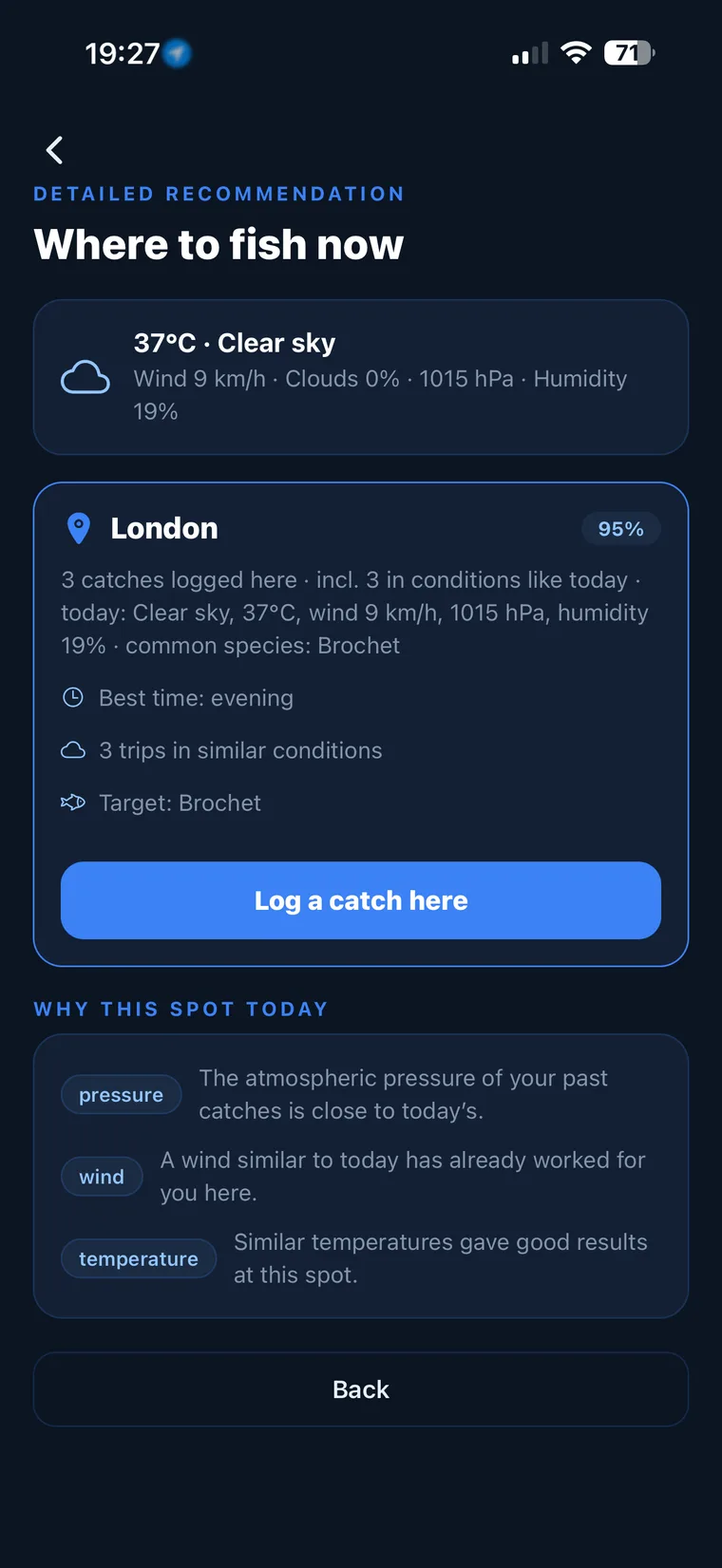
Not sure what to tie on?
Photograph your spot: CarnaFish reads the scene, cross-checks the conditions and gives you the zone, the lure and the retrieve. Free on iOS and Android.
The windows that count
Surface fishing is not an all-day affair. Three windows to favour.
First light, from the first glow to an hour afterwards. It is the most reliable window, at sea as in freshwater.
Dusk, often better still on sea bass, particularly on a rising tide flooding a shallow area.
Storm surfaces, that moment when the sky loads up and pressure drops. You cannot order it, but when it happens, that is the moment to drop everything and tie on a stickbait.
Conversely, it is no use in full midday sun on calm water, in water below 10 °C, or on fish clearly pinned to the bottom. A stickbait will not bring a fish up from five metres: it capitalises on a fish already in the upper layer.
Bonnie 128 or popper
A popper such as the Rebel Pop-R calls from a distance in noise and stained water: that is the right tool on rough water, or when you do not know where the fish is but want to make it react to sound.
The Bonnie takes the lead on calmer water and warier fish, and it covers far more surface per cast. Within the same family, the Lucky Craft Gunfish 115 mixes zigzag with a light spray, while the Heddon Zara Spook gives a wider, slower walk. For sea bass in open sea where maximum distance is needed, the Xorus Patchinko 140 remains the benchmark for range.
The simple logic: popper when you need noise, stickbait when you need movement. Our guide to lure fishing for sea bass details the tide windows. And if you are hesitating between surface and sub-surface when you reach the water, CarnaFish analyses a photo of the spot and answers.
Key takeaways
- The zigzag comes from the regularity of the cadence, not from the force of the twitch.
- Short flicks, five to ten centimetres, rod low and line slightly slack.
- Fine braid with a short fluoro leader gives a far crisper walk than heavy fluoro straight through.
- When a fish misses, change nothing and keep the same cadence.
- A lure for the changeover hours: useless at midday on calm water or in cold water.
FAQ
How do I make a stickbait zigzag?
Rod low, small wrist flicks of five to ten centimetres at a regular interval, with a quarter turn of the handle between each. If the lure jumps, you are pulling too hard; if it goes straight, your line is too tight or your cadence irregular.
Does the Bonnie 128 float or sink?
It is built to work strictly on the surface and does not dive during the retrieve. Depending on the version, it may sink very slowly on a long stop, which makes no difference as long as you keep the cadence going.
What line for a stickbait?
Fine braid with a 0.35 to 0.50 mm fluorocarbon leader about fifty centimetres long. Heavy fluorocarbon straight through sinks and pulls the lure's nose down, which noticeably restricts the zigzag.
Can it be used for pike?
Yes, with a wire leader or fluorocarbon of at least 0.60 mm. Pike often follow a stickbait a long way before attacking close in, so never lift the lure out of the water too early.
What time of day should I fish topwater?
First light and dusk mainly, plus periods of low cloud just before a storm. In full midday sun on calm water, surface fishing becomes very unproductive.
Should I pause during the walk?
Not systematically. The walk lives on its continuity. Introduce a one to two second pause only when you see a follow without an attack, then set off again on the same cadence.
The full sea bass lure guideSeason-by-season strategy: which family of lure, when, and why.Go from theory to fish
CarnaFish reads your spot from a photo and gives you the game plan: zone, lure, retrieve. Free on iOS and Android.