Evergreen Amazon Pencil: a 16 cm walking bait built for big predators
This lure shines under specific conditions. CarnaFish tells you in 10 seconds if today is one of them.
There is a moment in late summer when baitfish bunch up at the surface and big predators stop chasing single targets. A 10 cm walking bait slides straight through the ball without triggering a thing — it looks exactly like everything around it. The Evergreen Amazon Pencil attacks the problem from the other end: a 16 cm body, 42.5 g, and a deep knocking sound that travels far further than the silhouette can be seen. This is not a bait built for numbers.
What the spec table actually says
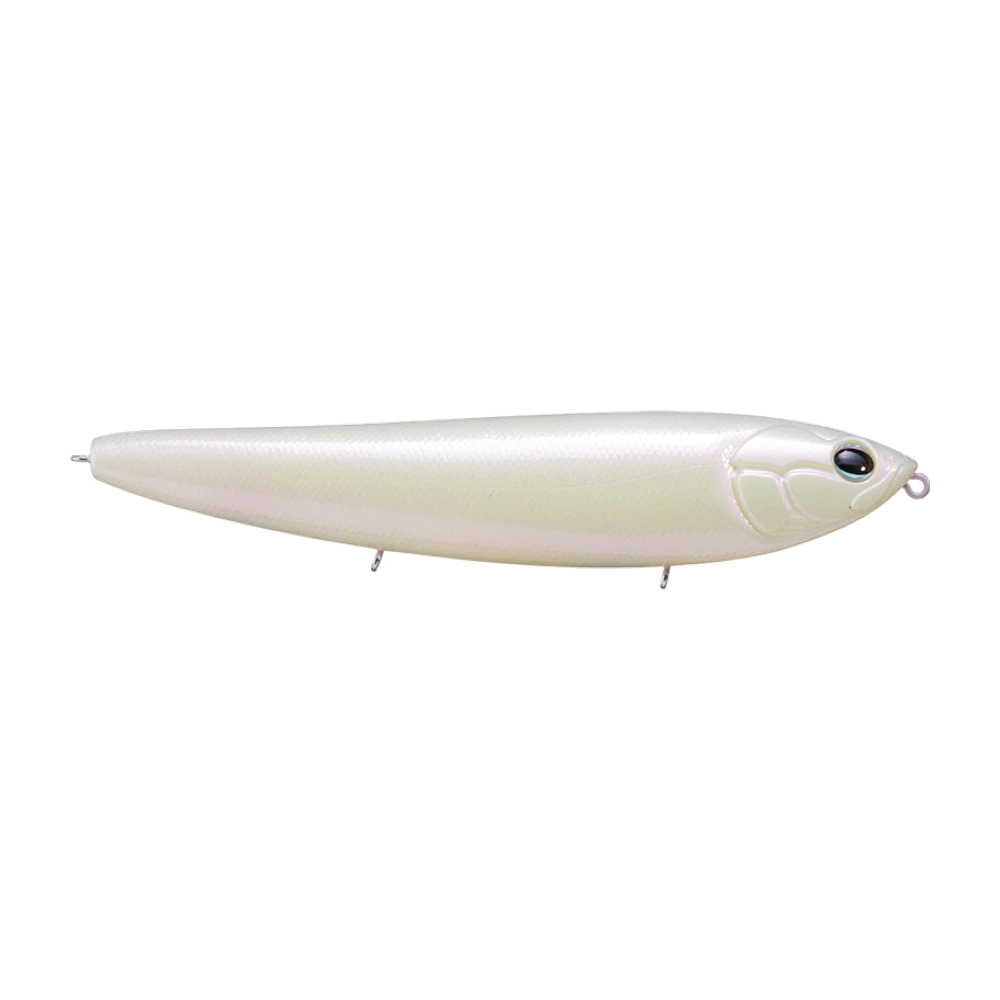
The manufacturer's table lists a single size, and that in itself is information: there is no compact version to fall back on. It reads 6.3 in, or 16 cm, for 1.5 oz, which converts to 42.5 g (1 oz = 28.35 g), class topwater, with hooks listed in size 1/0. The written description specifies three trebles, and the photo of the bare bait backs that up: two belly hook hangers and a tail eye.
Those 42.5 g over 16 cm make for a dense topwater bait — roughly 2.7 g per centimetre of body, where a standard bass walking bait sits nearer 1.2 to 1.5. In practice that means two things: the bait casts a very long way even into a headwind, and surface chop will not push it off line. The flip side is that it demands a rod that can take the load, and it forgives nothing in an undersized terminal setup.
A walking amplitude you have to learn to meter
Evergreen claims a wide-walking action, and the body shape backs it up: a flat belly over the rear half, pronounced shoulders, and a section that tapers towards the tail. A body that long sweeps a big angle on every rod stroke. On a fast, snappy cadence the bait never completes its arc and ends up skating sideways instead of zigzagging. On a slower, wider cadence — one downward rod stroke, half a turn of the handle, half a second of slack — it swings hard from one side to the other and leaves a trail of boils behind it.
That is a clear difference from a compact walker like the Megabass Dog-X, which accepts and even asks for a nervous retrieve. Here, the faster you go, the less amplitude you get. The cue is visual: if you cannot see the bait break cleanly off its axis on every stroke, you are going too fast.
Count rod strokes rather than reel turns. In this size class, a run of five or six zigzags followed by a dead stop of two seconds catches more fish than thirty metres of uninterrupted walking. A 16 cm bait sitting high and motionless is more than a following fish can stand.
The knock, the argument the photo cannot show
The description leans on a knocking sound meant to pull fish in from a distance. That is classic one-knocker logic: a single heavy ball tapping an internal wall, producing a low note that penetrates the water column far better than a rattle chamber full of small, high-pitched beads. It has a practical consequence: the bait works well in broken water, in chop, on a windy lake or along the coast, exactly where a silent bait gets overlooked.
The other side of the same coin is that a low note is still noise. On a small, clear spot fished all season it can push fish away. That is when you switch to a silent walking bait — which is precisely the slot filled by the Evergreen JT- Topwater Walking Bait, sold by the same maker and described as completely silent.
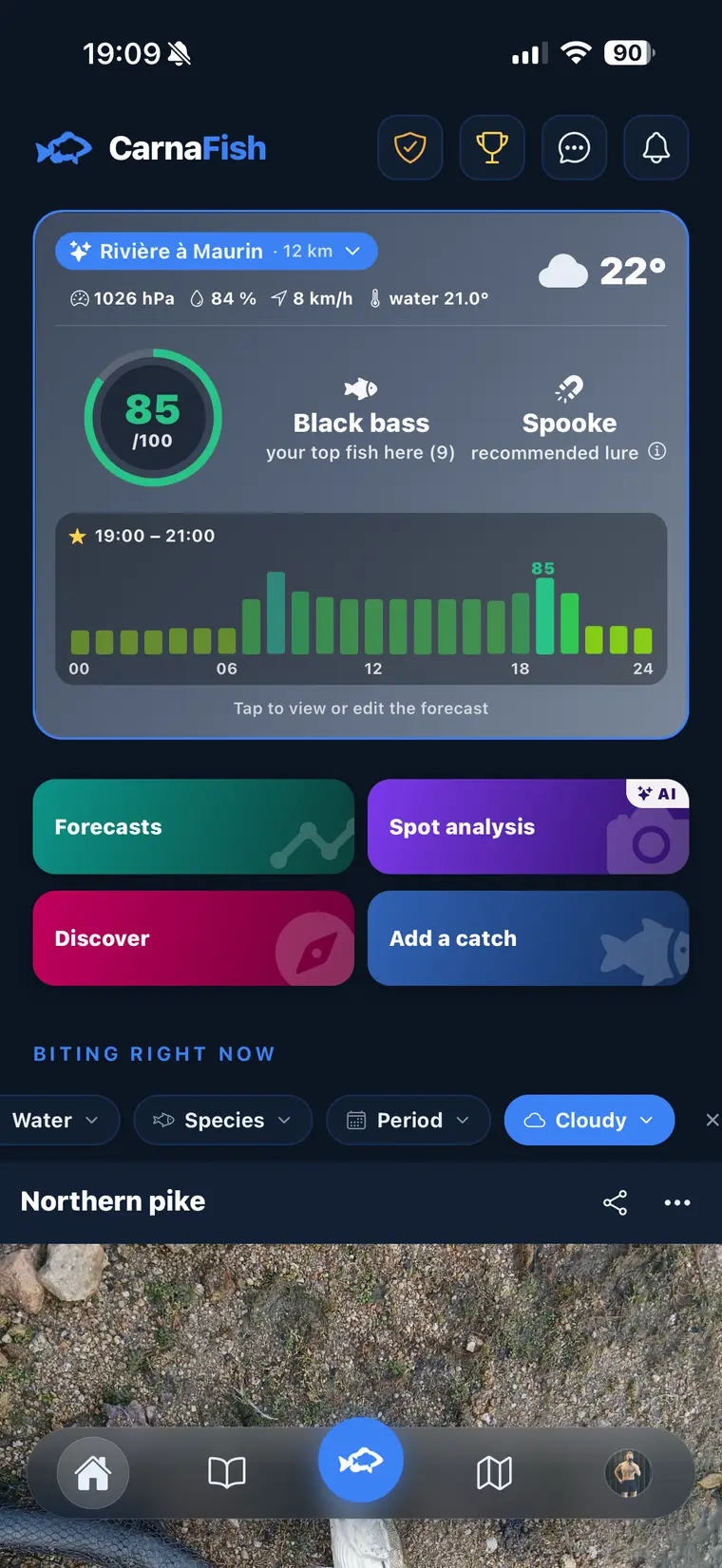
Not sure what to tie on?
Photograph your spot: CarnaFish reads the scene, cross-checks the conditions and gives you the zone, the lure and the retrieve. Free on iOS and Android.
Where and when to pull it out
The manufacturer claims both freshwater and saltwater use, and the mass and hardware make that credible. In Europe that translates into three concrete jobs. On a reservoir or a big lake, along the edge of a flat at dawn and dusk, to reach a big pike feeding on top. On a wide river in late summer, over slow seams where fry stack up. And along the coast, on a sea bass reef on a rising tide, where casting distance matters as much as the action.
It is not a bait for midday on a flat, heavily fished pond. It needs open water, fish looking up, and a surface that is not a mirror.
Tackle, because undersized gear ruins everything
A 2.10 to 2.30 m rod rated around 20-60 g is the minimum: throwing 42 g all morning on anything lighter wears out the blank and your technique at the same time. Braid in the 30 to 40 lb range, because walk-the-dog is transmitted through a line that does not stretch. A 50 to 60 lb fluorocarbon leader for bass and sea bass, and a wire leader the moment pike are possible on the spot: a bait at this price lost to a set of teeth ruins the morning.
One detail that matters: tie to a wide round split ring, or to a wide-gap snap. A knot cinched directly onto the nose eye restricts lateral movement and kills amplitude, exactly as it does on a lipped crankbait.
The classic mistake
Setting the hook on the sound. On a bait this size, the surface explosion often happens before the fish actually has the trebles in its mouth. Set on the noise and you rip the bait out of the strike zone. The right reaction is to carry the action one more beat, then set when you feel weight load the rod — not before. It feels wrong, and it is what separates follows from hooked fish.
Colours by water clarity
- Overcast skies, lightly stained water: pearl white, the finish in the photo, a clean silhouette with no aggressive flash that stays readable from below against a grey sky.
- Clear water and bright sun: a natural translucent finish, ayu or roach style, that lets light through and does not give the bait away to a wary fish.
- Dawn, dusk, dark water: solid black, which reads as a hard silhouette against the sky. That is the one moment colour genuinely matters on top, since the fish is looking into backlight.
Catalogue colour names vary by market and by series, but those three finish families cover most situations.
A topwater bait this assertive does not make up for misreading a spot: in the wrong place it just makes noise. That is where CarnaFish earns its keep: a photo of the spot, and the app suggests the zone, the depth and the lure family that fit the day's conditions. To place walking baits among the other options on a toothy spot, our guide on which lure to pick for pike runs through the families.
Key takeaways
- One listed size only: 16 cm / 6.3 in for 42.5 g / 1.5 oz, class topwater, three size 1/0 trebles.
- Walking amplitude comes from a slow, wide cadence, not from a nervous retrieve.
- The deep one-knocker note carries far in broken water but can work against you on a small, clear spot.
- Set on the weight you feel in the rod, never on the sound of the blow-up.
FAQ
Does the Amazon Pencil come in a smaller size?
No, the manufacturer lists a single version, 6.3 in for 1.5 oz. If you want the same kind of action in a format that is easier to cast all day, look at the Heddon Super Spook or a compact walker.
What rod do I need to throw 42.5 g all day?
A 2.10 to 2.30 m rod rated around 20-60 g, with an action soft enough to load on the cast. Anything lighter tires the blank and your shoulder, and casting distance collapses the moment the wind picks up.
Will this bait catch pike?
Yes, and in Europe that is one of its most logical uses: a big, noisy surface profile along a flat edge at first light. In that case a wire leader is mandatory — fluorocarbon, however heavy, is not enough.
Should I replace the stock trebles?
Evergreen lists size 1/0 hooks already sharpened. On a bait this heavy the question is less about the point than about resistance to opening: if you fish a spot holding big fish, move to reinforced trebles in the same size so the bait keeps its posture.
Why does my bait skate sideways instead of zigzagging?
Three causes, in this order: retrieve too fast, knot cinched directly onto the nose eye, leader too short and too stiff. Slow down first, then switch to a snap or a wide split ring.
Noisy or silent, which one should I pick?
Noisy when the water is broken, the lake large or the fish far off. Silent when the spot is small, clear and fished often: a muted walking bait like the Evergreen JT- Topwater Walking Bait then gets a much better reception.
The full bass lure guideSeason-by-season strategy: which family of lure, when, and why.Go from theory to fish
CarnaFish reads your spot from a photo and gives you the game plan: zone, lure, retrieve. Free on iOS and Android.