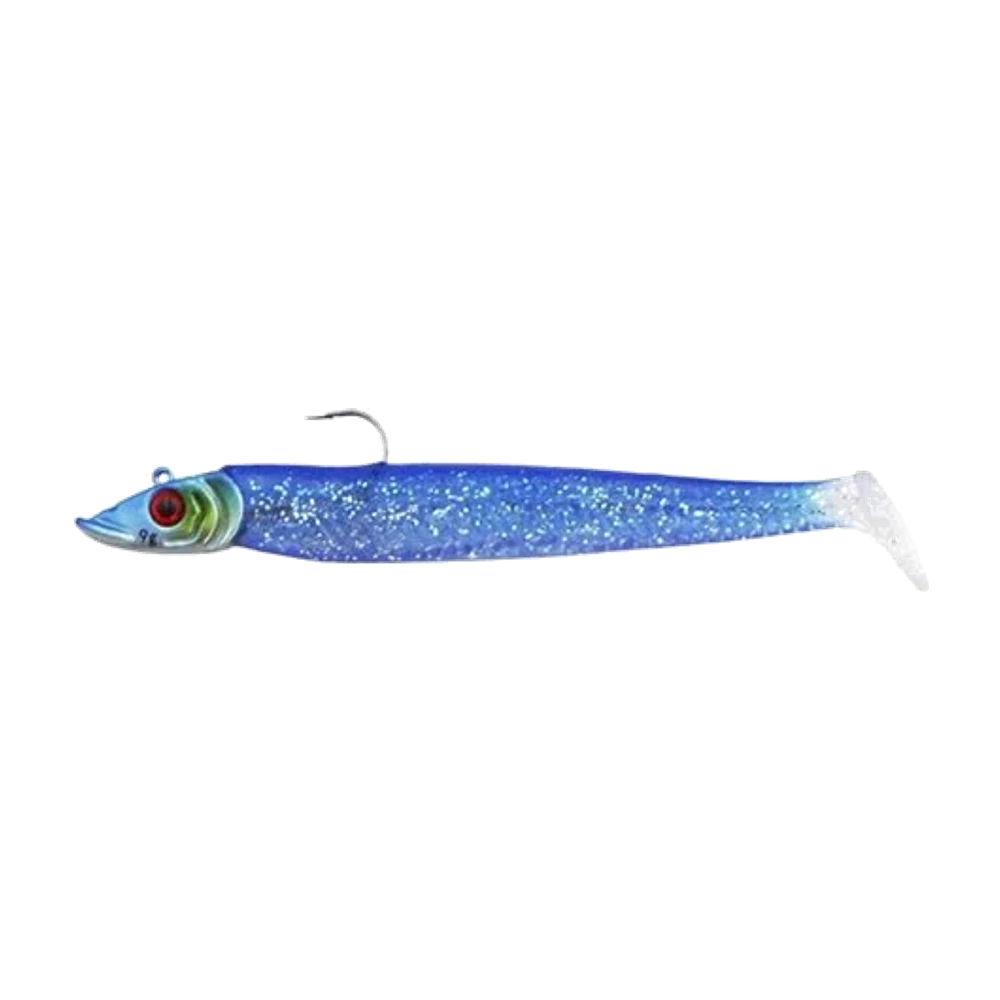
Flashmer Eel Tail: the margin sand eel, where sea bass run the sand
Rather not fish it blind? Photograph your spot — CarnaFish cross-checks the conditions and points you the right way.
A sand beach, two hours before high water, an offshore wind flattening the swell. The sea bass are there, but they are not out wide: they are running the margin in eighty centimetres of water, ten metres from your boots, using the wash to pick up whatever the waves shake loose from the sand.
In that situation, most sea bass lures are too heavy. A thirty-gram jig dives, scrapes and ploughs. A sand eel weighted at twenty-five grams hits bottom before you have made three turns. What you need is a lure that can swim ten centimetres above the sand, slowly, without ever getting buried in it.
The Eel Tail is a simple soft sand eel, designed to be rigged on a jig head and used as a consumable. It is not the most sophisticated lure in your box, and that is exactly what makes it useful where the others are too expensive to lose.
A sand eel that needs almost nothing to come alive
The body is long and slim, ending in a flat tail with no big paddle. That geometry has a direct consequence: the minimum working speed is very low.
- The tail quivers from the first few centimetres of pull. You do not need to retrieve fast to "start" the lure, unlike a broad-paddled shad that needs a minimum of flow to beat.
- The body stays true and does not turn sideways in the chop along the margin. On a beach where the water is constantly moving, a lure that spins loses all credibility.
- The silhouette is very slim. Head on it is almost invisible; in profile it is a long line. That is exactly what a sea bass sees when a sand eel goes past above the sand.
The downside: it is a plain soft body, with no frame and no through-wire system. It tears after a few fish, and a missed hit is sometimes enough to shift it on the head. That is not a manufacturing fault, it is the economics of the lure — you carry several, you replace, you carry on.
Choosing the head weight: the five-second rule
Head weight is not a cosmetic choice, it is the only depth control you have.
| Context | Jig head | Aim |
|---|---|---|
| Beach margin, 0.5 to 1 m, calm sea | 7 to 10 g | swim just under the surface of the wash |
| Beach or foreshore, 1 to 2 m, moderate chop | 10 to 15 g | occasional contact with the sand |
| Breakwater, channel, current or headwind | 15 to 20 g | hold the layer despite the flow |
The right setting is found on the water, not in the box: on a slow even retrieve, your jig head should touch the sand roughly every five seconds. If it drags constantly, you are too heavy. If you never feel it, you are too light and you are fishing above the fish.
On clean sand, a round head is enough. On a bottom mixed with pebbles, a slightly flattened head comes free better and snags less.
The retrieve, in five steps
- Cast at an angle to the bank, never straight out. You want the lure to run along the margin instead of crossing it in three seconds.
- Let it sink two to three seconds, no more, on a semi-tight line.
- Retrieve slow and even. No twitches: a sand eel is fished on a continuous swim, that is its strength.
- Pause for one second the moment you feel the sand. The lure noses down, the tail keeps quivering during the fall. That is the most productive moment of the retrieve.
- Fish it all the way in. Along a beach margin, sea bass often follow the lure into twenty centimetres of water. Do not lift the lure out: keep it swimming until it is a metre from your feet.
On the water: on a beach, do not fish out wide, fish the line where the waves break. The bass sit in the turbid band immediately behind the break, because that is where the sand releases its worms and crustaceans. One well-placed twenty-metre cast along that line is worth ten sixty-metre casts straight out, and you tire yourself three times less.
When the beach produces
The windows that count:
- The last two hours of the flood and the first hour of the ebb, when the water covers ground that was dry.
- Dawn and dusk, or the whole day under a low sky with a slightly stirred sea.
- After a blow, when the water has coloured up and the sand has been churned — the bass come in to feed.
And the moments not to persist: a flat calm under midday sun on a featureless beach, where the bass are simply somewhere else.
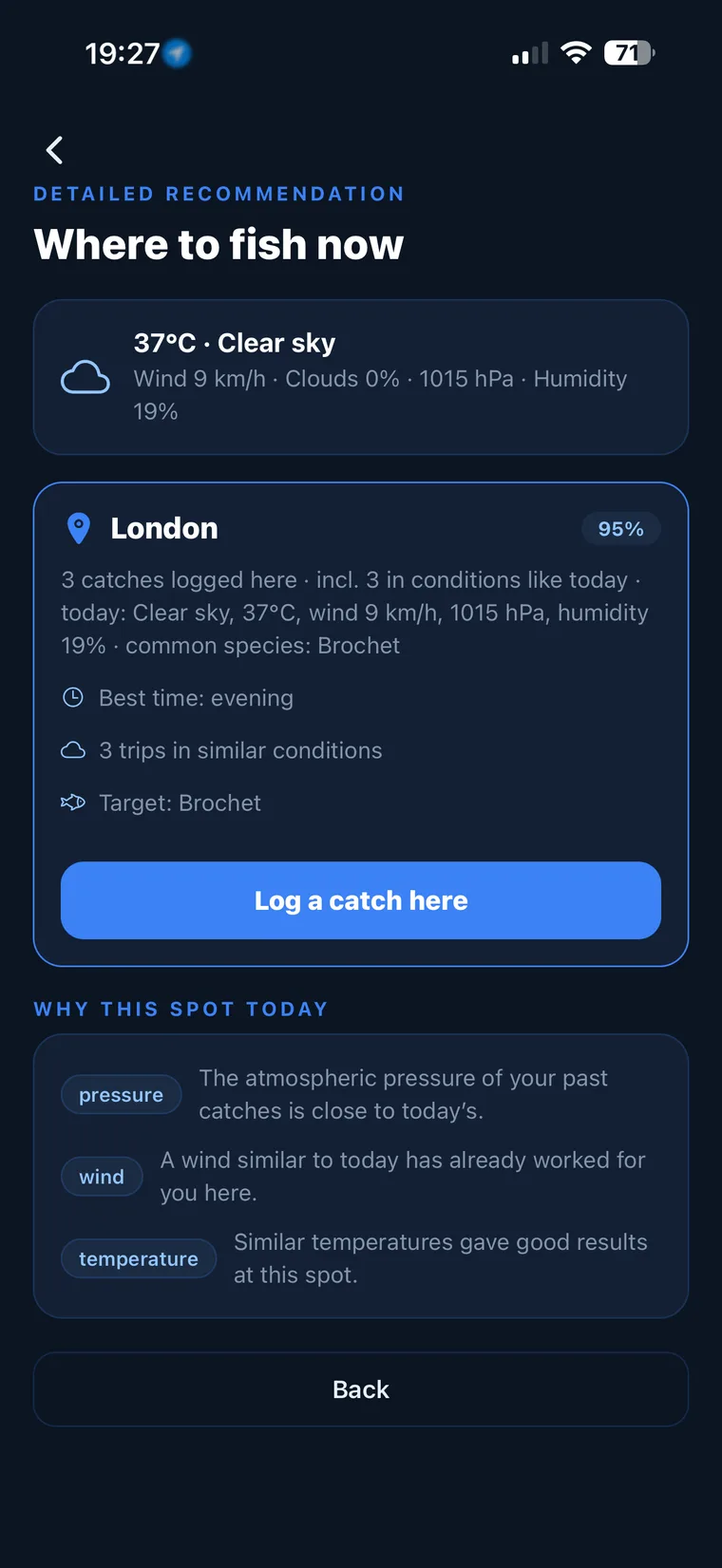
Not sure what to tie on?
Photograph your spot: CarnaFish reads the scene, cross-checks the conditions and gives you the zone, the lure and the retrieve. Free on iOS and Android.
Where the Eel Tail is outclassed
Be honest about its limits:
- Long-range fishing: it is a light body on a light head, it will never reach eighty metres into a headwind.
- Deep ground and moorings: beyond five or six metres you need a far denser lure.
- Fast surface feeding frenzies: it is neither castable enough nor fast enough to intercept a shoal on the move.
- Big hard-fighting bass near rock: the plain body tears and a jig head rig offers more leverage than a through-wire system.
Eel Tail or Crazy Sand Eel
The Fiiish Crazy Sand Eel answers a different question: it is built around interchangeable heads of various weights to intercept a feeding frenzy, hold in current or fish deep. It is a system, more versatile, more expensive, and cut out for fish you can see or are searching for out wide.
The Eel Tail is a margin and routine lure: less distance, less depth, but a unit cost that lets you fish a snaggy zone without holding back, and an action that lives at a speed where many sea bass lures do nothing at all. On a beach on the flood, it is very often the Eel Tail that stays on the end of the line all session.
For fights close to rock, the Savage Gear 3D Line Thru Sandeel and its through-wire rig keep a clear advantage on holding big fish. Our guide to sea bass fishing with lures covers reading the tides before you even choose a lure. And if you do not know which part of the beach to attack when you arrive, CarnaFish analyses a photo of the spot and answers.
Key takeaways
- A fine tail that quivers at very low speed: this is a lure for a slow continuous retrieve.
- Head weight is your only depth control. Aim for sand contact every five seconds or so.
- Fish the turbid band behind the break, not out wide.
- A disposable body: carry several and fish snaggy ground without fear.
- Outclassed at long range, in depth, and on big fish near rock.
FAQ
What jig head weight for the Eel Tail?
Between 7 and 10 g along a calm beach margin, 10 to 15 g in one to two metres with some chop, 15 to 20 g into a headwind or in current. The right weight is the one that makes you touch the sand roughly every five seconds on a slow retrieve.
Do you need a wire trace for sea bass?
No. Sea bass do not have cutting teeth like pike, so 0.26 to 0.30 mm fluorocarbon is enough and is far more discreet. Just check it for abrasion after each fish or each pass over rock.
How fast should you retrieve?
Slowly and evenly, just fast enough to feel the jig head brush the bottom from time to time. Twitches add nothing on a slim sand eel: its tail already works at very low speed, and it is the continuity that makes it believable.
When should you fish a beach margin?
The last two hours of the flood and the first of the ebb are the most productive windows, especially at dawn or dusk. A slightly stirred sea after a blow is also a very good time.
The body wears out fast, is that normal?
Yes, it is a plain soft body with no frame: it tears after a few fish or a few missed hits. That is the accepted trade-off with this type of lure, which stays cheap enough to replace without hesitating.
Can you fish it from a deep breakwater?
Down to about three metres going up to 20 g; beyond that it lacks density and sink rate. For a deep mooring or a rocky point, a much heavier jigging sand eel is more suitable.
The full sea bass lure guideSeason-by-season strategy: which family of lure, when, and why.Go from theory to fish
CarnaFish reads your spot from a photo and gives you the game plan: zone, lure, retrieve. Free on iOS and Android.