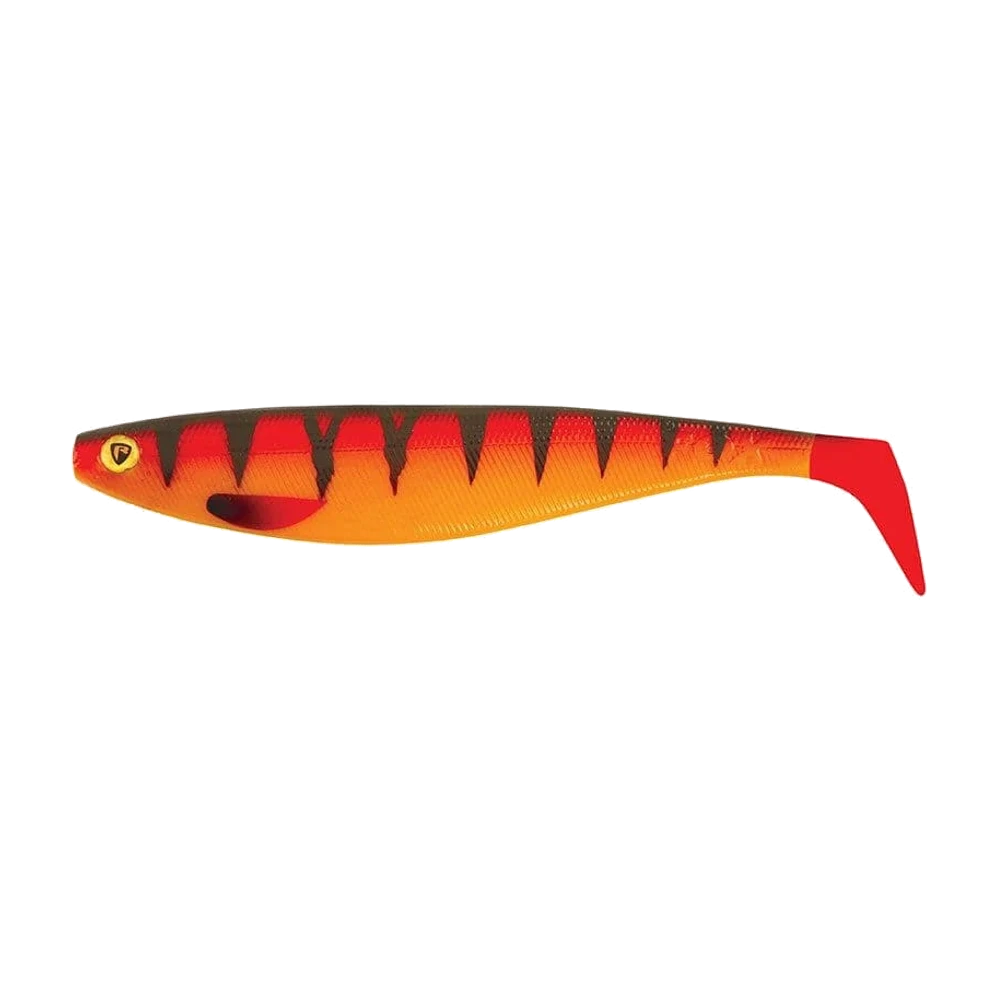
Fox Rage Pro Shad Firetails: the fluo tail that puts the bite in the right place
Not sure this lure fits YOUR spot today? CarnaFish tells you in 10 seconds, from a photo.
A zander attacking in stained water does not see your prey in full. It perceives a mass, a vibration, and a point of contrast. That point of contrast is what determines where it closes its mouth — and it also explains a good share of the bites that never turn into fish.
If the most visible point on your lure is the head, the fish attacks from the front and the head hook does its job. If it is the tail, the fish attacks from behind, closes on the paddle, and your head hook comes back without having caught anything. That is exactly what has happened when you wind in a shad with its tail bitten clean off.
The Pro Shad Firetails starts from that observation and owns it: it deliberately puts a bright aiming point on the tail, and it asks you to adapt your hooks accordingly. Rigged properly, it is not a lure that costs you hook-ups — it is a lure that tells you where the fish is going to strike.
A bulky body and a signal split in two
Two characteristics work in parallel.
A thick body with a strong vibration signature. The paddle is wide and the whole thing is chunky: on the retrieve the kick is broad, low-frequency, and readable several metres away through the lateral line. That is what lets a zander locate the lure in water where visibility is measured in tens of centimetres.
Colour contrast concentrated on the tail. Once the lure has been located by vibration, sight takes over for the last few centimetres. The fluo zone becomes the target, because it is the only element that stands out from a murky background.
That decoupling — vibration to attract from a distance, contrast to aim up close — is exactly the logic of a coloured-water lure. In very clear water, that same contrast becomes an artificial signal instead, and that is where the lure loses its point.
Hooks: this is where it is won or lost
Since you know the strike will often come from behind, rig for it.
- A jig head with a wide gap hook, with the point coming out high on the back. That is the base, but on its own it is not enough above 12 cm.
- A rear stinger as soon as you move up to the bigger sizes. A short stinger rig, positioned a third of the way up from the tail, catches the tail strikes without hindering the kick.
- Never hook the stinger into the paddle itself. You would kill the kick, and with it the vibration that brings the fish in. Hook it into the flank, just ahead of the tail wrist.
- Fine-wire hooks for zander, whose bony mouth needs clean penetration on sometimes long-range hooksets.
A zander hooked on a rear stinger is a zander you would not otherwise have had. On a session with plenty of bites and few fish, that is often half the result.
Head weight and working depths
| Lure size | Jig head | Target depth | Context |
|---|---|---|---|
| 10 cm | 7 to 12 g | 2 to 5 m | Big perch, zander in a pond, calm water |
| 14 cm | 12 to 20 g | 4 to 8 m | Zander in a river or big lake, light current |
| 18 cm | 20 to 45 g | 6 to 10 m | Big fish, vertical, marked current |
The minimum-weight rule still holds: take the lightest head that leaves you clear contact with the bottom. But on this lure specifically there is a nuance — its thick body offers strong water resistance, so it needs slightly more lead than a slim shad of the same length to achieve the same sink rate. Apply your usual weight mechanically and your lure will hang in the water three times too long and you will lose contact.
The retrieve: the pause is worth as much as the lift
- Let it sink to the bottom, line semi-tight, following with the rod tip.
- Two firm 40 to 60 cm rod lifts, taking up the slack immediately.
- Let it drop back while following it, rod tip at 45 degrees. Do not drop the line: it is during that controlled descent that the fish strikes.
- One to two seconds of rest on bottom contact, without moving.
- Start again, lengthening the rests in cold water and shortening them when the fish are active.
On the water: on a fluo-tailed shad, if you get bite after bite without hooking up, do not change lure and do not go heavier on the head. Check your paddle first when you wind in. If it is tooth-marked or shortened, you do not have a lure problem, you have a hook problem — rig a stinger and you will convert those same bites.
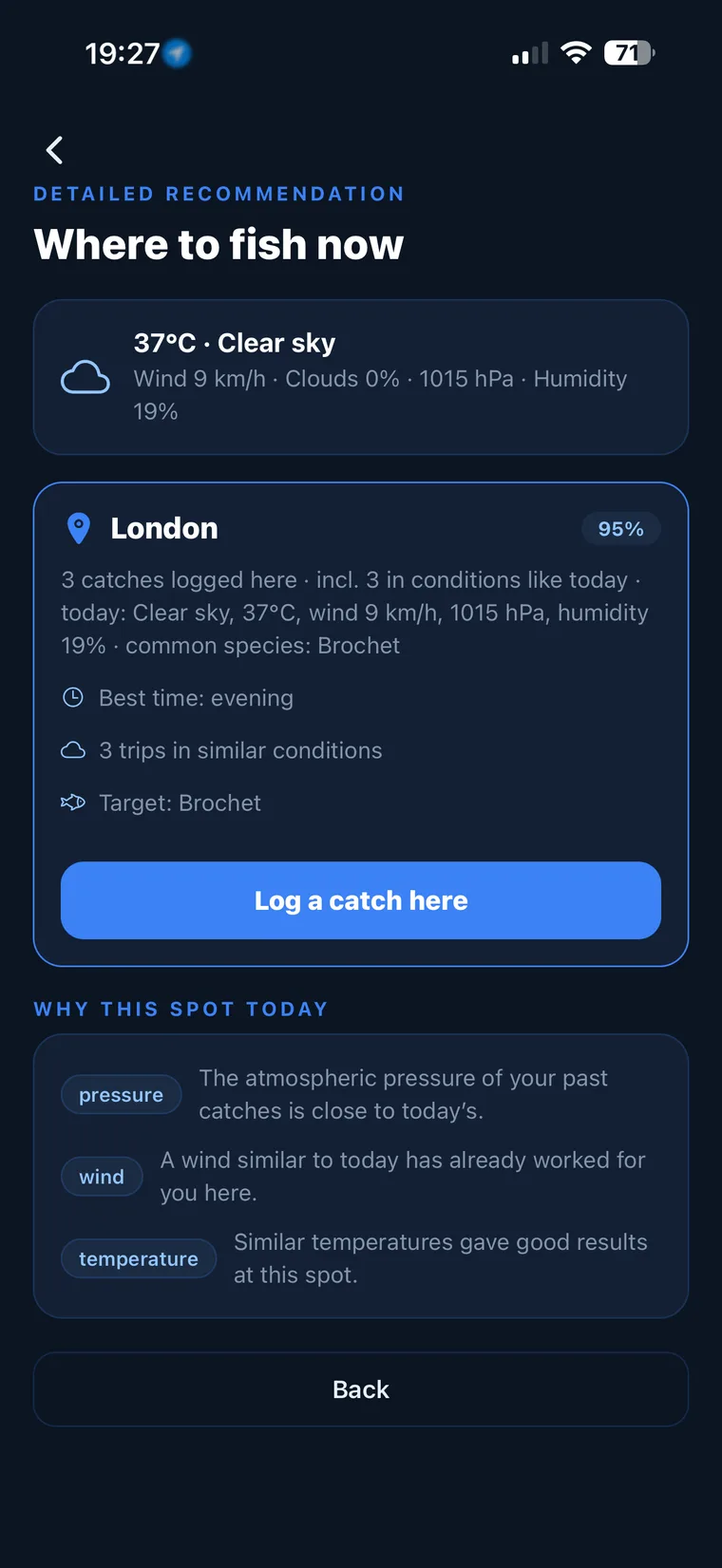
Not sure what to tie on?
Photograph your spot: CarnaFish reads the scene, cross-checks the conditions and gives you the zone, the lure and the retrieve. Free on iOS and Android.
Its ground, and where it disappoints
It is built for coloured water: a river dropping after a flood, a lake after a blow, a canal, a gravel pit after rain. It is also built for low light — dawn, dusk, heavy cloud — and for depths of four to ten metres where light no longer reaches.
It is a poor choice, on the other hand, in clear calm water on wary fish: the fluo contrast becomes an obvious artificial marker, and a lure in natural tones will go down far better. It is also wrong for ultra-finesse fishing — its bulk and water resistance demand a head weight incompatible with delicate work. Finally, on fish feeding on very small fry, the match is not there.
Pro Shad Firetails or Zander Pro Shad
The Fox Rage Zander Pro Shad is the zander-specific model in the same family: slimmer profile, less bulky body, smaller paddle. It vibrates less hard, sinks faster at equal head weight, and is more discreet. It is the right call in clear water, on pressured fish, and when you want a fast drop to fish efficiently on the vertical.
The Firetails takes the opposite line: more bulk, more vibration, a marked visual aiming point. You pull it out when the water colours up, when the light drops, or when you are looking for a bigger fish over a wide area.
At the other end of the scale — minimal signal, clear water, settled fish — a Keitech Shad Impact 3 inch does the exact opposite and rounds out the box nicely. Our beginner's guide to zander fishing with lures covers how to choose head weights for the current. And if you are torn between a contrasting shad and a natural one when you arrive at a spot, CarnaFish analyses a photo of the spot and answers.
Key takeaways
- Wide vibration to be located from a distance, fluo contrast to aim the strike up close.
- Frequent strikes from behind: rig a stinger from 12 cm up, hooked into the flank, never into the paddle.
- Thick body with high water resistance: it needs slightly more lead than a slim shad of the same length.
- Home ground: coloured water, low light, 4 to 10 m.
- Counter-productive in clear calm water on wary fish.
FAQ
What is the Pro Shad Firetails' fluo tail for?
It acts as a visual aiming point over the last few centimetres, once the fish has located the lure by vibration. In coloured water it is often the only element that stands out from the background, so it is what directs the strike.
Do I need a stinger with this lure?
Yes, from 12 cm upward. The contrast concentrated on the tail draws strikes from behind, and a head hook on its own lets a good share of those bites pass. Hook the stinger into the flank, never into the paddle.
What head weight should I choose?
7 to 12 g in 10 cm, 12 to 20 g in 14 cm, 20 to 45 g in 18 cm. Allow slightly heavier than with a slim shad of the same length: its thick body slows the drop and costs you bottom contact.
Does it work in clear water?
Much less well. The fluo contrast that makes it strong in coloured water becomes an artificial marker visible from a distance to wary fish. In clear water, prefer a slimmer shad in natural tones.
What is the difference with the Zander Pro Shad?
The Zander Pro Shad is slimmer, vibrates less and sinks faster at equal head weight: it is the model for clear water and fast vertical work. The Firetails brings more bulk, more vibration and an aiming point, for coloured water and low light.
Why does my paddle keep coming back bitten off?
Because the fish are striking from behind, drawn by the contrast. That is not a material fault but a sign of insufficient hooking: add a stinger positioned a third of the way up from the tail and those same bites will become fish.
The full zander lure guideSeason-by-season strategy: which family of lure, when, and why.Go from theory to fish
CarnaFish reads your spot from a photo and gives you the game plan: zone, lure, retrieve. Free on iOS and Android.