Savage Gear Craft Cannibal: the soft shad that buys you an extra second
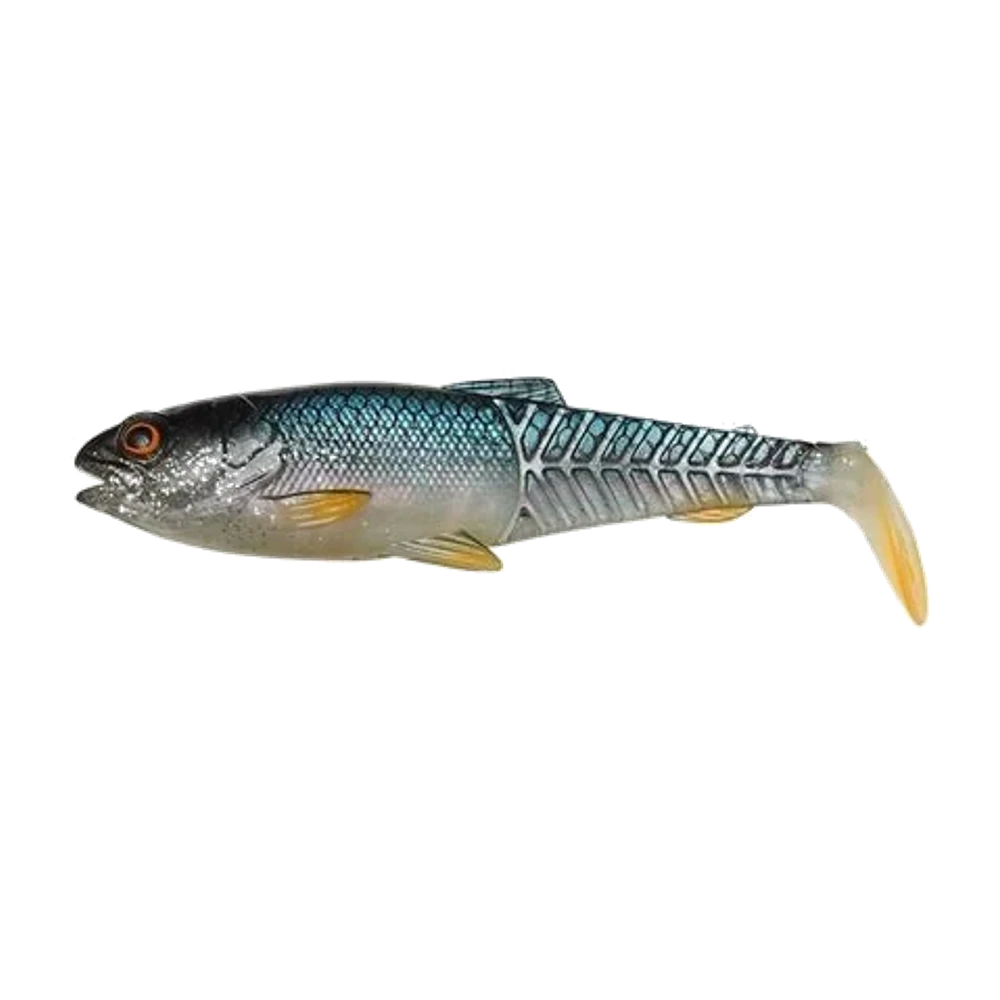
This lure shines under specific conditions. CarnaFish tells you in 10 seconds if today is one of them.
There is one statistic that annoys every perch and zander angler: the number of bites you feel that never turn into fish. The line tightens, you strike, and there is nothing there. Or worse: you wind in a lure with the tail torn off and a bare hook.
The explanation is nearly always the same. The fish grabbed the lure, felt something hard or lifeless, and spat it out before your hookset arrived. Between the bite and the rejection, sometimes less than half a second goes by. On a cold-water zander, which nips rather than swallows, that window closes faster still.
The Craft Cannibal plays on exactly that window. Its body is moulded in a distinctly softer material than average and ribbed along its whole length: when the fish clamps down, the lure compresses instead of resisting. The feel is closer to live prey, and the fish holds on longer. That extra second is often all that separates a missed bite from a fish in the net.
A body that compresses, a tail that starts from zero
Two mechanical features explain its behaviour.
The ribs on the body. They are not just there to create flashes. They reduce the cross-section of material between each ridge, giving the body far more crush than a smooth shad of the same diameter. A single hook also passes more easily through that pinched material, which improves penetration on the hookset.
A slim paddle tail well decoupled from the body. The wrist is narrow: it takes very little energy to set the beat going. In practice the tail is still working when you retrieve so slowly that you can barely feel the lure — and that is precisely the speed range that catches apathetic fish.
The downside is logical: that very soft material stands up poorly to teeth. On a session with pike or active zander, you will get through a few. That is a running cost to accept, not a design flaw.
Head weight, the only real setting
Everything hangs on it. The lure is identical; it is the weight at the front that decides the technique.
| Head weight | Depth / current | Behaviour wanted |
|---|---|---|
| 3 to 5 g | 1 to 3 m, calm water | Long gliding drop, perch in the margins |
| 5 to 7 g | 3 to 5 m, light current | Classic sawtooth, all-round |
| 7 to 10 g | 5 to 8 m or marked current | Clear bottom contact, zander |
| 10 to 12 g | Over 8 m, fast drift | Vertical and pulling from a boat |
The simple rule: take the lightest weight that still lets you feel the bottom. One gram too many and the drop becomes a vertical plunge, without the gliding phase during which the tail keeps beating — and that is almost always when the bite comes.
For the head shape, a plain round head works perfectly. For cluttered margins, a light Texas rig on a wide gap hook makes the lure snag-proof at the cost of a little sensitivity. And for very slow fishing on fish pinned to the bottom, the drop shot makes the most of that narrow wrist: the lure hangs in suspension and the tail quivers without you moving a thing.
The retrieve, and above all the hookset
- Cast and let it sink on a half-tight line, following the drop with the rod tip. Count the seconds: you are building your depth map.
- On bottom contact, give it a second of rest before moving. A lot of bites happen at that exact moment.
- Two short rod pulls, 30 to 50 cm of amplitude, then wind in the slack.
- Let it drop back while keeping contact, rod tip at 45 degrees. The falling phase is the biting phase.
- On the bite, do not strike within the second. Drop the rod tip slightly, let the fish take it properly for an instant, then set the hook sideways with a wide sweep.
On the water: with this lure specifically, a reflex hookset is counter-productive. The softness of the body means the fish feels no resistance, so it has no reason to spit immediately — you can afford to wait. Count "one" in your head before striking on a cold-water zander. You will lose two fish in a hundred and gain twenty.
For perch, the alternative that often works better than pulls is a very slow straight retrieve at mid-depth, just fast enough for the tail to beat. Over a shoal located on the sounder or by eye, it is deadly.
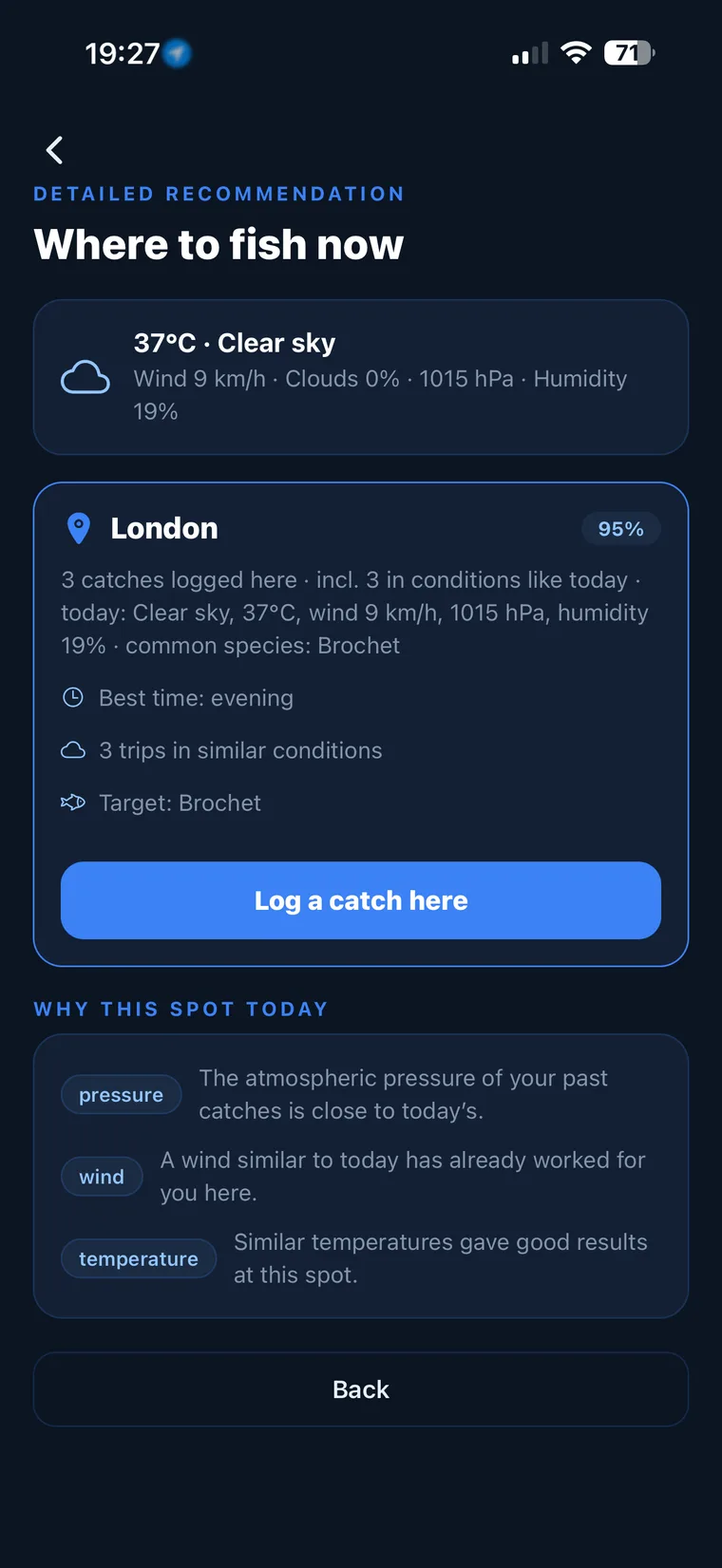
Not sure what to tie on?
Photograph your spot: CarnaFish reads the scene, cross-checks the conditions and gives you the zone, the lure and the retrieve. Free on iOS and Android.
Its windows and its limits
It excels when the fish are inactive but present: cold water in late autumn and winter, the day after a cold snap, bright sunny days when the perch are glued to the bottom. It is also a very good choice in clear water, where its slim silhouette and discreet swim get through better than a big shad with a strong vibration.
It is poorly suited in three cases. When searching large areas fast, where you need a lure that calls from a distance — a bulkier shad or a blade bait does that job. When pike are numerous, where its durability becomes a genuine economic problem. And in strong current over deep water, where the weight required completely crushes the tail's action.
Craft Cannibal or the classic Cannibal Shad
The Savage Gear Cannibal Shad is the historical model in the range, and the connection stops at the name. It has a thicker body, a firmer material and a wider tail: it vibrates harder, it carries further, it stands up to teeth far better and it is an excellent searching lure on active fish.
The Craft Cannibal goes the other way. Less vibration, more finesse, a tail that starts at almost zero speed, and above all that extended hold time. You take the Cannibal Shad to find the fish, and you switch to the Craft Cannibal once you have found them and they are not committed.
In the finesse register, a Keitech Shad Impact 3 inch offers a flatter profile still with a pintail, so a different signal to try on the same spots. Our beginner's guide to zander lure fishing covers speed ranges through the seasons. And if you are unsure which head weight to tie on at an unfamiliar spot, CarnaFish analyses a photo of the spot and answers.
Key takeaways
- A very soft ribbed body: it compresses on the bite and the fish holds on longer.
- A tail that starts at almost zero speed, ideal on apathetic fish.
- Choose the lightest head that still lets you feel the bottom.
- Delay the hookset slightly rather than striking on reflex.
- Not durable against teeth: keep it for perch and zander sessions.
FAQ
What jig head weight for the Craft Cannibal?
Between 3 and 12 g depending on depth and current. The right method is to take the lightest weight that still lets you feel bottom contact, so you keep a gliding drop during which the tail carries on beating.
Why am I missing bites with this lure?
Usually because you are striking too fast. Its softness means the fish feels no resistance and has no reason to spit immediately: give it a good half second before setting the hook sideways.
Which size should I choose between 6.5 and 10.5 cm?
The 6.5 cm for perch and difficult zander in clear water, the 8.5 cm as the all-round size, the 10.5 cm when you are after bigger fish or the water is stained and you need more volume.
Does it hold up to attacks?
No, that is its main weakness. The very soft material that makes it effective also makes it fragile against teeth, particularly pike. Bring several per session.
Can it be fished on a drop shot?
Yes, and it is a very good use. The narrow wrist makes the tail quiver without you having to work it at all, which suits fish pinned to the bottom in cold water perfectly.
When should I prefer a more conventional shad?
When you are searching a large area fast, when the water is stained and you need to call from a distance, or when the fish are genuinely active. A firmer shad vibrates more, casts better and lasts longer.
The full perch lure guideSeason-by-season strategy: which family of lure, when, and why.Go from theory to fish
CarnaFish reads your spot from a photo and gives you the game plan: zone, lure, retrieve. Free on iOS and Android.