Gambler Super Stinger 5.25: the big creature bait that trails bubbles
This lure shines under specific conditions. CarnaFish tells you in 10 seconds if today is one of them.
Thick cover is not fished like an open edge. In a weed mat or a pile of laydown timber you get one descent per hole: the bait drops, it triggers or it does not, and you pull it back out. Everything therefore hangs on those two or three seconds of fall. The Gambler Super Stinger is built around that window, and every detail of its mould contributes to it.
A point of vocabulary first
The description the maker publishes refers to the bait as the Stinger 5.25 in, while the product is listed on the shelf as the Super Stinger 5.25. These are not two different baits: it is the same one, with the name drifting between the spec sheet and the label. Worth knowing before you go hunting for a Super Stinger that appears nowhere in the documentation.
The description also states that this is an upsized version of the original Stinger, carrying the same features in a larger package. The length of 5.25 in, which is 13.3 cm, is the only published dimension: unlike most of the brand's other references, this bait has no spec table at all. No individual weight, no pack quantity, no density class. I am not going to invent them, so expect to weigh one yourself if that figure matters for your rig.
The chevron body: air and bubbles
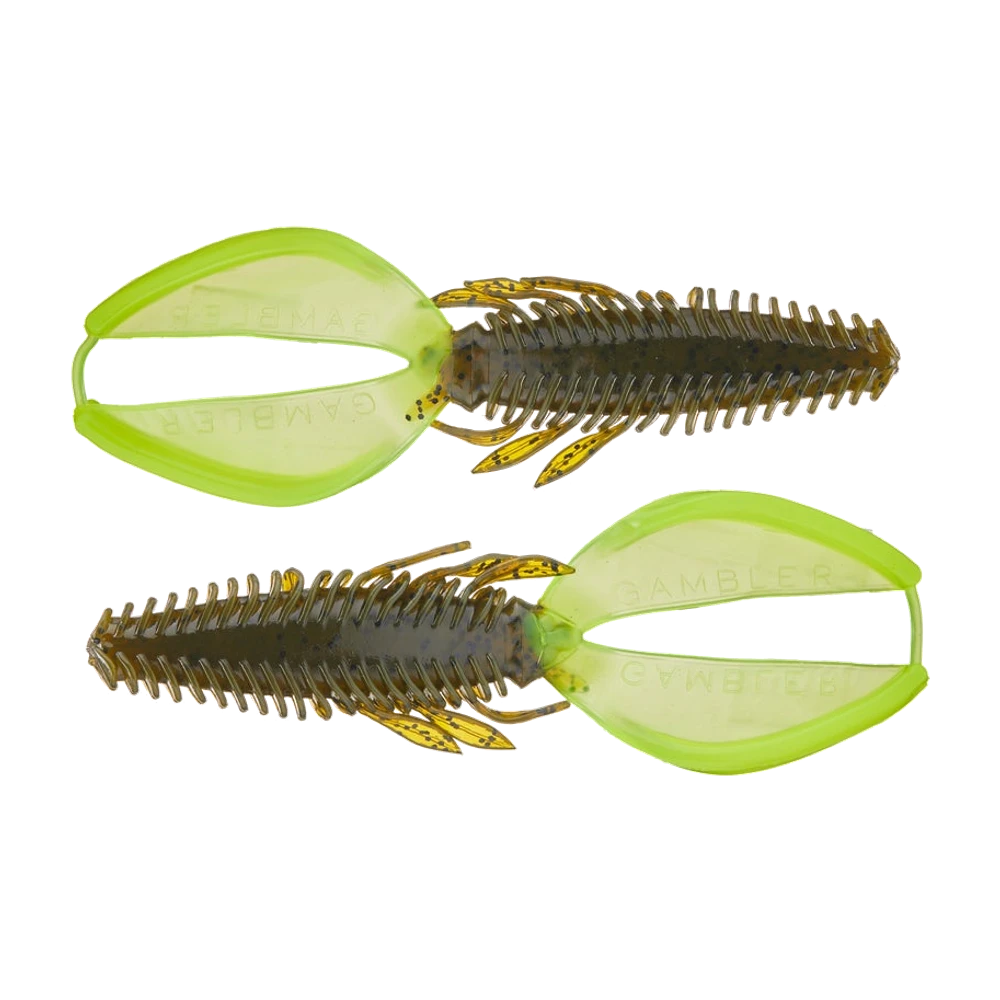
The maker describes a house signature, a chevron body design with heavy ribbing. In the photo you can indeed see the ridges running in rows along the body, edged with ranks of fine legs. That bulky profile has one consequence Gambler puts forward and which you cannot guess from a peg hook: the bait catches air as it falls and leaves a string of bubbles behind it.
That is a rare and underrated signal. A fish sitting under a weed mat in dark water sees very little above it. A column of micro-bubbles rising along the line of the fall acts as a vertical beacon, detectable even without direct line of sight. It is also why you should let the fall happen without tightening the line: a bait braked by the line drops less straight and releases less air.
The volume comes at a cost, and it should be said: this body churns, so it slows the descent and demands a heavier weight than a slim creature bait to penetrate the same cover. Figure a tungsten bullet weight of 10 to 24 g depending on how thick the mat is, and accept that in genuinely smothering vegetation a more compact profile will punch through better.
The claws, deliberately thinned
The two large flat claws visible in the photo are, according to the maker, a thinned-down version of the Flappy Daddy and Mega Daddy claws, two other baits in the range. The intent is clear: a thinner claw flexes under less pressure.
The concrete consequence, as the maker states, is a more subtle swimming action on the fall. This is not a claw that claps and beats like the pincer of an aggressive craw; it is a claw that undulates and quivers under its own weight during the descent, without you having to work it. On pressured fish or in cold water that difference matters: the bait stays alive without being aggressive.
The flat back, which is not a small detail
The maker states that the back of the bait is deliberately flat and unribbed, to leave more plastic around the hook. That is the answer to a problem every flipping angler knows: the heavy-wire hook that sinks into the plastic after three casts and eventually works its way out on its own. More plastic thickness under the shank means a bait that stays put longer and a hookset that goes where it should. It is also, the maker says, a gain in durability.
Get into the habit of burying the hook in the flat face, not in a ribbed flank. People do it the wrong way round without thinking when they rig in a hurry in the boat, and you lose exactly what the mould was drawn to give you: hook retention.
Three rigs
Flipping and pitching
This is the stated priority. Tungsten bullet weight, pegged or free depending on how thick the cover is, a heavy-wire flipping hook in 4/0 or 5/0, braid from 30 to 40 lb. You drop the bait into the hole, let it fall on a controlled line, count two or three seconds, and pull out if nothing happens. The bite is often just the line stopping.
Jig trailer
The second stated use. Behind a weed-guard jig or a football jig, the Super Stinger adds serious volume and a gliding behaviour on the fall. Watch the balance: a 10 g jig behind a 13.3 cm creature goes slow and soft. Run it behind a Strike King Tungsten Football Jig of 14 g or more to keep contact.
Carolina rig
The third stated use, and the most under-used in Europe. The bait runs free behind a heavy weight on a 50 to 100 cm leader: the lead stays on the bottom, the creature planes above it, and the thin claws work on every stop. It is slow searching work over hard bottom and flats, the opposite of flipping but with the same bait.
The classic mistake
Working it. The reflex, when nothing is happening, is to pull, shake and bring the bait to life. On this model the life is in the fall; animating it mid-descent kills the bubbles, stiffens the claws and turns a creature that planes into a piece of plastic being dragged. Cast, let it drop, wait. If nothing comes, cast somewhere else rather than insisting with the rod.
Not sure what to tie on?
Photograph your spot: CarnaFish reads the scene, cross-checks the conditions and gives you the zone, the lure and the retrieve. Free on iOS and Android.
Colours by environment
- Green weed and lightly stained water: the green pumpkin with black flake and chartreuse claws from the photo, a flipping classic where the claws provide an aiming point without betraying the silhouette.
- Coloured water or fishing under mats: a dark flaked tone, read as a silhouette from below.
- Hard bottom with crayfish present: a natural craw brown, worth favouring on a Carolina rig over rocky flats.
What it adds alongside other creatures
Against a Missile Baits D-Bomb, the Super Stinger plays the volume and bubble card rather than the penetration card. Against a Reaction Innovations Sweet Beaver, which is more compact and easier to push through smothering cover, it offers a slower and more demonstrative fall. The choice comes down to how thick the cover is: the denser it gets, the more a slim profile takes the advantage.
A perfect fall into the wrong hole catches nothing, which is exactly what CarnaFish is meant to spare you: a photo of the spot, and the AI suggests the water, the depth and the type of presentation that fit the day. Since flipping calls for a very specific rod and braid, our guide to predator tackle by budget will help you aim right without overpaying.
Key takeaways
- The maker's description calls this bait the Stinger 5.25 while it sells as the Super Stinger 5.25: it is the same product.
- The only published dimension is 13.3 cm. No weight, no pack quantity and no density class is given.
- The chevron body catches air and leaves a bubble trail during the fall: that is the bait's main signal.
- The flat unribbed back exists to hold a heavy flipping hook in place; always bury the point on that side.
FAQ
How much does the Gambler Super Stinger 5.25 weigh?
The maker publishes no weight for this model, and there is no spec table either: only the length of 5.25 in, which is 13.3 cm, is stated. If the bare bait's weight matters for your rig, you will have to weigh one.
How many baits are in a pack?
The quantity does not appear in the technical description, unlike other references from the brand where that figure is given. Best to check the packaging at the point of purchase.
Why is it called both Stinger and Super Stinger?
The technical description uses the name Stinger 5.25, the retail label Super Stinger 5.25. It is the same bait, with the name drifting between the two sources.
Which hook for flipping?
A heavy-wire flipping hook in 4/0 or 5/0, buried in the flat face of the back. That is exactly what the unribbed area is meant to allow: keeping the shank well seated in the plastic cast after cast.
Should I work it during the fall?
No, and that is the mistake to avoid. The bubbles released by the chevrons and the undulation of the thinned claws happen on their own during a free descent. Pulling on the line stiffens the whole thing and kills both signals.
Does it work as a jig trailer?
Yes, the maker lists it explicitly, alongside the Carolina rig. Just make sure not to put it behind too light a jig: a 13.3 cm creature needs at least 14 g in front to keep a clean descent and bottom contact.
The full bass lure guideSeason-by-season strategy: which family of lure, when, and why.Go from theory to fish
CarnaFish reads your spot from a photo and gives you the game plan: zone, lure, retrieve. Free on iOS and Android.