Gan Craft DANGOKU Frog: the slim frog that walks hard and takes add-ons
Not sure this lure fits YOUR spot today? CarnaFish tells you in 10 seconds, from a photo.
A tree down in two metres of water, branches half submerged, and bass rising under the canopy. A wide conventional frog wedges itself between two limbs by the second cast. That is exactly the water Gan Craft drew the DANGOKU Frog for: a long, narrow body meant to thread into wood, vegetation and heavy cover where bigger baits simply will not go.
A long, slim profile, against the grain of the classic frog
Most hollow-body frogs are wide and stocky, because width helps them sit on a mat of pads. Gan Craft goes the other way with a slender silhouette, almost fish-shaped seen from above. It is a deliberate choice for attacking wood and dense cover: less surface to catch on, and a sharper angle when the lure bumps a branch.
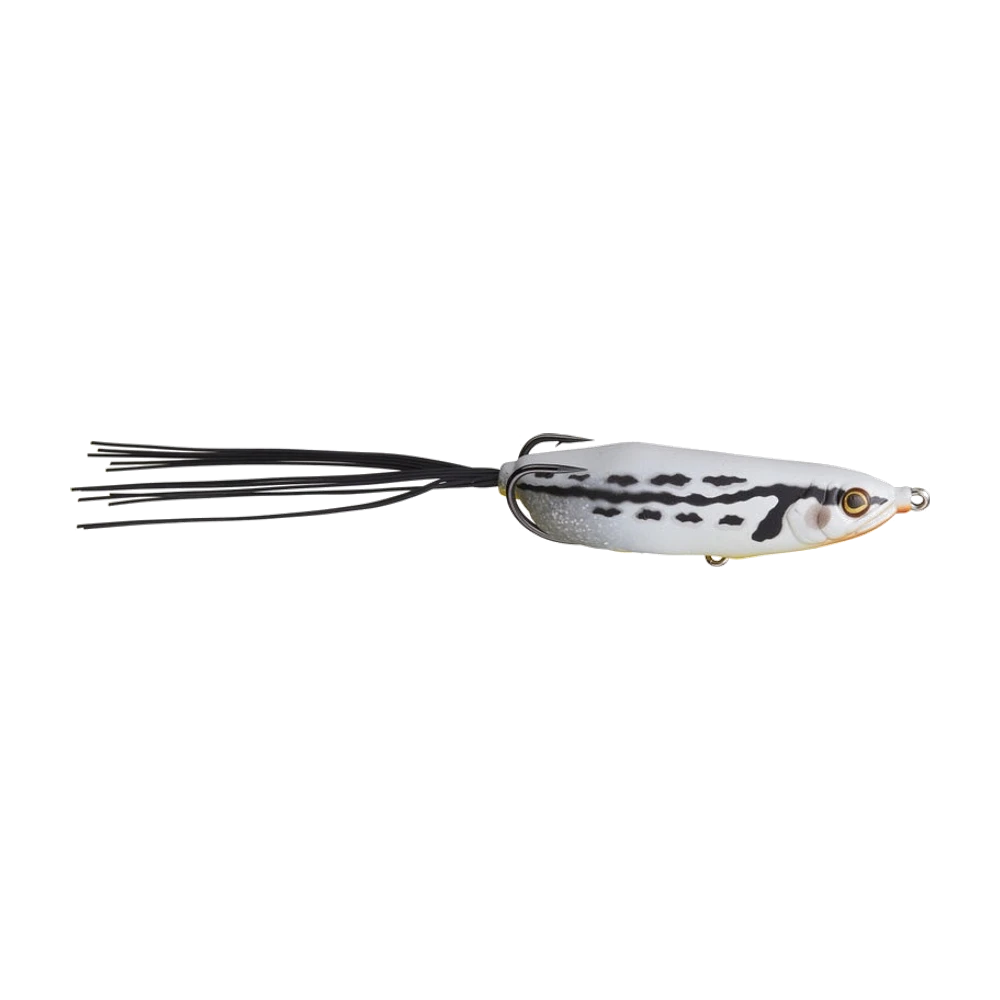
The back is not flat. It carries a bulge that rises above the hook points and deflects obstacles before they ever reach the hook — that bulge does most of the weedless work, more than the softness of the body does. At the same time Gan Craft left a slight gap between the hook and the body instead of burying the points against the back. The logic is simple: less material to collapse on the hookset, so cleaner penetration. In the photo you can clearly see the two gold points sitting just clear of the plastic.
The maker also stresses a very soft body and razor-sharp points, and those two go together: a stiff body with average points is the combination that produces dropped fish on a frog.
17.7 g for 6.6 cm: what that implies
Gan Craft's table lists 2.6 in, or 6.6 cm, at 5/8 oz, or 17.7 g, in the Topwater class. Take a moment to set those two numbers side by side, because they explain almost everything the lure does.
17.7 g on a 6.6 cm body is very dense for a frog — clearly more than a Gambler Walking Frog, which weighs 12.4 g at a comparable length. The immediate consequence: the DANGOKU casts like a bullet, including at a plate-sized hole in the weeds twenty metres out, and it settles low in the film. A frog that sits in the water rather than on it has more purchase to pivot, and that is what produces such a clean walk.
There is a trade-off. On a very thin duckweed skim or barely flooded grass, that density makes it punch through instead of sliding. This is not the floating-mat frog: it is the frog for wood, dense edges and open water.
The belly eyelet, the real distinguishing feature
This is the detail that sets the model apart from almost every frog on the market. Under the belly sits a free eyelet — clearly visible in the photo — waiting for you to decide what to do with it. Gan Craft suggests two options, and they serve completely different kinds of fishing.
A treble underneath, for open water
A split ring and a small treble turn the DANGOKU into a conventional topwater lure, with a markedly better conversion rate on soft strikes. That is the rig to adopt the moment you leave cover: over a clean flat or a tidy edge, weedlessness buys you nothing and misses cost a lot.
A swivel and a blade, for flash
The other option is to hang a swivel with a small blade under the body. You are then adding two signals the frog does not have on its own: a metallic flash below the surface, and extra water displacement. It changes the lure's category — it becomes a sort of quiet surface buzzer, useful in lightly stained water or when fish follow without committing.
Keep the lure bare while you are in cover, and change the hardware when you change water, not when you change your mind. The belly treble cancels the weedless design: fit it on the first cast into wood and you will spend the day unhooking your frog instead of fishing.
Working the walk
The DANGOKU is built for the walk-the-dog, and it does it sharply: short wrist snaps, rod tip low towards the water, a little slack between strokes. Gan Craft describes a steady head movement sending waves across the surface — it is that wake, more than the width of the zigzag, that brings fish from a distance.
The silicone skirt at the back does nothing during the walk; it works during the pauses. When the lure stops, the strands keep opening and closing for two to three seconds. That is the window when strikes most often come, and it is why you should never string bursts together without stopping.
The classic mistake
Working it too hard. The temptation with a lure this dense is to give it wide strokes to "make it work". The result: it skates sideways, loses its rhythm and ploughs instead of walking. A well-worked DANGOKU barely seems to move — the head swings maybe ten centimetres each way — but it does it on every stroke, without missing a pivot. If you see the lure sliding in a straight line, the cadence is not the problem, line tension is.
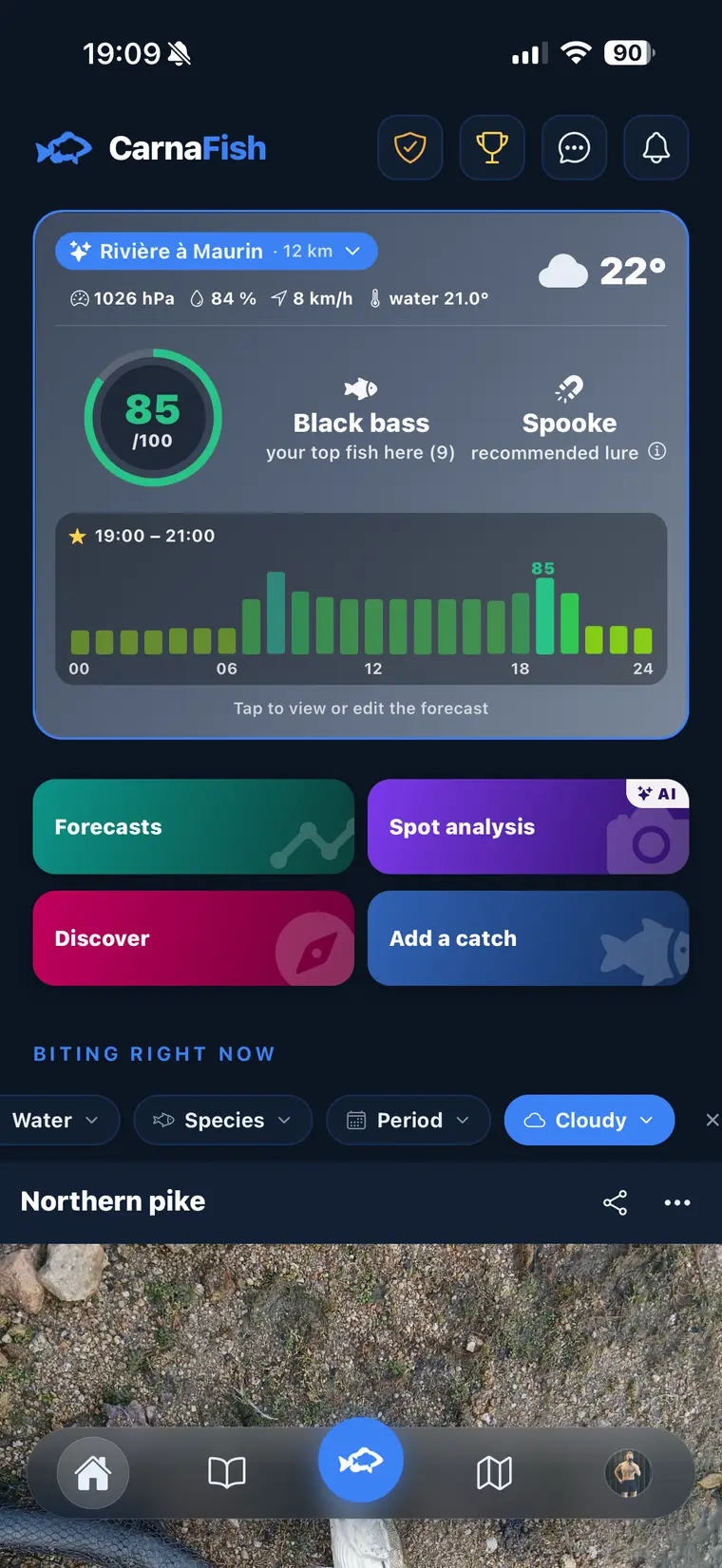
Not sure what to tie on?
Photograph your spot: CarnaFish reads the scene, cross-checks the conditions and gives you the zone, the lure and the retrieve. Free on iOS and Android.
Colours by light
- Bright light, clear to lightly stained water: the pale black-marbled finish photographed here. Seen from below it keeps clean contrast without being loud, and its pale belly reads as either a frog or a struggling baitfish.
- Low skies, dark water, dawn and dusk: solid black, which bets on nothing but the backlit silhouette.
- Clear water and pressured fish: a natural green back over a pale belly, for a quiet pass over water that already gets fished.
A Japanese frog at a Japanese price
At around 22 dollars apiece, the DANGOKU Frog costs nearly twice what a common American frog does. The question is not whether it fishes twice as well — it does not — but whether it solves a problem the others leave open. On two counts, it does: penetration into dead wood thanks to the narrow profile, and the modularity of the belly eyelet. If you mostly fish open pad fields, a SPRO Bronzeye Frog or a Deps Slither-K will do the job for less. If your water is full of branches, the gap is justified. And when the surface shuts down, a slow pass on the bottom with a Gary Yamamoto Covert Craw is the logical follow-up on the same spots.
Knowing which laydown is worth attacking matters at least as much as the choice of frog. That is precisely what CarnaFish does: one photo of the spot, and the AI suggests the zone, the depth and the kind of presentation that suit the conditions. To build your spot-reading before you get to the water, our guide to reading a fishing spot lays out the method.
Key takeaways
- A long, narrow body with a humped back that deflects obstacles: built for dead wood and heavy cover, not for a light floating mat.
- 17.7 g for 6.6 cm: very dense, hence long casts, a low stance and a decisive walk.
- The belly eyelet takes a treble for open water or a bladed swivel for flash — two different presentations from one lure.
- Work it short and sharp, and always let the skirt breathe for two to three seconds on the stop.
FAQ
What size is the DANGOKU Frog exactly?
Gan Craft lists 2.6 in, or 6.6 cm, at 5/8 oz, meaning 17.7 g, in the Topwater class. The length figure does not include the silicone skirt, which adds several centimetres to the silhouette the fish sees.
What is the eyelet under the belly for?
Customising the lure. A split ring plus a treble clearly improves the conversion rate in open water; a swivel with a small blade adds flash and water displacement. Both rigs, however, remove the weedless character.
Will this frog go through dense lily pads?
It will, thanks to the humped back that deflects stems, but that is not its home water. Its density makes it sink into very light floating vegetation: it is far more at ease in dead wood, cluttered edges and open water.
Why aren't the points buried against the body?
That is deliberate. Gan Craft leaves a slight gap between the hook and the back so there is less material to drive through on the hookset. Combined with a very soft body, it improves penetration without giving up passage through cover.
Do you need braid with this lure?
Yes, as with every hollow-body frog. Braid of 40 to 50 lb tied straight to the nose eye, with no fluorocarbon leader to stretch and absorb the hookset, and a rod with enough power to lift the fish straight out of cover.
Is the high price justified?
Only if your water demands it. The narrow profile and the belly eyelet solve two specific problems — dead wood and modularity. Over ordinary pad fields, an American frog at half the price will do the same work.
The full bass lure guideSeason-by-season strategy: which family of lure, when, and why.Go from theory to fish
CarnaFish reads your spot from a photo and gives you the game plan: zone, lure, retrieve. Free on iOS and Android.