Gary Yamamoto Slinko Floater: the ribbed worm that stands its tail up
Rather not fish it blind? Photograph your spot — CarnaFish cross-checks the conditions and points you the right way.
Some days the bass glue themselves to the bottom and stop moving altogether. You drop a regular stick worm, it sinks, it lies down in the silt, and it vanishes from the fish's field of view. That is exactly the situation the Slinko Floater is built to flip around: instead of flattening out on the substrate, it stands up, tail in the air, in the eight inches of water the bass is actually looking at. And it gets there with a detail very few soft plastics offer — a trail of bubbles.
Ribs that do more than add texture
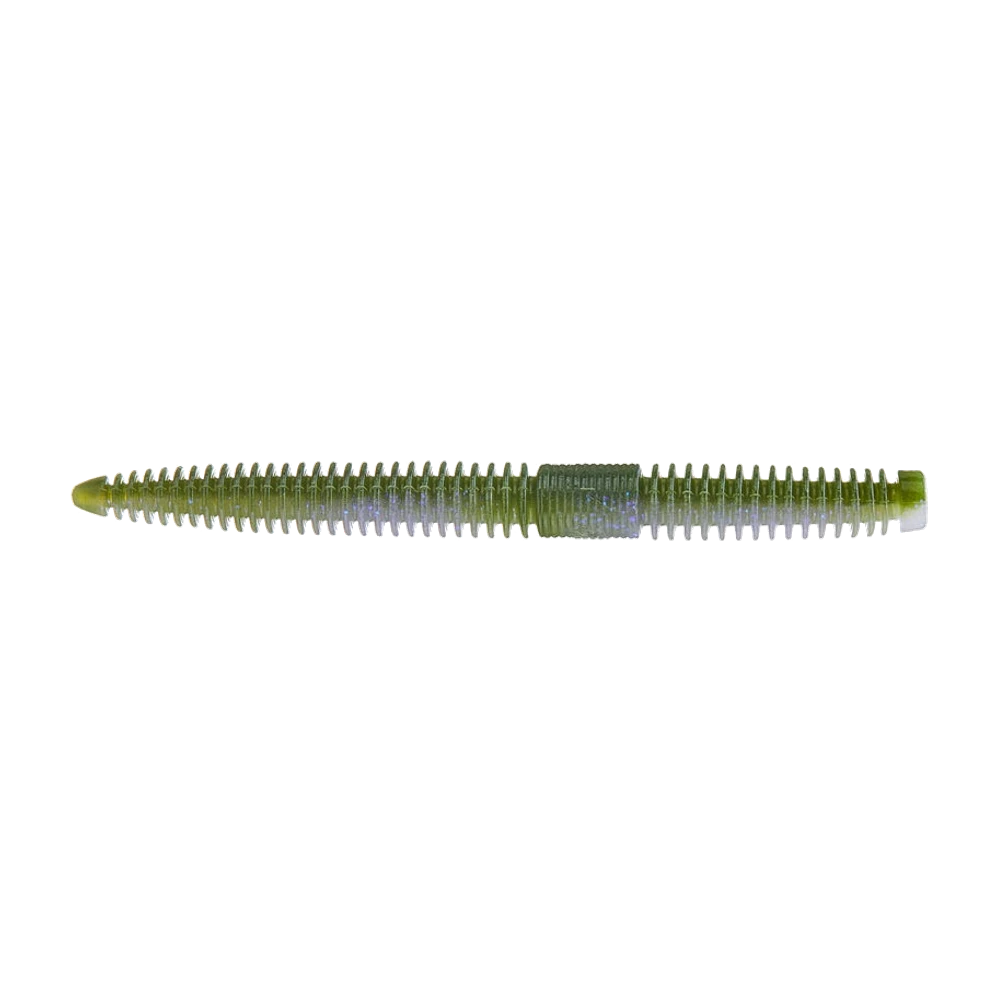
The first thing you notice pulling a Slinko Floater out of the bag is the profile: Senko-like, straight, no tail, no appendage, but covered in deep ribs from nose to tip. Those ribs are not cosmetic. Yamamoto states that they trap air as the bait hits the surface, and that the air escapes gradually as a string of bubbles while the lure travels through the water column. That is an extra visual cue, different from vibration and different from silhouette, and it works hardest in the first few seconds after the splashdown — which happens to be when a stick worm gets most of its bites.
In practice it changes how you cast. A Yamamoto Senko 5 asks you to let it sink and wait; the Slinko Floater also asks you not to waste the entry. A violent splashdown blows the air out before it is trapped, while a soft, flat landing barely picks any up. The sweet spot is a tight cast feathered in the last few feet, so the bait lands flat without slapping.
The body is also interrupted mid-length by a smooth, ribless collar. It works as a hooking marker: that is where the hook goes for a wacky presentation, and it is also where an O-ring sits if you want the bait to survive more than a couple of fish.
5.5 in or 5 in: what the size table actually says
Pay attention here, because the maker's own copy contradicts itself. The written blurb calls it a 5 in Slink-O Floater, while the size table — the only hard figure in the whole description — lists 5.5 in, roughly 14 cm, in packs of 7. The commercial model name also carries that 5.5 in. So 14 cm is the number to keep, bearing in mind the gap with the 12.7 cm quoted in the prose is not trivial: half an inch on a stick worm means one hook size of difference and a noticeably larger volume.
Weight per bait is published nowhere, and there is no buoyancy class column in that table. The maker says the bait is moulded in its Mega Floater formula and that it lifts off the bottom, but that is a claim on their part, not a measured spec. If you need the exact density to work out a Carolina sinker, test it in a bucket before you fish: one minute of checking saves an afternoon of doubt.
The rigs that make the tail stand up
Everything worth having with the Slinko Floater comes down to one behaviour: on a jighead, the body lies on the bottom while the tail stands vertically and waves at the slightest movement of water. That posture is not something the angler sets up — it comes from the plastic itself.
Ned rig and shakey head
The most direct use. A round head or a shakey head of 2-5 g (1/16 to 3/16 oz) is enough; heavier and you bury the nose in the sediment and lose the angle. Cast, let everything settle for three or four seconds, then shake the rod tip without moving the lure. The worm stays put and only the tail works. For the theory behind the setup, our Ned rig page covers head choices and rod matching.
Neko rig
With a nail weight pushed into one end and the hook through the smooth centre collar, the bait noses down and works the opposite tip. The Slinko Floater gets a sharper nose-down angle than a dense worm does, because the back end is trying to rise while the weight pulls down. It is worth comparing directly with the Daiwa Yamamoto Neko Fat Worm, which was designed for that job from the start.
Carolina rig
The one people forget. With a heavy sinker dragging the bottom and a 60-90 cm / 24-36 in leader, the Slinko Floater naturally holds above the substrate instead of ploughing along behind it. On a big sand or gravel flat, that is a way to cover serious ground while keeping the lure inside the fish's cone of vision.
Do not lift the rod to work this bait: make it tremble. The gap between an angler who catches on a Slinko Floater and one who does not comes down to keeping the nose pinned to the bottom while the tail does the moving. The moment you drag the jighead, the tail drops back down and the effect is gone.
The classic mistake
Over-weighting. By reflex you clip on a 7 or 10 g head to feel the bottom better and cast further, and you kill the behaviour you paid for. The same logic applies to line: heavy braid straight through, with any current, lifts the leader and lays the bait flat. A 20-25/100 (8-10 lb) fluorocarbon leader fixes it.
Not sure what to tie on?
Photograph your spot: CarnaFish reads the scene, cross-checks the conditions and gives you the zone, the lure and the retrieve. Free on iOS and Android.
Colours by water clarity
- Lightly stained water: Green Pumpkin with purple flake, the shade on the photographed sample. The olive base stays discreet while the flake picks up what light there is.
- Clear water: Watermelon Seed, a neutral translucent green that gives nothing away when a bass comes to inspect the bait from eight inches.
- Dark water or late evening: Black/Blue, a hard silhouette that reads from below.
Colour matters far less here than head weight and where you put the cast. Reading the bottom — hard or soft, clean or cluttered — decides whether this lure can work at all: on soft silt the nose sinks in and the tail stops being visible. That is exactly what CarnaFish helps you anticipate: one photo of the spot, and the AI suggests the zone and the presentation that suit the conditions of the day. For the rest of the method, our guide to getting started with bass fishing covers the gear and the water to look for.
Key takeaways
- The ribs trap air on entry and release a bubble trail on the way down: take care of the splashdown, it is what charges the bait.
- The size table lists 5.5 in (about 14 cm) in packs of 7, while the maker's prose says 5 in; the table wins.
- No per-bait weight and no official buoyancy class: the lift off the bottom is a manufacturer claim, worth checking in a bucket if your rig depends on it.
- Lightest possible head, and a shake of the rod tip rather than a drag of the nose.
FAQ
Does the Slinko Floater really float?
The maker says it is moulded in its Mega Floater formula and that it rises off the bottom. No buoyancy class appears in the size table, however, and no per-bait weight is published. A bucket test before the session gives you the exact answer for your rig.
How long is this bait exactly?
The size table gives 5.5 in, about 14 cm, in packs of 7. The maker's blurb says 5 in, which contradicts it; the table and the commercial name agree on 5.5 in, so that is the figure to use.
What jighead weight for the Ned rig?
Between 2 and 5 g (1/16 to 3/16 oz) depending on depth and wind. The aim is to set the nose down without burying it: if the tail no longer stands up when the bait rests, the head is too heavy for the bottom you are fishing.
Which rigs make the most of this worm?
The maker lists jigheads, shakey heads, Ned rigs and Neko rigs for the standing tail, and the Carolina rig to hold the bait off the bottom. All four are slow, fish-located presentations: this is not a search bait.
Can you fish it wacky like a Senko?
Yes, and the smooth centre collar is the natural hooking point. You do give up the standing-tail effect, which needs a weighted nose. For a pure wacky presentation the Yamamoto Senko 5 still makes more sense.
Is this a perch or zander bait?
It is designed and sold as a bass bait, and at 14 cm it sits well outside most finesse perch fishing. Nothing stops you trying it on a settled zander, but that is not the use the maker intends, and there are better-suited shads for the job.
The full bass lure guideSeason-by-season strategy: which family of lure, when, and why.Go from theory to fish
CarnaFish reads your spot from a photo and gives you the game plan: zone, lure, retrieve. Free on iOS and Android.