Gary Yamamoto Ichi Worm: 10 inches of ribbed worm for big bass
Before tying this one on, it helps to know if the spot actually calls for it. CarnaFish reads the scene from a photo.
Late August, a drop-off in six metres of water, a lake everyone has been fishing since May. Small finesse baits still produce fish, but always the same ones: thirty-centimetre bass biting out of reflex. To reach the ones that went deep and stopped coming up, you have to change both register and volume. The Gary Yamamoto 10 inch Ichi Worm belongs to the category of lures you reach for once you accept getting fewer bites.
A 25 cm worm, and what that actually means
Yamamoto's table is short: 10 in, meaning 25.4 cm, in packs of 6. That is all of it. But that single figure is enough to define a style of fishing. A worm this size rules out almost every small and medium fish, which follow it without ever committing. In exchange, it gets the attention of fish that no longer move for a 10 cm bait.
There is nothing promotional about that reasoning: it is a mechanism big-worm anglers have known for decades, and it works both ways. If you want to rescue a tough day on numbers, this is the wrong tool. If you are hunting one particular fish on water you already know, it is exactly the right profile.
It is also worth noting what the maker does not say. Yamamoto publishes the length and the pack count, and nothing else: no per-bait weight, no buoyancy class. That has an immediate practical consequence we will come back to when choosing the bullet weight.
The ribbed body is more than decoration
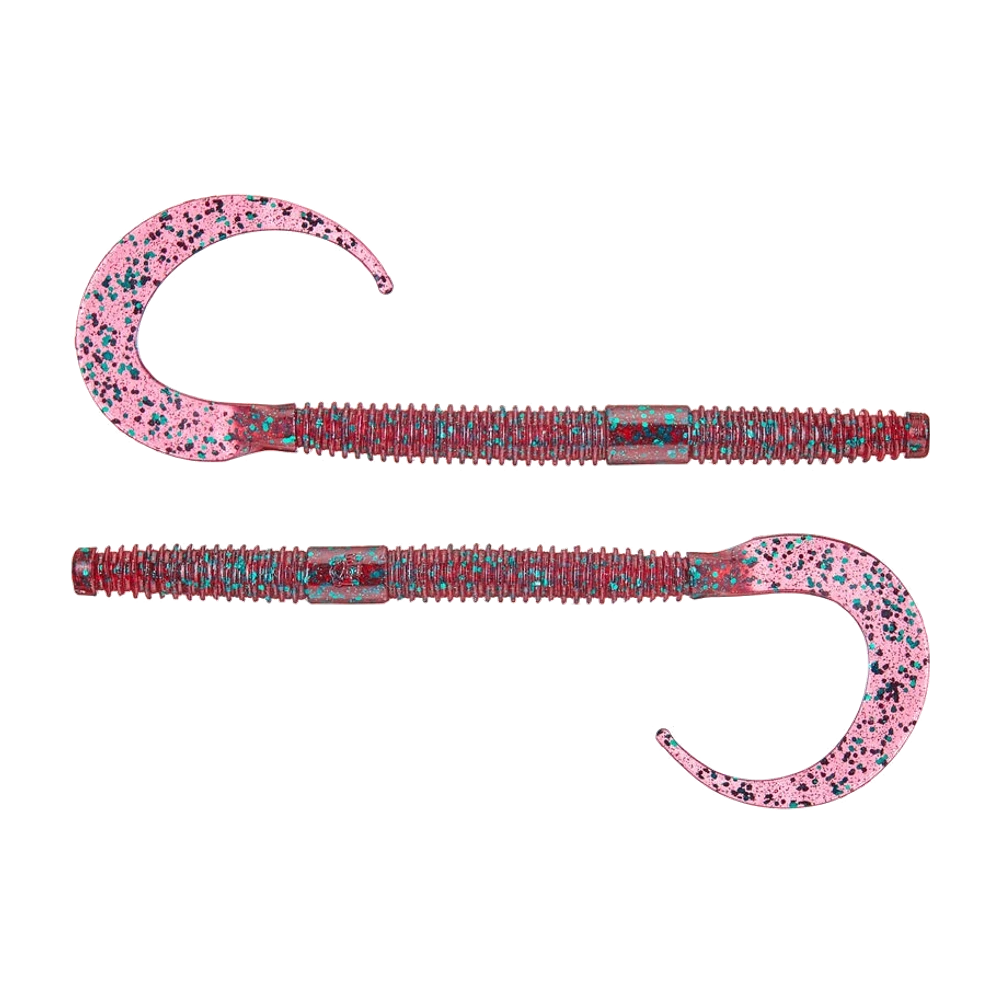
The body is heavily ribbed along almost its whole length, on the same principle as the brand's Slinko. In the photo you can clearly see the tight ribs on the front and rear sections, broken by a short smooth panel in the middle carrying the moulded logo.
Those ribs are not cosmetic. They increase the surface in contact with the water, and so the volume of water pushed on every movement — that is what makes a worm this size detectable to the lateral line, including in stained water where sight counts for little. Yamamoto also points out that the texture releases a bubble trail behind the bait: air trapped in the valleys between the ribs peels away gradually during the fall and the first few pulls. The effect is modest and short-lived, but it happens at the most critical moment, when the bait lands in front of a fish.
The ribbon tail and the Mega Floater formula
The ribbon tail takes up nearly a third of the total length. Wide and flat, it swings into a broad kick on the slightest pull — including during a vertical drop, purely from water resistance. That is what makes the Ichi Worm a Texas and Carolina bait by vocation: the two rigs that leave the tail free to work behind a fixed point of weight.
Yamamoto moulds this worm in its Mega Floater formula and states that it makes the tail stand up off the bottom when the bait is at rest. That is the argument behind fishing it on a magnum stand-up jighead. One point of honesty is needed, though: the maker does not back that claim with any buoyancy class in its spec table, which lists only length and pack count. So treat it as a property the brand states rather than a measured, published specification — worth checking in a bucket before you build a whole strategy on it.
Three rigs, three different presentations
Texas rig
The default. A 5/0 to 7/0 wide gap hook, a sliding bullet weight, and above all patience in the retrieve: two short pulls, a five second pause, repeat. With no weight published by Yamamoto, start at 7 g (1/4 oz) to fish down to three metres or in light wind, and move up to 10 or 14 g (3/8 or 1/2 oz) as soon as you pass five metres or need to reach the bottom quickly. Watch one drop beside the boat before you start: with a bait this bulky, the difference between a 7 g and a 14 g bullet completely changes the fall rate.
Carolina rig
The rig that exploits the tail best. A heavy weight ahead of a swivel, then a 60 to 100 cm leader, with the worm trailing freely and kicking every time the weight moves. You drag the weight along the bottom while the bait stays just above it: the best way to cover a wide hard-bottom flat in summer without losing the action.
Magnum stand-up jighead
The rig the Mega Floater formula is meant to justify, using a head designed to settle flat and leave the bait pointing upward. At rest the silhouette reads as prey in a defensive posture. Keep it for clean bottoms: with the point exposed, a pass through dead wood turns into a snag very quickly.
With a 25 cm worm, count to three before you set. The fish almost always takes the tail first and needs time to work the whole body into its mouth. Setting on the first tap gets you a bait bitten in half and nothing else.
Not sure what to tie on?
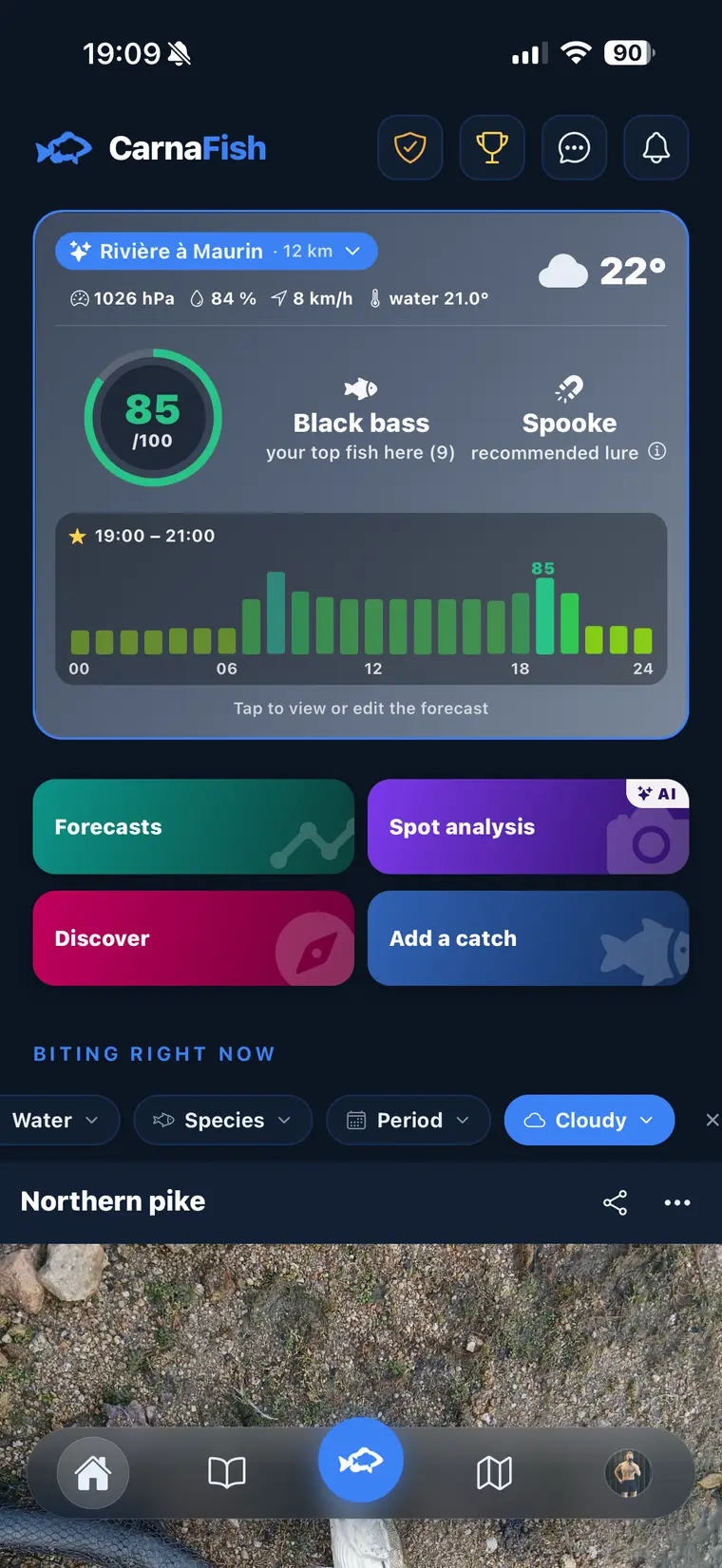
Photograph your spot: CarnaFish reads the scene, cross-checks the conditions and gives you the zone, the lure and the retrieve. Free on iOS and Android.
Colours by water clarity
- Stained or coloured water: the raspberry red with green flake photographed here. The flake catches what little light there is, and the dark base keeps a readable silhouette.
- Clear water over hard bottom: green pumpkin, the safe bet when fish can see well and you do not want to alarm them.
- Dark water, muddy bottom or late in the day: black and blue, maximum contrast against the light when there is nothing left to show but a shape.
Where it fits in a soft-plastic box
The Ichi Worm is not a search bait. It comes in afterwards, once you have located an area with something faster and want to know whether a big fish is sitting there. Against a Culprit Original Worm, another ribbon-tail benchmark, it plays on markedly greater bulk and texture. Against a Yamamoto Senko 5 the contrast is total: the Senko trades on a horizontal fall and silence, the Ichi Worm on displaced water. And when a fish follows twice without committing, dropping the volume hard with a Gary Yamamoto Yama Craw on the same spot often gets the result.
A big worm is useless cast at random: everything rests on identifying a drop-off, a flat or a laydown that actually holds a fish. That is exactly what CarnaFish does: one photo of the spot, and the AI suggests the zone, the depth and the kind of presentation that match the conditions. To lay the groundwork for reading a bass lake, our guide to getting started with bass fishing covers the water to work first.
Key takeaways
- 25.4 cm sold in packs of 6: a bait that deliberately cuts the number of bites to raise the average size.
- Heavily ribbed body: substantial water displacement and a bubble trail as it lands, useful in stained water.
- Yamamoto publishes neither weight nor buoyancy class — test your bullet weight before building a strategy on fall rate.
- Texas and Carolina first, magnum stand-up head only over clean bottom.
FAQ
How much does the 10 inch Ichi Worm weigh?
Gary Yamamoto does not publish it: the spec table gives only the length, 10 in or 25.4 cm, and the pack of 6. If bait weight matters to your fall calculation, put one on a kitchen scale rather than trusting an estimate.
Does this worm really float?
Yamamoto states a Mega Floater formula that makes the tail stand up off the bottom, but the table carries no buoyancy class column. Treat it as a property the brand claims and check it in a bucket before relying on it.
What hook suits a bait this size?
A 5/0 to 7/0 wide gap Texas hook, depending on how thick the body is where you pin it. Undersizing the hook on a 25 cm worm is the main cause of missed fish: the point has too little clearance to drive back out of the plastic on the hookset.
Should you wait before setting the hook?
Yes, considerably longer than with a short bait. Bass frequently attack the tail first and then have to pull the whole body in. Give it two to three seconds and set when you feel the weight move off, not at the first tick.
Is this lure suitable for beginners?
Not as a first soft plastic. It demands a very slow retrieve, restraint on the hookset and a spot you have already identified. Start with a 10 to 13 cm worm to learn the rhythm, then move to the 10 inch format when you are specifically after a big fish.
Texas or Carolina, which one?
Carolina as soon as you want to cover a wide hard-bottom area while keeping the worm up off bottom and free to kick. Texas as soon as you are fishing in or right against cover: laydowns, stumps, grass, where the sliding rig goes through without fouling.
The full bass lure guideSeason-by-season strategy: which family of lure, when, and why.Go from theory to fish
CarnaFish reads your spot from a photo and gives you the game plan: zone, lure, retrieve. Free on iOS and Android.