Gary Yamamoto Sensei Worm: the straight tail that works unweighted
One lure, endless conditions. CarnaFish reads your spot from a photo so you are not just guessing.
Late August, a pressured lake, warm water and bass glued to the laydowns. You've already dragged a stick bait and a craw through without a bite, and the fish you can see on the sonar aren't moving an inch. That's exactly the window for a 16.5 cm straight worm: a profile that doesn't imitate any identifiable prey, a very slow fall, and a tail that keeps moving while you do absolutely nothing.
One published dimension, and a formula stated to be neutrally buoyant
Yamamoto publishes a single dimension for this worm: its length, 6.5 in or 16.5 cm, in packs of ten. No per-piece weight, no diameter. That's common on finesse worms, where plastic density varies enough from colour to colour that makers would rather stay quiet — but it's worth knowing before you buy, because you'll be judging the weight by hand rather than reading it off a label.
Another detail worth knowing on the shelf: the manufacturer itself flags that some packages carry a mistaken "6" label. The worm is 6.5 in in every case. If you come across a pack marked 6, it isn't a shorter version, it's a printing error on the packaging.
The second stated fact is the plastic formula: Yamamoto describes it as neutrally buoyant in the water. That's a manufacturer claim, not an independent measurement, and the hook's own weight is obviously enough to sink the whole thing. But the difference shows on the first cast: rigged weightless, the Sensei settles slowly and flat instead of diving nose-first the way a classic salted worm does the moment it touches down.
The bulbous tail, and why it changes the fall
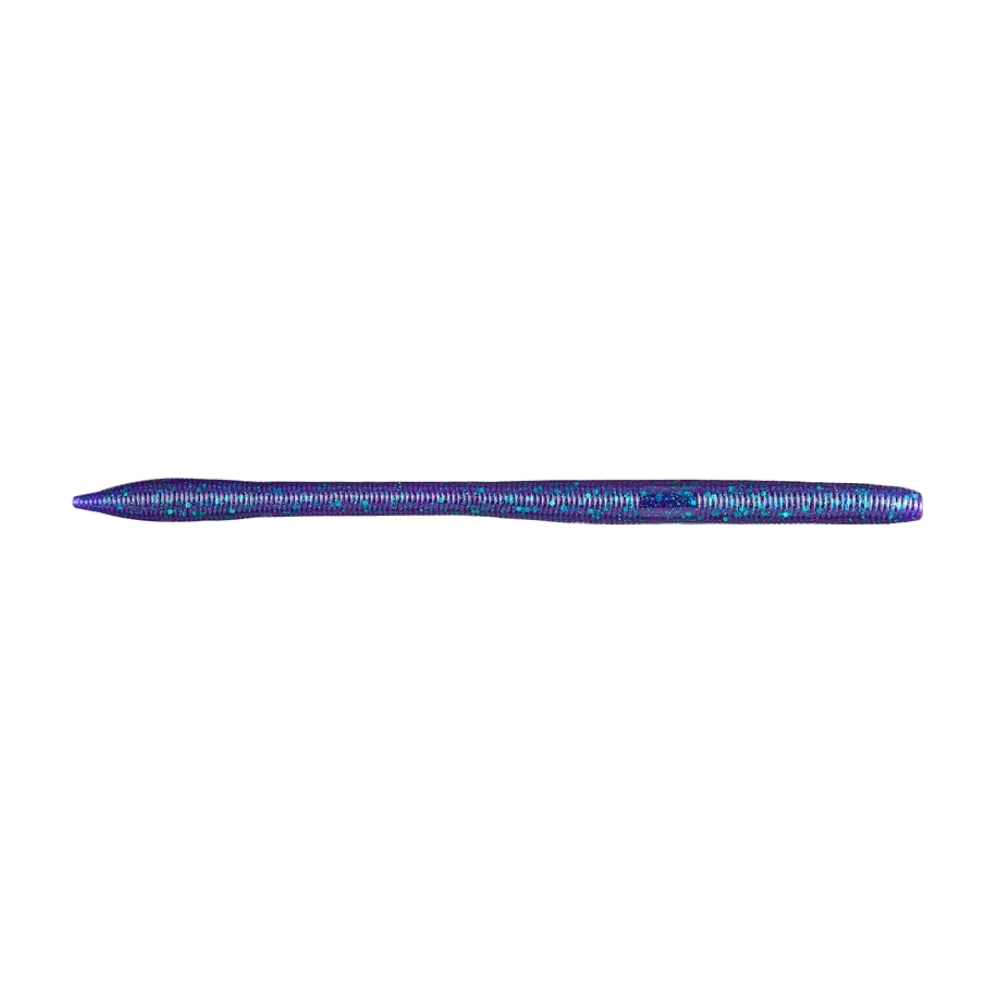
Look at the bait in profile: the head is slim and tapered, the body is ribbed along its whole length, and the back end is clearly thicker — a bulbous tail, with no paddle and no appendages. That small surplus of material at the rear, paired with an evenly balanced head, is enough to produce a permanent lateral quiver as soon as the worm moves, even by a centimetre.
It's a far more discreet action than a paddle tail, and you have to accept that: you won't feel a thing in the rod. The Sensei transmits no vibration and never loads the tip. What it does is create movement a fish can see at close range, within a metre or two. Which means it's useless for covering water: you fish it on targets you've already identified, not to find fish.
Count the seconds of the fall out loud the first time you drop it on a spot. A neutrally buoyant worm sinks so slowly that you'll pick the line back up far too early out of habit — and on this kind of bait, the bite almost always comes during the fall, not after it.
Four rigs with genuinely different jobs
Weightless
This is the rig the profile was drawn for. A 2/0 or 3/0 wide gap hook through the first third, point tucked back in, and nothing else. Cast alongside a laydown, a dock or a reed edge, and let it happen. The fall can take fifteen to twenty seconds over three metres of water: it's long, it feels wrong, and that's precisely the point. Keep a slight bow in the line so you can see it move off sideways.
Drop shot
Nose-hooked twenty to forty centimetres above the weight, the worm hangs at the exact depth of a marked fish. The 16.5 cm here gives an unusually long silhouette for European drop shot work, where 10 cm finesse worms are the norm. That's an asset when fish have seen a lot of small baits go past: length alone sometimes restarts an educated fish.
Neko rig
A 1-2 g nail weight in the head, an O-ring around the middle of the body, and the worm stands vertically on the bottom, tail up, where it keeps quivering on its own. It's the most productive rig over clean hard bottom, gravel or rock, when fish are sitting still and won't follow. The Sensei's length-to-weight ratio keeps it standing longer than a short worm.
Shakey head
A screw-lock jighead, 3.5 to 7 g depending on depth, worm threaded straight. Drag it along the bottom with small wrist shakes. Faster to deploy than a neko rig and less subtle, but it's the one rig that lets you cover a whole breakline without spending the day on it.
The classic mistake
Trying to work it. An angler used to swimbaits and creatures will instinctively give sharp snaps, because that's what fires up a high-action bait. On a straight worm, that cancels everything: the bulbous tail never gets time to do its job between pulls, and you turn a fall bait into a piece of plastic that hops. Two small tip shakes, then five seconds of complete stillness: that's the right rhythm.
Where and when to reach for it
This worm finds its best ground on pressured waters, in high summer and early autumn, when bass turn down fast presentations. Pad edges, laydowns, dock pilings, gravel breaks — anywhere you can land the bait within a metre of a likely fish.
In Europe it's also worth remembering on late-season gravel pits for perch, drop-shotted on a fine diameter. Perch won't always take a 16.5 cm worm whole, but they frequently grab it by the tail — and on a well-placed drop shot hook, that's enough to connect.
Not sure what to tie on?
Photograph your spot: CarnaFish reads the scene, cross-checks the conditions and gives you the zone, the lure and the retrieve. Free on iOS and Android.
Colour by water clarity
- Lightly stained water: Junebug, the purple with blue flake shown in the photo, a dark tone that keeps a glint as long as there's any light left.
- Clear to lightly stained water: Green Pumpkin, the safe bet of finesse worms, which goes anywhere without alarming a wary fish.
- Low light or dark water: Black Blue, a clean silhouette that stands out against the sky when a bass is looking up.
A long worm alongside the short staples
The Sensei doesn't replace a Yamamoto Senko 5: the Senko leans on a fast falling shimmy and its salted density, the Sensei on a long descent and a continuous quiver. It doesn't replace a Zman TRD Ned Rig either, which plays a short profile and an upright stance. The closest comparison is the Yamamoto Kut Tail Worm — with a bulbous end on the Sensei instead of a cut tail.
The right worm is worth nothing if you put it in the wrong place, and that's exactly where CarnaFish comes in: a photo of the spot, and the app suggests a zone and a presentation suited to the day's conditions. To build tackle and spot-reading fundamentals, our beginner's guide to bass fishing is still the right way in.
Key takeaways
- One published dimension: 16.5 cm / 6.5 in, ten per pack. No weight and no diameter from the manufacturer.
- Stated neutral buoyancy: a slow, flat descent when weightless, where a salted worm dives nose-first.
- Four genuinely distinct rigs: weightless, drop shot, neko rig, shakey head — and nothing for covering water.
- The bite comes during the fall. Any nervous rod work cancels the bulbous tail's action.
FAQ
How long is the Sensei Straight Tail Worm really?
16.5 cm, or 6.5 in, ten per pack. The manufacturer notes that some packages carry a mistaken "6" label: that's a printing error, not a shorter version.
How much does a Sensei Worm weigh?
Yamamoto doesn't publish a per-piece weight, and we won't invent one. Plan on testing your rig with two or three different hooks to find the balance that suits your target depth.
Does the Sensei Worm float?
The manufacturer states a neutrally buoyant formula, which isn't the same thing as a floating plastic. Rigged on a hook, the whole thing sinks — just far more slowly than a classic salted worm.
Which rig should I start with?
Weightless on a 2/0 or 3/0 wide gap hook, along a cluttered edge. It's the rig the head-to-tail balance was drawn for, and the one that needs the least specific tackle.
Is it a good bait for covering a big lake?
No, and that's its main limitation. It transmits no vibration and works within a metre or two. Use it on targets you've already found, after locating fish with something noisier.
Does it catch anything other than bass?
On a drop shot and a fine diameter, perch grab it by the tail regularly, especially late season on gravel pits. It isn't what the bait was built for, but the rig works.
The full bass lure guideSeason-by-season strategy: which family of lure, when, and why.Go from theory to fish
CarnaFish reads your spot from a photo and gives you the game plan: zone, lure, retrieve. Free on iOS and Android.