Deps Kincoo Air Worm: the bubbling worm that spirals on the drop
One lure, endless conditions. CarnaFish reads your spot from a photo so you are not just guessing.
Most straight worms look so much alike that you end up picking one on colour. This one is set apart by something you cannot see on the shelf: Deps moulded air pockets along the entire length of the body. That is not a catalogue gimmick, it is what changes the bait's behaviour on the drop — a trail of bubbles, more flex, and a fall that spirals instead of dropping straight.
Air in the body, and what it actually changes
Deps advertises air pockets distributed along the whole length of the Kincoo. Two effects follow directly. The first is mechanical: for the same volume, a hollowed body flexes more than a solid one, so it responds to weaker input. A single tap of the rod tip is enough to ripple the full length, where a solid worm needs a proper pull.
The second is visual. Those cavities release small bubbles as the bait descends. To a fish holding at mid-depth, that trail is a small-surface but highly readable signal: nothing else in the box produces it. The argument carries most weight in clear water and on fish that watch for a long time before committing.
The maker also talks about buoyancy boosted by that trapped air. Don't over-read it: no buoyancy class is published for this model, and the rest of the description plainly describes a bait that heads for the bottom, falls through the water column and vibrates on the way down. So the Kincoo sinks — just more slowly and for longer than a solid worm of the same size.
The ribs and the knife tail
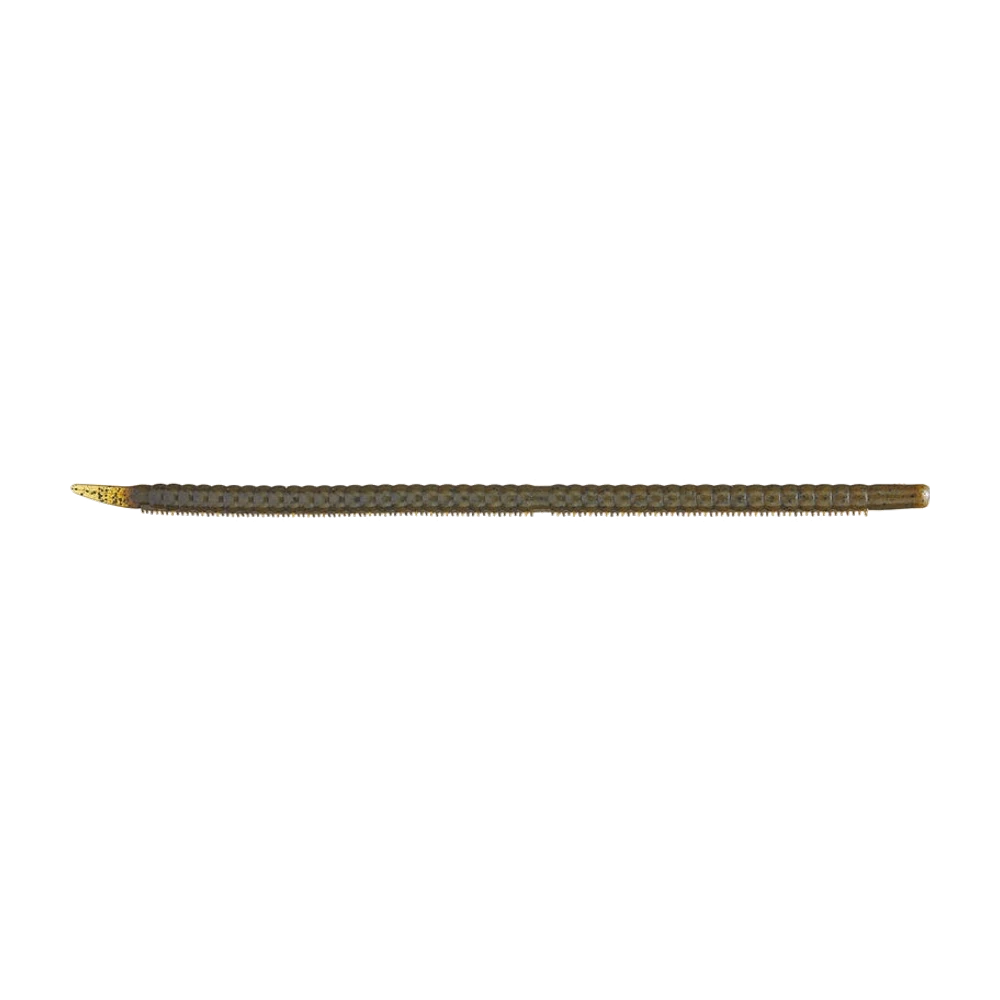
The body is covered in fine, evenly spaced ribs, clearly visible in the photo, running end to end. Their job is to break up the flow of water along the body and produce unpredictable micro-deviations. Combined with the flex the air provides, they explain why this worm moves so much for so little angler input.
The tail is long and flat, a knife blade rather than a curl. It does not kick like a paddle: it vibrates along its length during the descent, producing a low-frequency signal the lateral line picks up at a decent range. That is a clear difference from a slim-tailed worm like the Roboworm Straight Tail, whose tail undulates without really vibrating.
Three sizes, one of them surprising
Deps catalogues three lengths: 12.2 cm / 4.8 in (8 per pack), 14.7 cm / 5.8 in (6 per pack) and a 33 cm / 13 in version (4 per pack). The maker does not publish per-bait weights, only lengths and pack counts — so you will have to weigh one yourself if you need a precise figure to size your lead.
The first two sizes are the normal working formats for bass. The 13 in is a different animal: at 33 cm it is a big-fish presentation, reserved for waters where you know fish over a kilo are moving, and it demands a hook and a rod to match. Don't order it out of curiosity, it will be unusable on an average venue.
With an aerated worm like this, resist the urge to work it. Four anglers out of five pull too hard and too often, and drown the bubble signal under the movement. Cast, let it drop doing nothing, count to ten, and only then give it a small tap. You will watch your fall bites climb over the season.
Four rigs, and what each one is after
On a jighead or a standard Texas rig, the Kincoo descends tracing a gentle spiral. That is the behaviour Deps puts forward, and it is the one that works on fish suspended in mid-water — the ones you see on sonar over a drop-off or alongside a bridge pillar. A straight-line fall leaves them cold; a fall that slowly turns on itself brings them up.
Wacky rigged through the middle, both halves of the body work independently and the flex that the air provides really pays off. This is the rig for a located but wary fish, along a bank or under a dock.
On a neko rig, with a nail weight in one end, the bait stands up on the bottom and pivots around its anchor point. It is historically a Japanese rig, and the Kincoo suits it thanks to its length and flexibility.
For both of those, Deps stresses one point of execution: keep the line very slightly tensioned through the long pauses. Not tight enough to brake the descent, but enough that the thick body meets resistance from the water and wobbles down rather than simply dropping. That nuance of tension is what separates a dead-stick that fishes from one that sleeps.
The classic mistake
Rigging too much lead in order to "feel something". The Kincoo is built for a slow, long fall, and a 10 g weight cancels all of it: no spiral, no usable bubbles, no tail vibration. If you cannot feel anything, change your braid or your rod before you change the weight. And if depth genuinely demands mass, switch baits rather than ruining this one.
Not sure what to tie on?
Photograph your spot: CarnaFish reads the scene, cross-checks the conditions and gives you the zone, the lure and the retrieve. Free on iOS and Android.
The scent, an argument worth qualifying
Deps infuses the Kincoo with a crustacean scent made from crushed crawfish and shrimp, and advertises a high salt content. The stated goal is that fish hold the bait longer, buying you time to set the hook. That is a credible argument on rigs where the bite shows up as weight arriving gently — neko, wacky, dead-stick — and far less relevant when you are fishing tight and striking on feel.
Keep in mind that scent wears off. After a few dozen casts, and especially after a spell in a pocket, the effect fades. That is no reason to bin the bait, but it is not a permanent quality either.
Colour by water clarity
- Clear water: flaked olive browns, like the one in the photo with its gold tip, remain the baseline. The translucency lets light through and bubbles show up better against a light body.
- Weedy bottom and lightly stained water: a solid green pumpkin, blending into the vegetation while keeping usable contrast at close range.
- Coloured water: a plain dark tone, for a clean silhouette. At that point it is the tail vibration doing the work, not the colour.
A worm this slow is only worth anything if you drop it on the right vertical, and that is exactly what CarnaFish sets out to simplify: a photo of the spot, and the app suggests the zone and depth to aim for given the day's conditions. To learn to spot the drop-offs and edges where this kind of presentation earns its keep, our guide to reading a fishing spot is the right starting point.
Key takeaways
- Air pockets moulded through the whole body: more flex, a trail of bubbles on the drop and a gentle spiralling fall.
- Three catalogue sizes — 12.2 cm / 4.8 in, 14.7 cm / 5.8 in and a 33 cm / 13 in version for big fish; per-bait weights are not published.
- Jighead and Texas rig for suspended fish, wacky and neko rig for dead-sticking on slight line tension.
- Too much lead kills the spiral, the bubbles and the tail vibration: that is the mistake that costs the most bites.
FAQ
Does the Kincoo Air Worm float?
No. Deps states that the air trapped in the body boosts buoyancy compared with a solid worm, but publishes no buoyancy class and describes a bait that falls through the water column towards the bottom. It sinks, just more slowly.
Which size should I start with?
The 12.2 cm / 4.8 in covers most situations and rigs easily Texas or wacky. The 14.7 cm / 5.8 in takes over when fish are active. The 33 cm / 13 in only makes sense if you are explicitly targeting very big fish.
How much does a Kincoo Air Worm weigh?
The maker does not publish per-bait weights, only lengths and pack counts. If you need an exact figure to balance a rig, weigh one yourself rather than trusting an estimate.
Should the line stay tight during the pause?
On wacky and neko rigs, yes, but only slightly. Minimal tension makes the thick body wobble down instead of dropping inert. Too much tension swings the bait back towards you and removes the fall altogether.
How is it different from a standard straight worm?
Through the air pockets, which make it softer and release bubbles, and through the flat tail that vibrates on the fall. A Yamamoto Kut Tail Worm relies on an angle-cut tail and a solid body: the action is quieter and more linear.
What situation should I pull it out for first?
Bass suspended in mid-water, marked on sonar or guessed over a drop-off. That is where the spiralling fall makes the difference. To comb a weed bed on a steady retrieve, a Jackall Flick Shake Worm or a faster rig remains better suited.
The full bass lure guideSeason-by-season strategy: which family of lure, when, and why.Go from theory to fish
CarnaFish reads your spot from a photo and gives you the game plan: zone, lure, retrieve. Free on iOS and Android.