Optimum Boom Boom Weedless Swimbait: the 6-inch bait that stays upright
One lure, endless conditions. CarnaFish reads your spot from a photo so you are not just guessing.
Late summer, baitfish flicker over a drop-off and nothing will commit. The crankbait has been through, the spinnerbait too, the 4 in paddle tail came back empty. One option is left that few anglers actually reach for: thread six inches of soft plastic onto a weighted hook and walk it slowly along the cover. That is exactly where the Optimum Boom Boom lives, a bare swimbait you rig yourself and fish by simply turning the handle.
A wide body borrowed from a bigger bait
Optimum states that the Boom Boom carries over the frame of the Bubba Shad, one of its bulkier swimbaits, shrunk into a 6 in format, roughly 15.2 cm. That matters more than it sounds: at equal length, two swimbaits can have wildly different volume and water resistance. A wide body pushes more water, rolls harder and registers from further away on a fish's lateral line — and in exchange it demands a stout hook and a rod that can drive a point through a thick slab of plastic.
Put differently, this 6 in bait fishes like something bigger than its measurement suggests. If you come from slim paddle tails of the same length, such as the Keitech Fat Swing Impact 4.8, you feel the difference on the first cast: the rod loads more and you have to slow down before the bait swims cleanly.
The manufacturer credits the design to Fred Roumbanis, a BASS Elite Series angler, and says the bait draws on a model that has since been discontinued. That is an origin story, not a guarantee of results, and it is worth taking as such.
Two fins that are not decoration
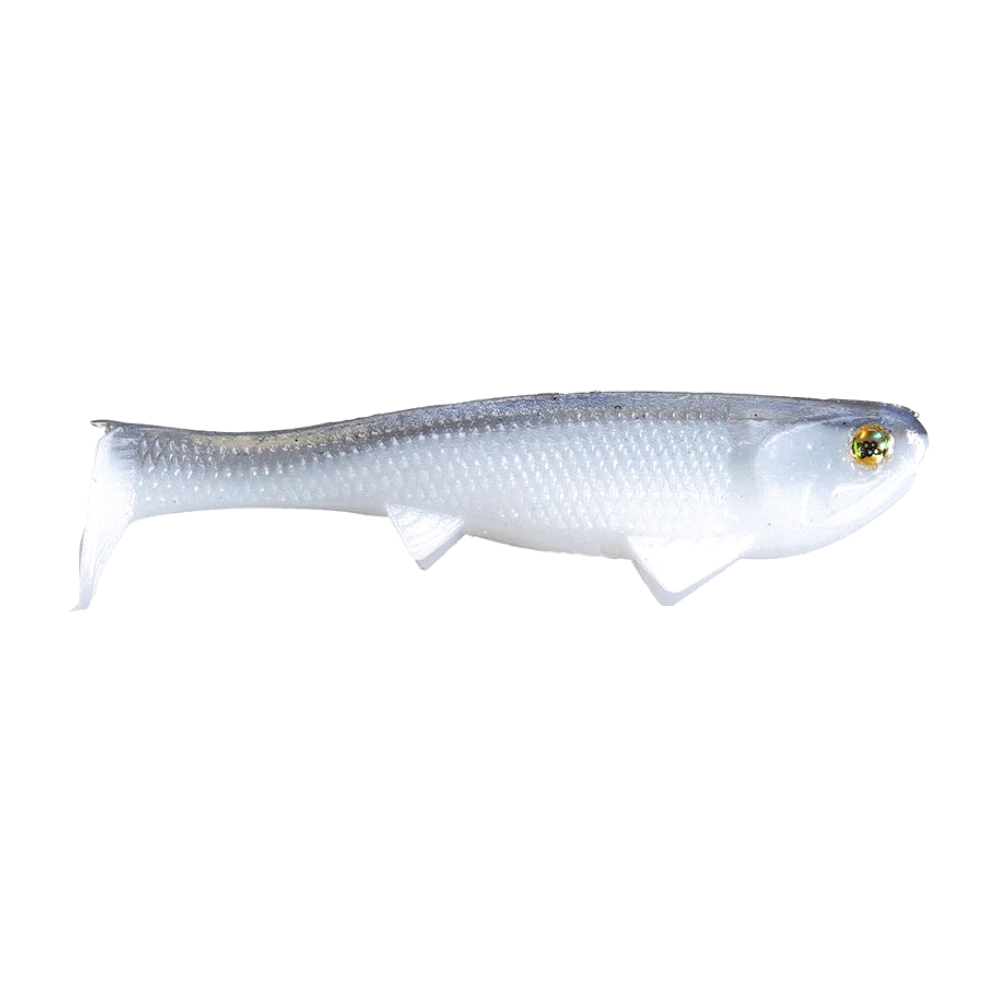
In the product photo the bait appears bare, with no hook at all: that is how it ships. A pectoral fin sits just behind the head and an anal fin further back under the belly, both moulded into the body. Optimum states that these appendages reduce rolling at higher speeds.
The reasoning holds up: the bulkier a soft body, the quicker it blows out and spins once you accelerate, and any lateral surface that resists that motion settles the swim. In practice the bait tracks straight when you pull harder to lift it off an obstruction. This is not an invitation to burn it — the manufacturer calls for a slow retrieve tight to cover — but it is a useful safety margin.
The ribbed tail and what the maker calls panic action
The tail is a boot-style paddle with ribbing across the wrist. Optimum states that it produces a pronounced kick paired with a wide but controlled body roll, and that the combination creates what the brand names a panic action, meant to trigger fish sitting in ambush. The wording is marketing; what you can verify through the rod is that the bait sends back a low, steady pulse, very different from the tight shiver of a small paddle tail.
The description also says development aimed at reproducing the tight vibration of a shad. There is an admitted tension between a bulky body, which shoves a lot of water, and a vibration you want to keep fine: the fins and the tail profile are precisely what tries to balance the two.
There is really only one way to rig it
The manufacturer is explicit: this bait is built to be fished slowly around cover on a weighted screw-lock swimbait hook. That is the only configuration it was drawn for, and departing from it means fishing a different lure.
Picking the hook weight
Neither the bare weight nor the plastic density is published, so the hook weight alone sets the sink rate and the running depth. Start with the lightest head that reaches the zone. Along a reed edge in under 2 m, 7 to 10 g is enough and lets the tail work; over a drop-off at 5 m you need 14 or even 21 g, at the cost of a tighter kick. A 5/0 to 8/0 hook is the usual range for a body of this volume.
The mistake that ruins everything
Screwing the bait in crooked. The centring pin has to enter dead on the nose axis, and the hook point has to emerge exactly along the spine. A body sitting even slightly off centre spins within the first few metres, and no stabilising fin will rescue it. Lay the bait flat on your palm, line the point up with the back, and check it boatside before you cast long.
Leave the point just under the skin of the back rather than buried: setting a hook through six inches of soft plastic is already hard enough.
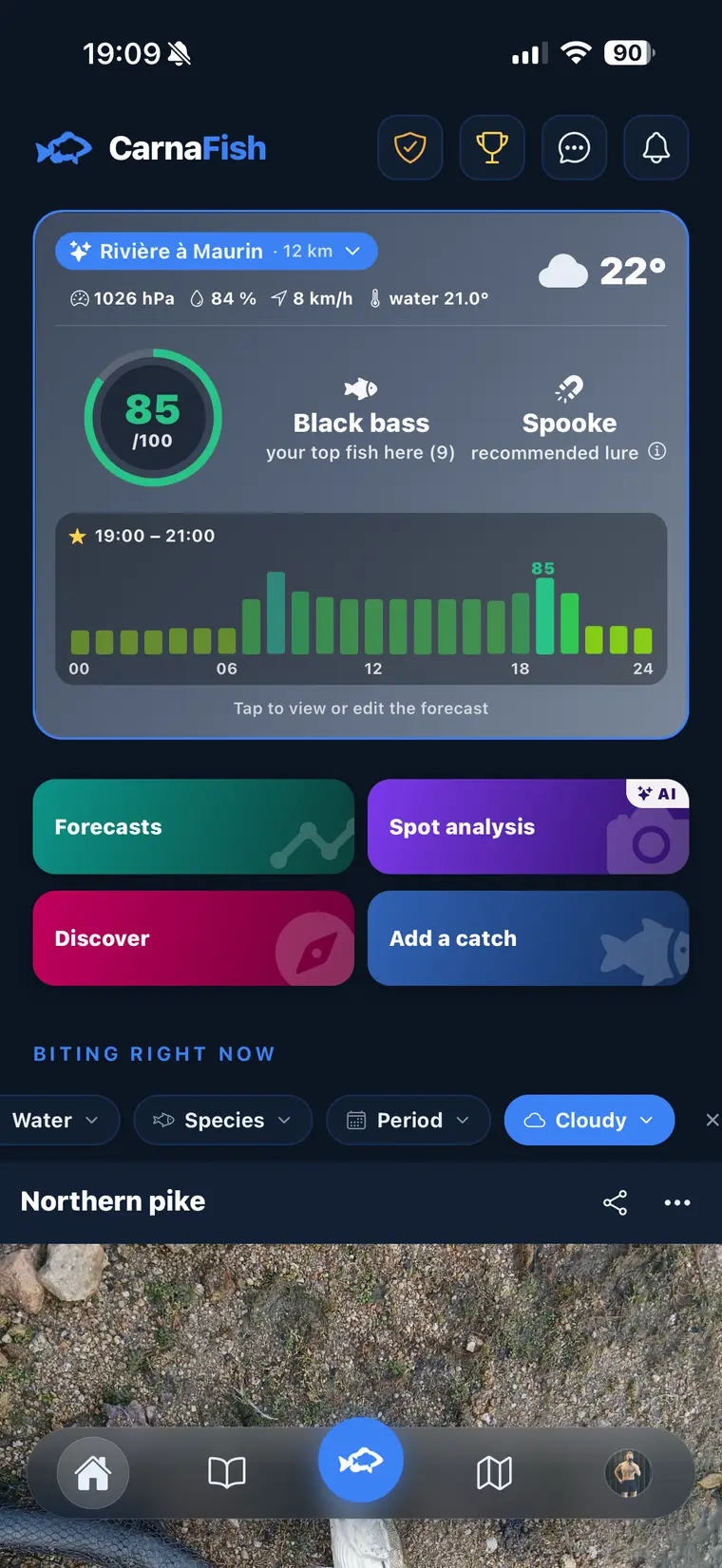
Not sure what to tie on?
Photograph your spot: CarnaFish reads the scene, cross-checks the conditions and gives you the zone, the lure and the retrieve. Free on iOS and Android.
Where and when to use it
This is a cover bait and a big-fish bait, not a fast search tool. Laydowns, dock edges, isolated rock humps and grass lines are its natural water, because the weedless rig goes where a treble-armed swimbait would snag on the first cast.
In Europe, beyond the bass it was built for, a 6 in bait of this bulk genuinely interests pike along lake margins and in the backs of reservoirs — provided you add a bite-resistant leader. Do not count on it for perch or zander, though: the volume is simply too much for both in most situations. If you want a quieter option for the same spots, the Huddleston Weedless Shad plays in the same register, while the Megabass Magdraft removes the rigging question by arriving ready to fish.
Before you settle in, always run the bait a metre from the boat and watch it swim for five metres. A soft swimbait this bulky goes on crooked about one time in three, and you will not necessarily feel it through the rod: you can fish ten minutes with a lure spinning on its own axis and no chance of a bite.
Colours by water clarity
- Clear water: a translucent pearl white with a blue-grey back, like the one in the photo, reproduces a baitfish outline without excess flash. It is the default when you can see bottom at 2 m.
- Stained water: a pattern with a strongly marked dark back over a pale belly. Back-to-belly contrast is what stays readable as visibility drops, far more than the hue itself.
- Low light or dirty water: a solid dark colour, black or deep brown. The silhouette cuts against the sky, and that is all a fish looking up needs to see.
Optimum points out that because the baits are hand-poured, colours vary slightly from one piece to the next. That is not a manufacturing fault, it is the trade-off of the process.
A bait this size punishes a bad spot choice: cast in the wrong place, all it does is spook fish. That is exactly what CarnaFish is for — one photo of the spot, and the AI suggests the zone, the depth and the presentation that fit the day's conditions. To build the groundwork before stepping up to big volumes, our guide to getting started with bass fishing is still the right entry point.
Key takeaways
- A 6 in (15.2 cm) bait with a wide frame taken from the Bubba Shad: it fishes bigger than its length suggests.
- The pectoral and anal fins exist to contain roll as speed rises, not to look pretty.
- The bait ships bare: the weight of the screw-lock swimbait hook alone decides depth and fall rate.
- A body screwed on crooked spins and catches nothing — check it visually before every serious cast.
FAQ
Does the Boom Boom come with a hook?
No. The product photo shows it bare, and the manufacturer says it is meant to be fished on a weighted screw-lock swimbait hook bought separately. Choosing the weight for the target depth is down to you.
What hook weight should I use?
The lightest one that reaches the zone. Around 7 to 10 g for a margin under 2 m, 14 to 21 g over a deeper drop-off. The heavier the lead, the tighter the tail kick becomes.
How much does the bare bait weigh?
The manufacturer publishes neither that figure nor the plastic density. Plan on testing two hook weights on the water rather than trusting a spec sheet.
Can it be fished fast?
It handles speed better than most wide soft swimbaits thanks to the fins that damp the roll. But the manufacturer aims it at a slow retrieve tight to cover, and that is where it performs. Acceleration is mainly there to lift it off an obstruction.
Is it any good for pike in Europe?
Yes, the bulk and length match margin pike well, as long as you add a bite-resistant leader. It is far too big for perch and zander in the vast majority of situations.
How does it differ from a pre-rigged swimbait?
A ready-to-fish model such as the Megabass Magdraft saves you the rigging step and the centring error, but locks in the weight and the hook position. The Boom Boom asks for more care and gives you full control over depth and weedless clearance in return.
The full bass lure guideSeason-by-season strategy: which family of lure, when, and why.Go from theory to fish
CarnaFish reads your spot from a photo and gives you the game plan: zone, lure, retrieve. Free on iOS and Android.