Googan Blooper Popper: 7 cm of calibrated noise to pull fish up
Rather not fish it blind? Photograph your spot — CarnaFish cross-checks the conditions and points you the right way.
A windless morning on a pond, the water flat as glass and no fish showing anywhere. You land a popper two metres off a patch of pads, leave it dead still for ten seconds, then snap the rod once: the bloop carries across the whole bay. Three seconds later the water explodes. All of topwater fishing sits in that sequence, and the Googan Blooper Popper is built to make it as easy as possible.
A cupped mouth that makes noise, not spray
It starts with the mouth. Googan drew it as a wide cup, meant to throw as much water as possible and produce the low "bloop" the bait is named after. That's a deliberate choice: a narrow-mouthed popper spits a thin, high-pitched jet that doesn't carry far, while a wide cup shifts a volume of water and puts out a dull sound audible from a distance below the surface.
The consequence on the water is simple. This bait is there to call fish, not to convince one at point-blank range. Over a big flat calm area, three or four well-spaced snaps beat a continuous retrieve: every knock carries, and it's the silence afterwards that gives a fish time to come and look. On a tight, already-identified bank, you don't need all that noise and can drop a notch in amplitude.
The belly strips, the detail that changes the rhythm
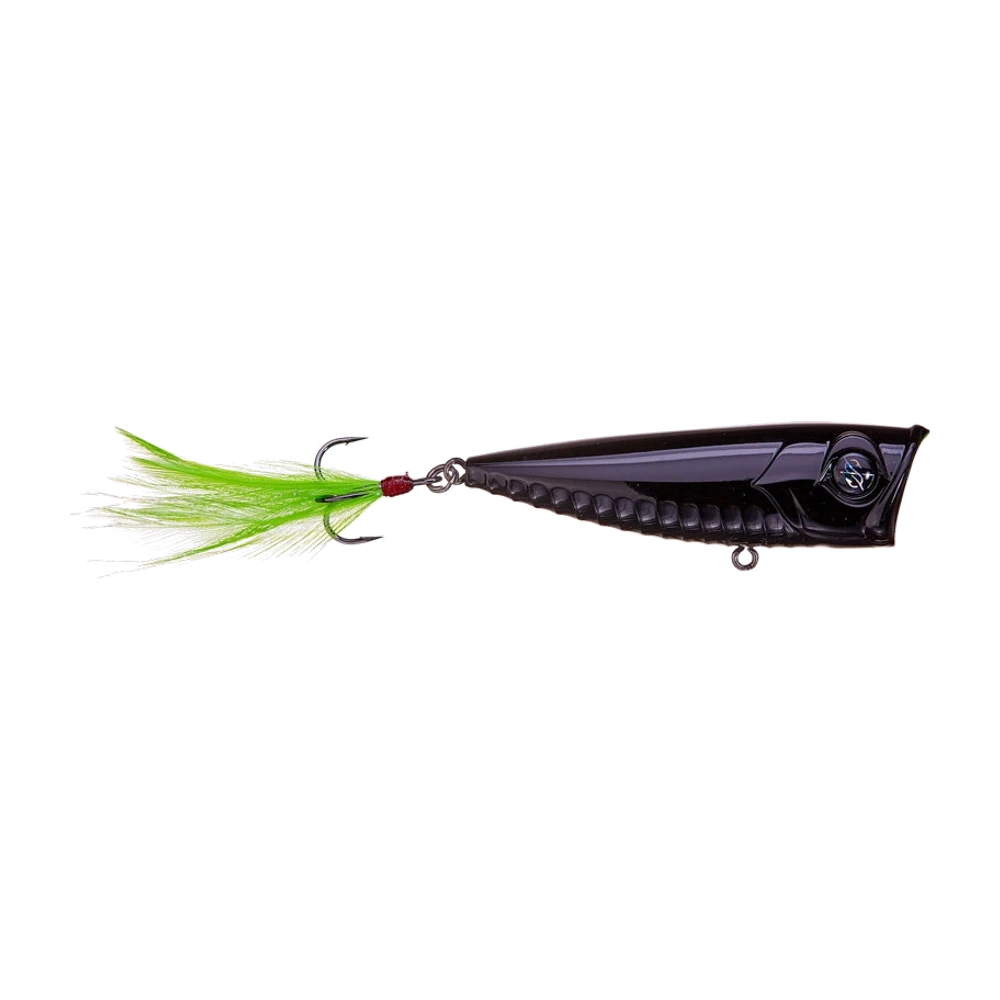
Under the front of the belly, the Blooper carries a row of raised ridges — clearly visible in the photo. Googan calls them rumble strips and states their role is to increase drag and surface disturbance. In fishing terms: for the same pull, the bait travels less. It therefore stays longer in the useful zone, the one where a fish has already spotted it, instead of crossing it in three pulls.
That's exactly what you want on a small target. The classic beginner's flaw in topwater is retrieving too fast: the bait makes twenty plops and leaves the spot before any fish has decided. A popper braked from underneath hangs under the target longer, which lets you work it more aggressively without losing ground. Where an Arbogast Hula Popper leans on its skirt to make the pauses count, the Blooper leans on the hydraulic drag of the body.
Two retrieves, and they don't catch the same fish
The manufacturer describes two ways to fish it, and both deserve a try in the same session before you commit.
Fast popping
Sharp, closely spaced rod-tip snaps, the bait chaining knocks as it moves. The image you're after is a school of small baitfish pushed to the surface by predators: the bait isn't fleeing, it's panicking. That's the retrieve for active days, visible schooling activity, and slightly choppy water where a discreet sound would be lost. It draws the most violent strikes — and the highest miss rate.
Slow plopping
Short, soft sweeps of the rod tip that just slap the mouth without throwing water, followed by two to five second pauses. You've gone from a fleeing school to a fish feeding calmly on the surface — an easy target, and that's exactly what decides a wary or inactive fish. In late summer over flat warm water, this version is almost always the one that works.
The pause isn't dead time, it's the main retrieve. Count it out in your head: three seconds minimum after each series of plops, five if the water is slick. Nine bites out of ten come during that silence, and the reflex to set on the sound rather than on the weight is what loses half of them.
The feathered treble, and how to set the hook
The Blooper comes with a rear treble dressed with feathers. That's not decoration: the fibres keep moving while the bait sits still, giving a fish that followed the sound but is still hesitating a reason to stay. It's also what makes the pause productive rather than merely silent.
The classic mistake
Setting on the sound. Topwater strikes are spectacular and the hand goes on its own — except the fish has very often missed the bait or pushed it without taking it. Wait until you feel weight in the rod, then sweep sideways without a big movement. A rod with a slightly forgiving tip, braid and a short fluorocarbon leader cushion enough for the trebles to hold. Tie the bait on a loop knot or a small snap: a tight knot on the split ring restricts how the head rocks and dulls the sound.
Not sure what to tie on?
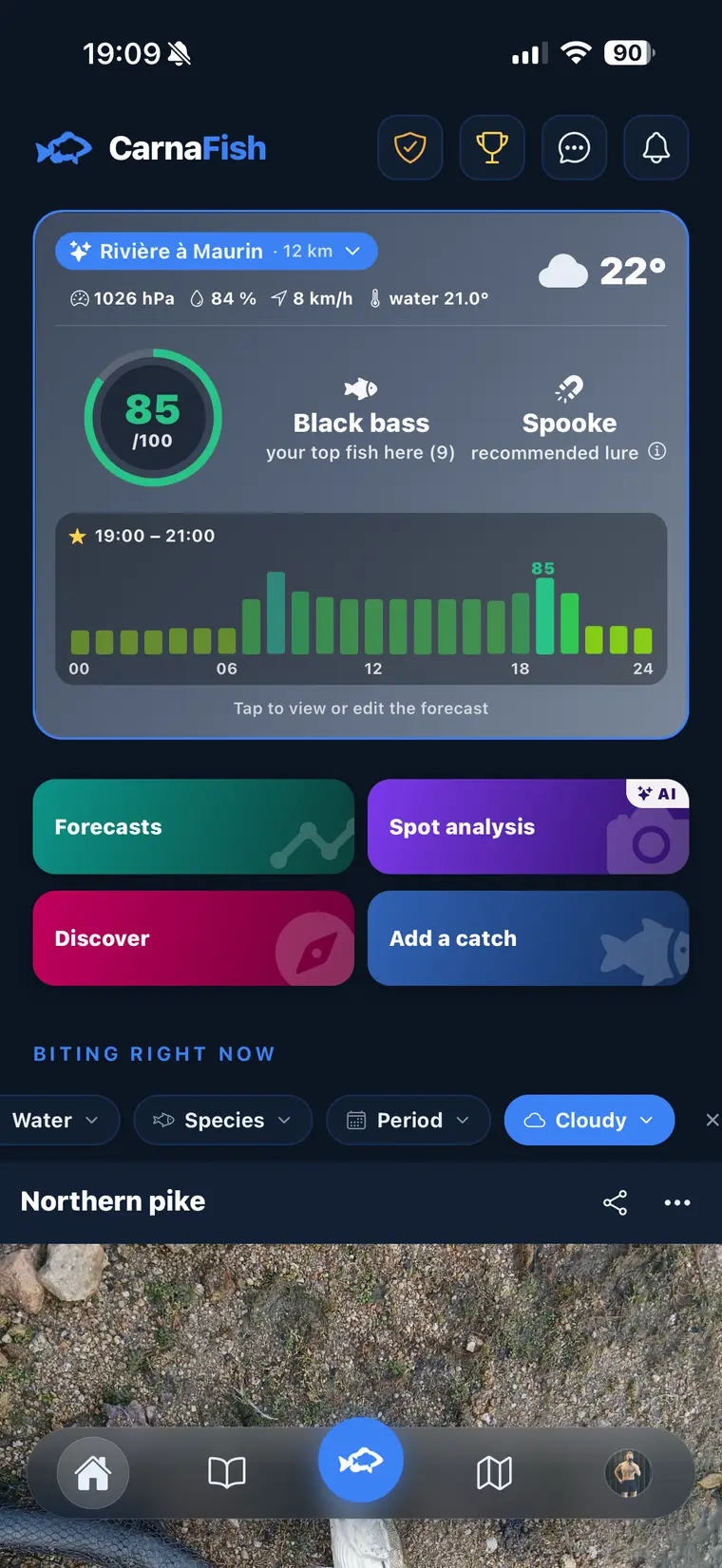
Photograph your spot: CarnaFish reads the scene, cross-checks the conditions and gives you the zone, the lure and the retrieve. Free on iOS and Android.
What the spec table says
Googan's table lists a single version: 2-3/4 in, that is 7 cm, at 3/8 oz, that is 10.6 g, rated Topwater. It's a mid-size bait, bigger than a classic perch popper and smaller than a sea bass popper. Those 10.6 g cast easily on a medium rod and carry decently into a light breeze, which matters in topwater where you often fish at range to avoid spooking fish.
That calibre also explains its real versatility: drawn for bass, it has no trouble interesting a good perch along a weed edge, where a 10 cm popper would be refused. For strictly perch-focused fishing, a shorter model such as the Yo-Zuri 3DB Popper remains the better match.
Colour by light
- First light, backlight, grey skies: black. From below, a fish only sees a silhouette against the sky — black reads best, and it's the colour photographed here.
- Clear water in full sun: bone or white, mimicking a baitfish belly without throwing harsh flash.
- Stained water or rising wind: a chartreuse back over shad flanks, to add a visual marker when the surface is broken.
Topwater only works when fish are high in the column, and that reading is what most anglers lack. CarnaFish answers exactly that: a photo of the spot, and the app suggests the zone to work and the presentation suited to the day's conditions. For bass fundamentals, tackle and typical spots, our beginner's guide to bass fishing remains the right way in.
Key takeaways
- One size in the catalogue, 7 cm / 2.75 in for 10.6 g / 3/8 oz, rated Topwater: the go-anywhere format between perch popper and sea bass popper.
- The wide cupped mouth is there to call fish from a distance with a low sound, not to make continuous noise.
- The belly strips brake the bait and keep it in the strike zone longer.
- The three-to-five-second pause is the main retrieve, and you set on felt weight, never on sound.
FAQ
What size and weight is the Blooper Popper?
The manufacturer's table lists a single version: 2-3/4 in, roughly 7 cm, at 3/8 oz, roughly 10.6 g. The bait is rated Topwater, meaning strictly a surface lure.
Should I work it fast or slow?
Both work and answer different situations. Sharp fast popping imitates a school pushed to the surface, for active fish. Short sweeps followed by long pauses imitate prey feeding calmly, and that's often what decides a wary fish.
Why do I miss so many topwater bites?
Because you're setting on the sound. The visual explosion triggers the move before the fish actually has the bait. Wait to feel weight in the rod, then sweep sideways. A forgiving tip and a short fluorocarbon leader help a lot.
Can it be fished for perch?
Yes, 7 cm stays within reach of a good perch, especially along a weed edge at daybreak. For perch-only fishing, a shorter popper will still produce more bites over a session.
Which colour at daybreak?
Black. Against the light a fish only makes out a silhouette on the sky, and contrast is what counts, not colour. Light tones like bone belong to full-sun hours over clear water.
Does the feathered treble actually do anything?
Yes, above all during the pauses. The fibres keep breathing while the bait sits still, giving a fish drawn by the sound a reason to stay put and commit. It's the part that makes the pause productive.
The full bass lure guideSeason-by-season strategy: which family of lure, when, and why.Go from theory to fish
CarnaFish reads your spot from a photo and gives you the game plan: zone, lure, retrieve. Free on iOS and Android.