Yo-Zuri 3DR-X Popper: 6.7 cm that move a lot of water
This lure shines under specific conditions. CarnaFish tells you in 10 seconds if today is one of them.
There are two ways to call a fish to the surface. The first is visual: a lure that zig-zags quietly and gets noticed from close range. The second is acoustic: a lure that cracks, throws water and can be heard twenty metres away. The Yo-Zuri 3DR-X Popper belongs to the second category, with one twist — its pencil body also lets it do the first thing, which is unusual on a 6.7 cm lure.
A cupped face on a slender body
Most poppers have a stocky body, wide at the front, that drags heavily and casts poorly. The 3DR-X keeps a tapered stickbait profile and simply carves a deep, wide cup into the nose. That choice produces two behaviours in one lure.
A sharp pull and the cup bites into the surface: it shoves a serious volume of water and bursts into bubbles, with a clean crack. A single knock rattle completes the sound signature, a heavy ball that strikes once rather than producing a constant fizz. That is deliberate: on calm water a single clear sound carries further and feels less artificial than permanent clicking.
Same stroke, softer, rod tip down: the slender body pivots and the lure starts walking like a pencil. You will not get the glide of a true stickbait, the cup drags too much, but you get a tight walking step, enough to pull a fish right to the bank.
At 7.1 g for 6.7 cm, the density is sufficient to cast a small topwater without a specialist rod. It is not a distance lure, but it cuts through a light breeze without complaint.
The adjustment that matters most is the length of the pause after the pop. Two seconds on active fish, five when they refuse. The strike almost always lands once the rings have faded, not while the water is still moving. Count in your head: it is the only way not to shorten the pause without noticing.
Two retrieves to alternate
The clean pop with a pause
Rod at forty-five degrees, line lightly tensioned, one sharp wrist pull, then take up the slack without moving the lure and wait. That is the base retrieve, the one that carries furthest, for rippled water or over submerged grass.
The string of short pops
Three or four quick small pops, then a long pause. The sequence mimics fry scattering in a group rather than a single fish, and it works particularly well on perch, which hunt in shoals and react to collective commotion.
Switching to a walk
Drop the rod tip towards the surface and shorten the pulls: the lure stops spitting and starts to zig-zag. Useful when a fish has followed the pop without committing — changing register without changing lure sometimes closes the deal. For a genuinely wide walk, a dedicated pencil remains clearly better.
The mistake that wastes casts
Striking at the noise. With a popper the strike is spectacular and the reflex is to set the hook when you see the splash. Except the fish often does not have the lure in its mouth yet. Wait until you feel the weight in the rod, then set sideways rather than upwards: the hook-up rate doubles.
The tackle that goes with it
A medium rod of 1.95 to 2.10 m, with a tip soft enough to absorb the head shake on the strike, and thin braid finished with thirty centimetres of fluorocarbon. A fast retrieve reel is almost mandatory: between two pops you have to take up slack without moving the lure, and a slow spool forces you to pull on it. Above all avoid a stiff rod: on a 7 g lure carrying small trebles, a dry blank tears the hook out of the jaw on the first head shake.
What the photo shows, and what is on it
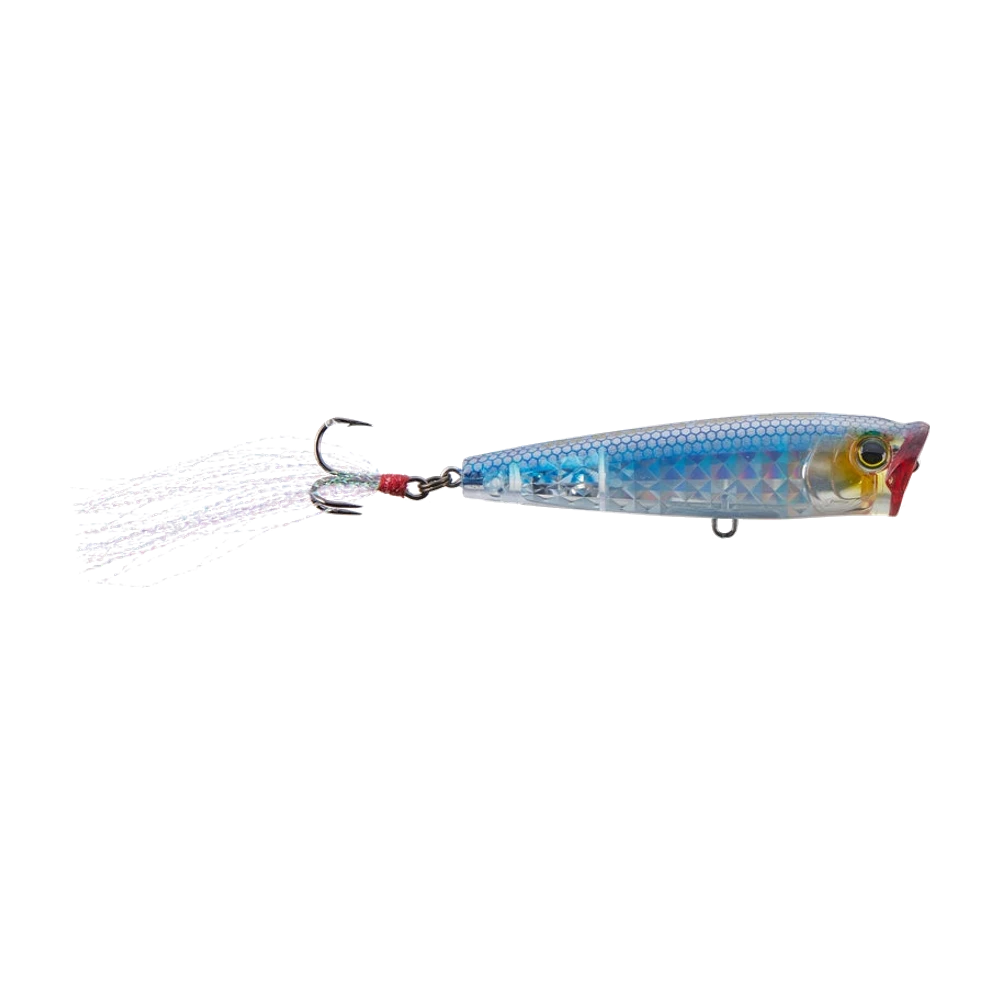
The model photographed has a scaled blue back and silver flanks with prism facets visible through the translucent shell — Yo-Zuri paints the finish inside the body, which prevents chipping from teeth and rock strikes. The cup is bright red, the eye gold with a black pupil.
Watch the hooks though: in this photo only the tail treble is fitted, dressed with a bundle of pearl white Mylar bound with red thread. The belly hanger is bare. Mylar is an interesting choice — unlike feathers it does not soak up water, does not collapse into a wet clump and keeps reflecting light after several sessions. Just check the exact hook specification of the reference you buy.
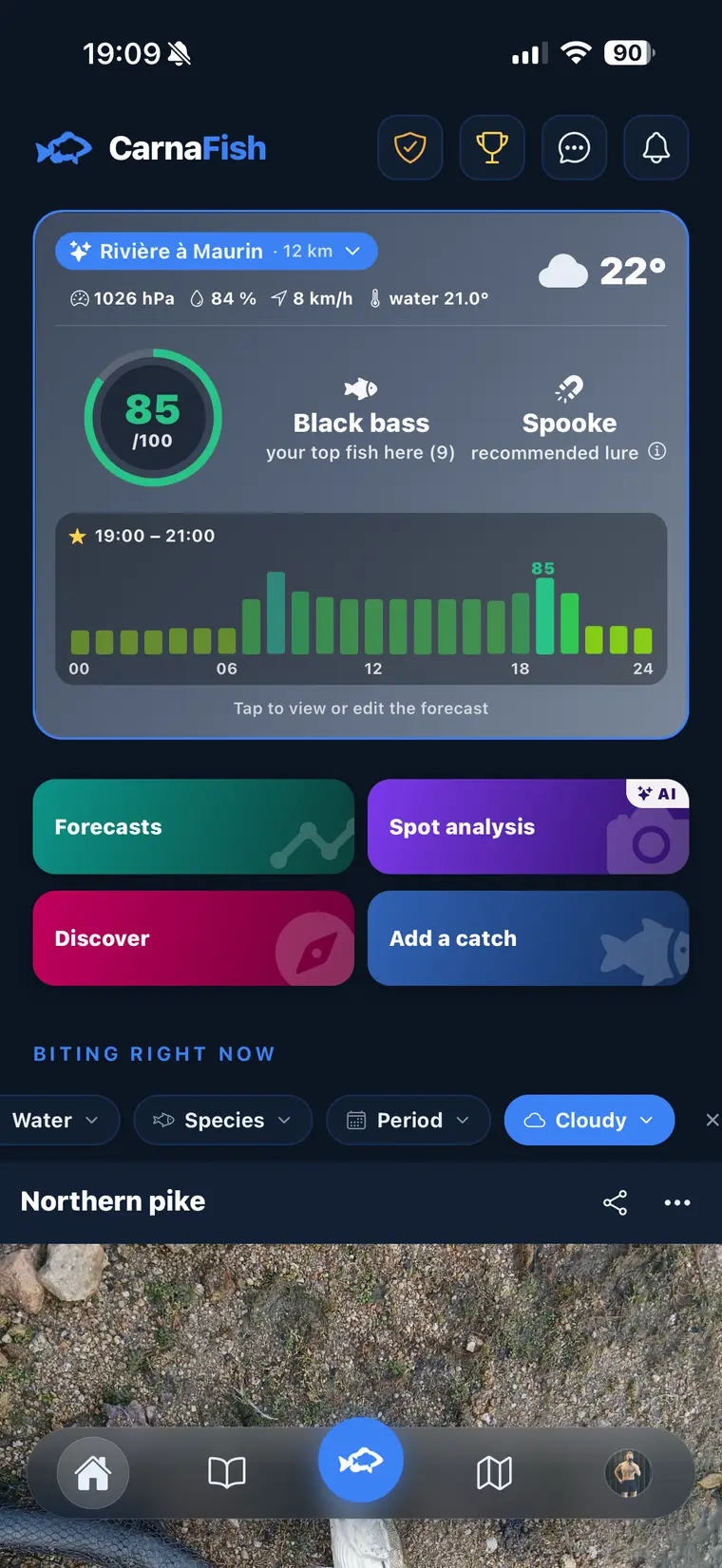
Not sure what to tie on?
Photograph your spot: CarnaFish reads the scene, cross-checks the conditions and gives you the zone, the lure and the retrieve. Free on iOS and Android.
Colours by water
- Clear water, silver forage: the blue with prismatic flanks of the model photographed, which throws short flashes without ever looking flat.
- Lightly stained water: a pearl white with a pale back, which keeps a readable silhouette from below while staying natural.
- Low light or dirty water: a solid dark back. The fish attacks from below, and in loaded water only the outline against the sky counts.
Where this size fits
6.7 cm is small for an American bass popper, and that is exactly what makes it useful in Europe. On a perch water it is the right size: enough noise to pull a shoal together, small enough that a 25 cm fish attacks it properly. For bass it is the size to tie on when a 9 cm popper only draws follows without strikes.
On the other hand, do not count on it to call a fish across heavily coloured water on a big lake: the volume it displaces is still that of a small lure. For that, a bigger popper carries better.
Knowing whether the surface is worth an hour of your time is what CarnaFish helps with: a photo of the spot, and the AI suggests a zone, a depth and a presentation that fit the time of day and the weather. To go further on smaller predators, our guide to perch fishing with lures covers the other families worth knowing.
Key takeaways
- A deep cup on a pencil body: the same lure can crack and then walk with no change of rig.
- A single knock rather than a continuous rattle — a cleaner, less artificial sound on calm water.
- The pause after the pop matters more than the pop itself: two to five seconds depending on activity.
- The 6.7 cm size suits perch, and bass that refuse bigger poppers.
FAQ
How long should the pause after each pop be?
Two seconds when fish are active, up to five when they refuse. The strike almost always lands once the rings have faded. Count mentally, otherwise you will shorten the pauses without realising it.
Can the 3DR-X Popper walk the dog?
Yes, within limits: the slender body pivots if you drop the rod tip and shorten the pulls, but the cup drags and the step stays tight. It is a useful way to change register, not a replacement for a real stickbait.
Why do I miss so many fish on a popper?
Because you are striking at the noise. Wait until you feel the fish's weight in the rod, then set sideways rather than upwards. On a topwater, that single correction transforms the hook-up rate.
What is the Mylar bundle on the treble for?
It visually extends the silhouette and reflects light at rest, exactly when the lure is still and vulnerable. Compared with a feather, it does not soak up water and keeps its volume and shine far longer.
Is this popper suitable for perch?
Yes, it is one of its best uses in Europe. Its 6.7 cm suits average fish, and a string of short pops triggers feeding shoals very reliably.
Do I need a fluorocarbon leader?
Yes, thirty centimetres of 10 to 12 lb, with a soft snap or a loop knot. Braid knotted tight to the ring chokes the cup and stops the lure pivoting cleanly between pops.
The full bass lure guideSeason-by-season strategy: which family of lure, when, and why.Go from theory to fish
CarnaFish reads your spot from a photo and gives you the game plan: zone, lure, retrieve. Free on iOS and Android.