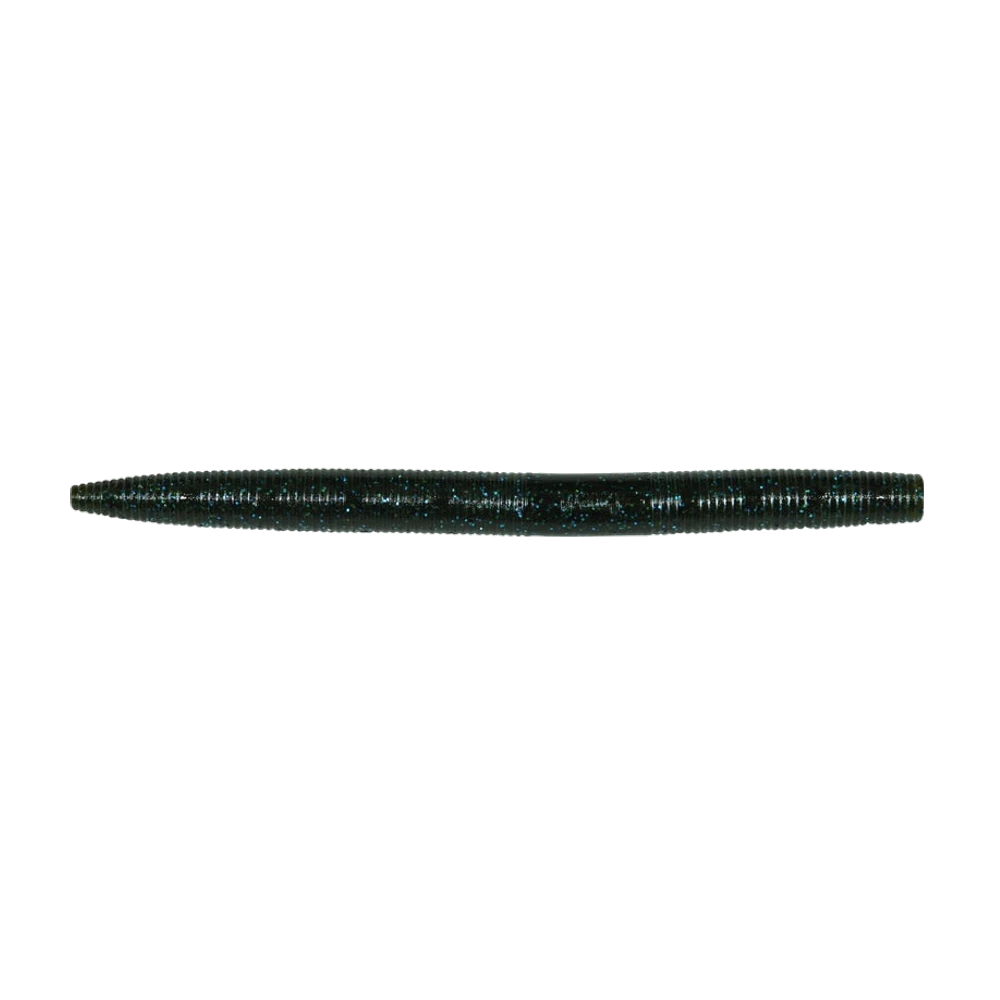
Googan Lunker Log: the soft stickbait that shimmies on its own
Rather not fish it blind? Photograph your spot — CarnaFish cross-checks the conditions and points you the right way.
Some days bass refuse anything that moves fast. You have run the crankbait along the drop-off, the spinnerbait past the laydowns, a topwater at first light, and nothing has moved. That leaves one answer American anglers have been reaching for over the last twenty years: a salt-loaded plastic stick you cast with no weight, let sink, and simply watch work. The Googan Lunker Log belongs to that family — and like every stickbait, what matters is what you cannot see from the outside.
A stickbait is judged on density, not on shape
From the outside, every soft stick looks alike: a cylinder tapered at both ends, no tail, no arms, not a single appendage. It is deliberately the plainest bait on the rack. What separates one from another is the plastic formula — salt content, how soft the blend is, and how the body spreads its mass along its length.
Googan claims a particularly heavy salt load for the Lunker Log, plus its in-house additive, Slaunch Sauce, worked into the material. Salt does not only add taste for a fish that bites: it sets the bait's density, therefore its fall rate, therefore its action. A lightly salted stick glides and stays high in the column; a heavily salted one drops with purpose and quivers more on the way down. That is a trade-off, not an outright advantage: the denser a stickbait is, the more depth you need for the fall to have time to exist.
The Lunker Log's body is ribbed from end to end, with a slight swell in the middle. Those ribs are not decoration: they give the water something to push against on the way down, and they give an o-ring a seat when you rig the bait wacky.
The shimmy on the fall is the only argument that counts
Googan says it tuned that fall action with three tournament pros — Jacob Wheeler, Dustin Connell and Scott Martin — to get a shimmy at the right cadence. Behind the names, the technical point holds: on a stickbait, fall action is not a bonus, it is ninety per cent of the bait. Rigged wacky, the stick folds into a V around the hook set in the middle, and both halves flutter in alternation all the way down, like two arms beating slowly.
The practical consequence catches many beginners out: the bite almost always comes on slack line, while you are doing nothing. The bait does not need you. Your entire job is to give it room to drop cleanly, line loose, never holding it back.
The bite signal on a stickbait is not a thump in the rod. It is a line that drifts sideways, tightens gently, or simply stops sinking when the bait should still be going down. Learn to watch your line rather than feel your rod: on this kind of bait you will see the bite long before you feel it.
Four rigs, four different ways of fishing
The Lunker Log is listed as a wacky, Texas, neko and weightless bait. That is not marketing filler: those four rigs genuinely cover four distinct situations.
Wacky
A round hook pushed through the middle of the body, ideally through a rubber o-ring so the plastic does not tear after three fish. It is the most productive rig on a holding, wary fish, and also the snaggiest: fish it over clean ground, along a dock, a riprap bank or a hard weed edge. Jacob Wheeler took an MLF win at Table Rock Lake in 2019 with the Lunker Log rigged exactly this way.
Neko
A nail weight pushed into one end, hook still through the middle. The bait then noses down and stands on the bottom, with the tail still quivering vertically. This is the rig to favour as soon as you are past three or four metres, or as soon as wind stops you from tracking your line.
Weedless Texas
A wide-gap hook through the head, brought back out through the body, point tucked in. You lose part of the shimmy — the body is held straight instead of folding — but you earn the right to go into branches, pads and weed. It is the compromise to reach for when fish are in the cover rather than beside it.
Weightless on the drift
The simplest and the most underrated: hook only, no weight at all, and you let the bait sink slowly with the current or the wind along a bank. On a calm, warm lake, that presentation imitates nothing in particular, which is exactly what makes it believable.
The dimensions Googan does not publish
This point deserves to be stated plainly, because it changes how you buy the bait. The manufacturer's description publishes no length or weight table at all for the Lunker Log, unlike most American references. No size, no weight per piece, no numerical density figure is given.
What can be stated is what Googan does claim: a heavily salted, therefore sinking body, and a fall action that has been worked on. For the rest — exact length, weight per piece, number of baits per pack — read the packaging or the retailer's listing when you order. A product page that handed you a precise figure here would be inventing data the maker itself does not provide, and you would risk buying a size that does not match your rod.
The useful guideline meanwhile: a stickbait is chosen first against your outfit. A short stick is a finesse bait for a medium-light rod and thin braid; a long one wants a medium to medium-heavy rod to cast a weightless bait any real distance.
The classic mistake
Trying to work it. The reflex of an angler coming from hard baits is to pull, to twitch, to impose a rhythm. On a stickbait, every pull cancels the fall in progress — you string together fast lifts and delete precisely the moment the fish eats. The right cadence is three movements: cast, let it sink to the bottom while watching your line, reel two or three turns, let it sink again. Nothing else. One well-fished cast easily takes a minute.
Second, quieter mistake: setting the hook too hard. Wacky rigged, the hook sits in the middle of the body and often ends up in the fish's lip. A hard cross-rod hookset tears out. Sweep, load, and let the rod do the work.
Not sure what to tie on?
Photograph your spot: CarnaFish reads the scene, cross-checks the conditions and gives you the zone, the lure and the retrieve. Free on iOS and Android.
Colour by water clarity
- Stained or dark water: Black Blue Flake, exactly the colour in the photo. A black bait is not seen as black underwater, it reads as a silhouette against the light, and the blue flake throws back what little light there is.
- Clear water over vegetation: Green Pumpkin, the universal olive of American soft plastics. It melts into the scenery and triggers no suspicion.
- Clear water and bright sun: Watermelon Red, translucent with red flake, playing the small-organism card rather than the baitfish one.
One stick among many, but in the right family
The Lunker Log reinvents nothing, and Googan does not claim it does: it lines up directly against the Yamamoto Senko 5, still the historical benchmark of the category, and against chunkier shapes like the Yamamoto Fat Senko. In a bass soft-plastic box it fills the versatile salted-stick slot, next to the Zoom Trick Worm for surface presentations and the Googan Darts Soft Jerkbaits when you need a bait that darts sideways instead of falling.
Choosing the right stick matters less than choosing the right place to let it drop. That is exactly what CarnaFish makes easier: a photo of the spot, and the app suggests the zone and the kind of presentation that fit the day's conditions. To build the tackle and spot-reading fundamentals for bass, our beginner's guide to bass fishing is still the right way in.
Key takeaways
- Everything the Lunker Log does happens on the fall: it is a bait you let work, not a bait you animate.
- The heavy salt load Googan claims makes it a sinking stick, best kept for spots with some depth.
- Four genuinely different rigs: wacky over clean ground, neko in depth or wind, Texas in cover, weightless on the drift.
- The maker publishes no dimensions: check length and pack count on the packaging before you order.
FAQ
Do you need to work the Googan Lunker Log?
No, and that is the key point. Its fall action runs on its own, on slack line. Cast, let it sink while watching your line, reel two or three turns and let it drop again. Every pointless pull deletes a fall, and with it a chance at a bite.
Which rig should a beginner start with?
Wacky, on a round hook with an o-ring, along a clean bank. It is the rig that shows the body's shimmy best and the easiest one to fish correctly. Move to weedless Texas as soon as you want to get into branches or weed.
How long is the Lunker Log?
Googan does not publish it in its technical description: there is no length or weight table at all. That is information to read on the packaging or the retailer's listing at the point of order, not something anyone can reliably quote you here.
Does the Lunker Log sink or float?
It sinks. The maker stresses its high salt load, and salt is exactly what makes a soft plastic denser than water. The precise fall rate, however, is not quoted anywhere, and it also depends on the size you pick.
Can it be fished for anything other than bass?
It is a bait designed and tuned for bass, and that is where it makes the most sense. In Europe a soft stick in the smaller sizes can interest perch, but that is not the use Googan built it for, and its slow fall is aimed at a holding fish rather than a roaming hunter.
How do you stop the bait tearing on a wacky rig?
Use a rubber o-ring: slide it to the middle of the body with the dedicated tool, then hook under the ring without piercing the plastic. A stick rigged that way easily survives ten fish instead of two.
The full bass lure guideSeason-by-season strategy: which family of lure, when, and why.Go from theory to fish
CarnaFish reads your spot from a photo and gives you the game plan: zone, lure, retrieve. Free on iOS and Android.