Big Bite Baits Trick Stick: the ribbed stick that falls flat
The right lure in the wrong spot still catches nothing. CarnaFish spots the zone that works, from a single photo.
There are days when nothing works. The water is clear, the sky is blue, the fish are pinned against cover and refuse anything that moves fast. That is exactly when a soft stickbait becomes the most logical tool in the box: a length of plastic with no tail, no claws, no paddle, whose only quality is to sink slowly while moving just enough. Big Bite Baits' Trick Stick belongs to that family, with one feature you can see with the naked eye: a fully ribbed body.
Why ribs on a stick
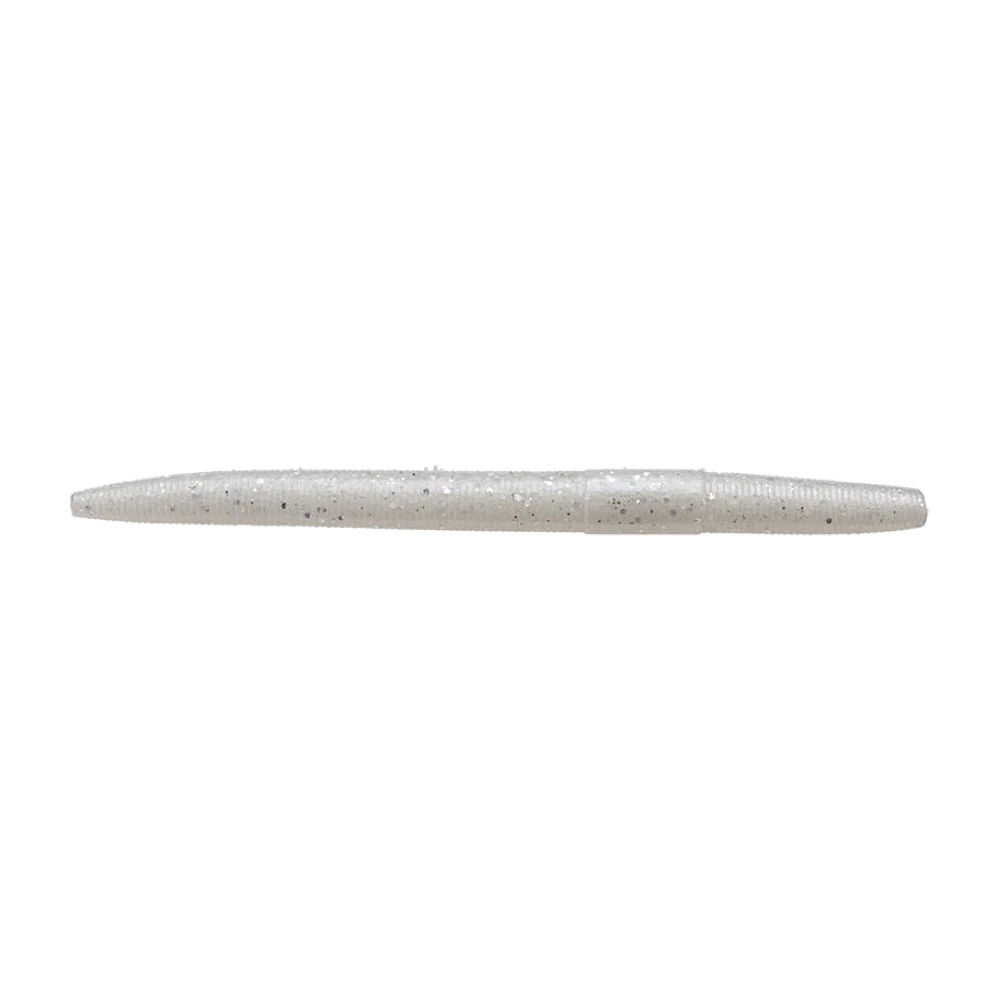
Look at the photo: the body is not smooth, it is ringed with small ribs along its whole length. That is not decoration. Three things follow from it.
First, ribs increase the surface in contact with the water. At equal mass, a ribbed body creates more drag than a smooth one, so it sinks slightly slower and quivers more. That is precisely what you want from this kind of bait: slowing the fall without adding bulk.
Second, they trap micro-bubbles of air on entry, producing a small bubble trail over the first seconds of the drop. A minor detail, but on a fish sitting still and watching the bait fall fifty centimetres from its nose, that kind of detail ends up mattering.
Third, the texture holds the scent the plastic is loaded with. Big Bite states a proprietary scent infused into the material, not a surface coating. In practice a fish that takes the bait holds it a little longer — a second or two more, which is often enough to turn a late-detected bite into a hooked fish.
A horizontal fall, not a vertical one
That is the Trick Stick's central claim, and it deserves an explanation. Most weighted soft worms drop nose-down in a straight line, because the weight is up front. An unweighted stick, by contrast, descends flat if its density is well distributed: it stays horizontal, rolls gently on its axis and undulates with nothing from you.
That attitude changes everything about how a fish sees it. A bait lying flat shows its whole silhouette, stays longer in the field of view, and above all does not look like something trying to escape. A wary bass that has refused a crankbait and a shad will often accept something that sinks slowly without appearing to flee.
Count the fall under your breath, about two seconds per metre. If a bite comes, it will almost always come before you finish counting. The discipline with a stick is to do absolutely nothing during that time.
The three rigs to know
Texas, weighted or not
A wide-gap hook through the nose, then back out and tucked into the body. Unweighted, you keep a perfectly horizontal fall, which suits water under two metres. With a sliding 3-7 g tungsten bullet you get down faster and gain accuracy in wind — but you give up most of the flat fall. Choose on depth, not on habit.
Wacky
A round hook through the middle of the body, at right angles. The bait folds in half and both ends flap on every release. It is the most effective rig on difficult fish and the hardest on the bait: a rubber O-ring around the centre multiplies the number of fish per stick by five or six.
Neko rig
A nail weight pushed into one end, the hook pricked wacky-style a little above it. The bait falls head-down then stands up on the bottom and shivers in place with every small tap of the rod tip. That is the presentation to pull out on hard bottom with inactive fish, when nothing else draws a reaction.
The classic mistake
Working it. It is counter-intuitive, but the Trick Stick does better when you do nothing. The vast majority of bites come during the fall, on a barely tight line. If you cast and immediately start hopping it, you delete the one phase where the bait genuinely works. Cast, let it reach bottom, wait another two seconds, pull it back two metres, and start over.
Tackle and bite detection
Big Bite presents this stick as usable on spinning or casting gear, on light line in open water or on heavier tackle in cover. Both approaches hold up and answer two different situations.
In open, clear water, a light spinning outfit with thin braid and a 0.20-0.25 mm fluorocarbon leader gives the best detection: you see the bite on the line before you feel it. In cover, switch to casting with 20-30 lb braid and a stronger Texas hook, because a hooked fish has to come out of the snag immediately.
Either way, fish on a semi-tight line, never fully slack, and watch the line more than the rod. A bite on a stick is not a thump: it is a line drifting sideways, or one that stops sinking earlier than it should.
Not sure what to tie on?
Photograph your spot: CarnaFish reads the scene, cross-checks the conditions and gives you the zone, the lure and the retrieve. Free on iOS and Android.
The specs, and what the manufacturer does not say
The description Big Bite Baits supplies for the Trick Stick carries no length or weight table — unlike other baits in the range, where sizes and the count per bag are spelled out. In other words, no exact length can be stated here without inventing it, and the packaging remains the only reliable source at the point of purchase. Check it in the shop, especially if you want to match hook or O-ring size to the real diameter of the body.
Colour by water clarity
- Clear water: silver-flake Pearl, exactly the colour shown here, imitating a small baitfish in water the fish can read easily.
- Lightly stained water: Green Pumpkin, the reference colour for soft plastics aimed at bass, natural without being invisible.
- Dark water or low light: Black and Blue, a hard silhouette the fish picks out by contrast.
The right stick in the wrong place catches nothing: it all comes down to choosing the cover and the depth. That is where CarnaFish comes in — a photo of the spot, and the app suggests the zone and the presentation matched to the conditions. To build the method around it, our beginner's guide to bass fishing covers tackle and typical spots.
In the same family, the Yamamoto Senko 5 remains the historical benchmark and the Strike King Ocho offers a faceted body rather than a ribbed one. For an even finer presentation in clear water, the Zoom Finesse Worm steps down a diameter, and the Big Bite Baits B2 Worm stays in the same range with a different profile.
Key takeaways
- Ribbed body: slower fall, stronger quiver and scent held better in the texture.
- The horizontal fall is the whole point of the bait; weight it heavily and you lose it.
- Three complementary rigs: Texas for cover, wacky for difficult fish, Neko for hard bottom.
- Big Bite publishes no size table for this stick: the real length is on the bag.
FAQ
How long is the Trick Stick?
The manufacturer's description for this model has no size table, unlike other baits in the range. The length is printed on the packaging, which is the only reliable source, and we would rather not quote a figure we cannot verify.
Should a soft stickbait be weighted?
Not if you are fishing under two metres: unweighted, it keeps a far more effective horizontal fall. A small 3-7 g weight becomes useful as soon as there is wind, current or more than three metres of water.
Why does my Trick Stick tear so quickly?
Most likely because it is rigged wacky without an O-ring. A simple rubber ring around the middle of the body, with the hook passed under it, greatly extends the life of the bait without changing the action at all.
What is the difference between wacky and Neko?
Wacky-rigged, the bait is hooked in the centre and falls folded in half with both ends flapping. On a Neko rig, a nail weight in one end makes it fall head-first then stand up on the bottom. Wacky covers the water column, Neko works the bottom.
Should the Trick Stick be worked at all?
As little as possible. Almost all bites come during the fall, with no reel input. Cast, let it sink, wait, then pull it back two metres and repeat: that is the whole programme.
Is it good for anything other than bass?
Yes, rigged wacky it also takes good perch regularly, as they respond well to a bait that sinks without fleeing. It has no real value for pike, though, which wants volume and signal, and it would be destroyed in two bites.
The full bass lure guideSeason-by-season strategy: which family of lure, when, and why.Go from theory to fish
CarnaFish reads your spot from a photo and gives you the game plan: zone, lure, retrieve. Free on iOS and Android.