Googan Bandito Bug Craws: the ribbed craw that works on the fall
Before tying this one on, it helps to know if the spot actually calls for it. CarnaFish reads the scene from a photo.
Some days a bass simply will not leave its stump. You can run a crankbait past it ten times and it won't move. Drop a soft craw a foot off the wood instead, let it sink down the trunk without touching the reel, and the slack line swings sideways before the bait ever reaches bottom. The Googan Bandito Bug is cut for exactly that kind of fishing — short, slow, and decided in the first second of the fall.
Ribs that work before the claws do
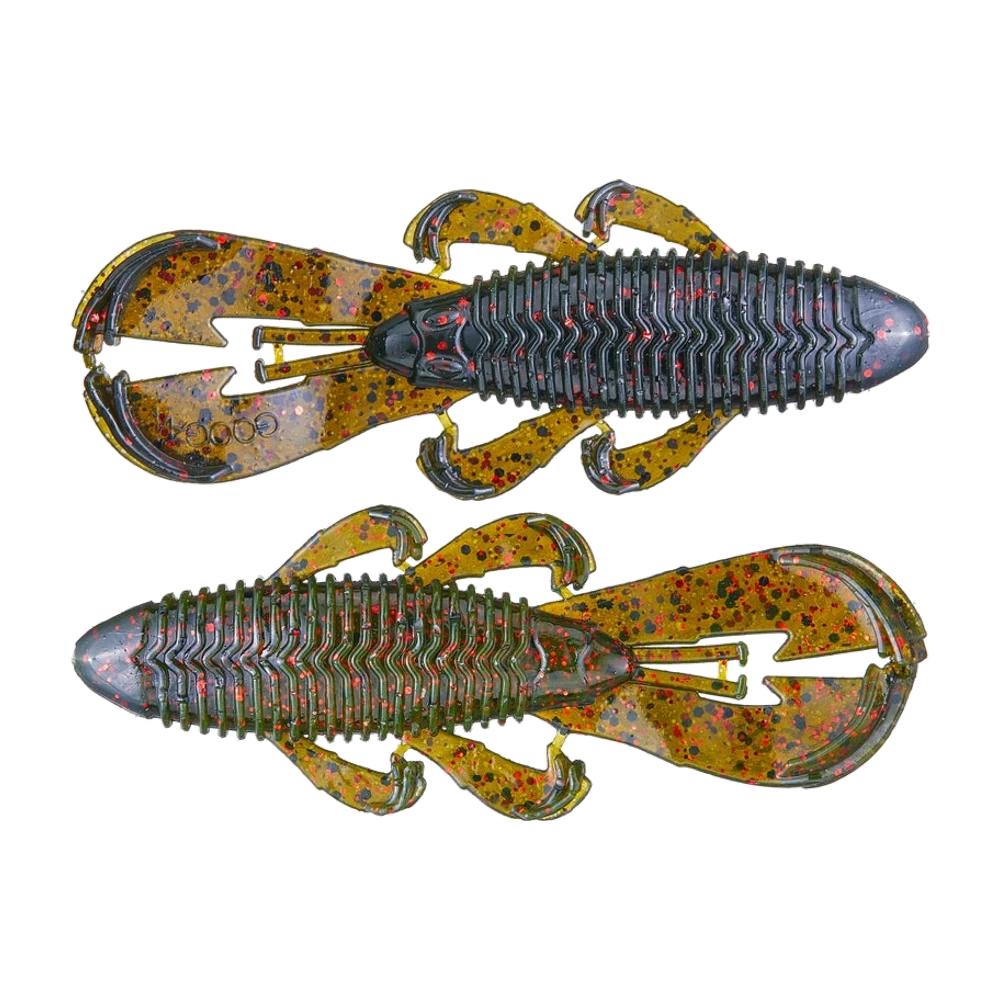
Googan builds this bait around a heavily ribbed body, and it's the first thing you feel in your hand: the raised rings running the length of the back aren't a moulding detail. Each one grabs water and breaks the flow, turning a body that would have sunk in silence into a source of low, continuous vibration you can register the moment the bait moves a couple of inches.
The practical point is simple. A soft craw is fished in contact, where the fish never sees the bait coming from a distance: under a dock, in flooded timber, at the base of a rock. It doesn't pick up the silhouette, it picks up the signal. A smooth body sends almost none on the drop; a ribbed one sends it the whole way down with no input from you. Hence the fact that most bites come while the bait falls, not on the following hop.
Claws that snap instead of waving
The Bandito Bug's claws are elongated, and the manufacturer notes that both the main claws and the several side pinchers carry a raised ridge on their face. That ridge changes the behaviour of the appendage entirely: instead of waving softly like a plain strip of plastic, each claw loads against the water and snaps back. The stated result, and it holds up when you watch it in three feet of clear water, is a lively and fast kicking action rather than a slow flutter.
That distinction matters when you choose. A craw with wide, soft claws such as a Strike King Rage Craw works with big amplitude and shows up from far away: it's the stained-water, active-fish tool. The Bandito Bug plays a tighter, more nervous register that goes down better with a fish that has already seen pressure. The two complement each other in the same box.
Before you commit to a colour or a rig, drop the bait once alongside the boat and watch it. You'll see straight away whether the claws kick or just trail: a Bandito Bug stored folded in a tight bag sometimes keeps a crease that kills the kick on one side. Ten seconds of warm water in your hand and it comes back.
The rigs, and what each one is after
Googan presents this bait as versatile, and the list of rigs it gives does cover genuinely different kinds of fishing. Here's what matters on the water.
Weighted Texas rig, flipping and pitching
This is the priority rig, the one the shape was drawn for. Wide-gap hook buried in the back, tungsten bullet pegged or free depending on how thick the cover is, and short, accurate casts inside thirty feet. The weight is there to get the whole thing through vegetation or branches, not to sink fast. Keep the line tight but never pulled during the drop: that's when the ribs do their work and when the bite comes, usually as a simple sideways move of the slack.
As a jig trailer
The second classic use. Rigged on the back of a skirted jig, the Bandito Bug swaps a soft mass of silicone for two claws that genuinely kick, giving the whole package a far livelier signature on the descent. On a Strike King Tungsten Football Jig dragged across rocky bottom, that difference means a bait that keeps talking when you stop, not only when you move.
On a swinging wobble head
A hinged wobble head rolls the bait along the bottom with a sway no fixed jighead produces. With a ribbed craw on the back, every roll rubs those rings against the substrate and adds a sound component to the signal. An underused rig in Europe, even though it shines over hard bottom and shallow flats.
Carolina rig and shaky head
Two slower search techniques. On a Carolina rig the bait follows freely three feet behind the weight and glides back down after each pull, so the claws work through the whole drift. On a shaky head you drop a notch into finesse, small round head and vibrations imparted on the spot, rod low. For something even more discreet, a Zman TRD Crawz on a ned rig remains the minimalist version of that approach.
Salt and scent: what they actually change
The Bandito Bug is loaded with salt and soaked in the brand's own attractant. The salt makes the plastic denser and steadies the descent, which partly offsets the lift of those wide claws. The scent does not pull fish in from a distance: its useful role, and the manufacturer words it that way, is to lengthen the time a fish holds on to the bait. On a slow presentation where you detect the bite visually, that extra second changes your hookup rate. The trade-off is that a salted bait tears quickly — plan on going through several over a serious day of flipping.
Not sure what to tie on?
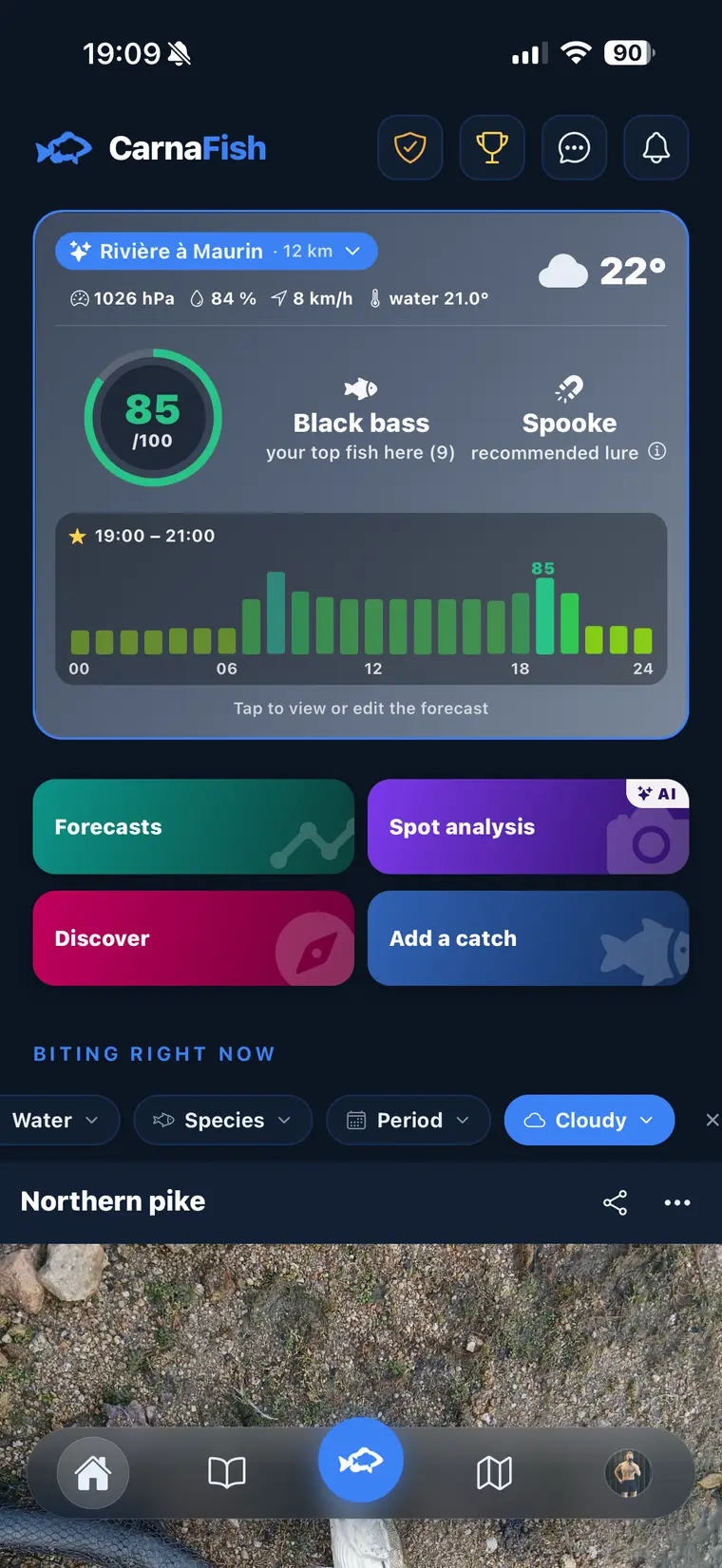
Photograph your spot: CarnaFish reads the scene, cross-checks the conditions and gives you the zone, the lure and the retrieve. Free on iOS and Android.
Dimensions: what the manufacturer doesn't publish
Let's be clear, because plenty of pages online improvise here: Googan publishes no length or weight table for this bait. The official technical description covers the shape, the claws, the salt and the rigs, but gives neither inches nor ounces. We're not going to invent them. Take it as a flipping-size craw — enough volume to carry a wide-gap hook — and pick your weight based on cover rather than on a number nobody states. If exact size decides your purchase, check the package.
The classic mistake
Over-weighting. Out of a reflex to reach bottom fast, a lot of anglers tie on a half-ounce bullet where a quarter would do, and the bait crosses the strike zone in half a second. Yet that drop is exactly what brings the claws and the ribs to life. In shallow flooded timber, come down to 5 or 7 g / 3/16 to 1/4 oz: you'll lose a few seconds per cast and double your bites on the fall.
Colour by water clarity
- Lightly stained water: Green Pumpkin with red flake, exactly the colour photographed here. The flake throws a short glint on every claw beat without blurring the silhouette.
- Dark water or muddy bottom: Black and Blue, a hard silhouette that reads by contrast rather than by colour.
- Clear water over gravel: Watermelon, more muted, for a fish that inspects a bait before taking it.
Picking the right craw is pointless if you put it in the wrong place: on this kind of fishing, reading cover matters more than the bait itself. That's exactly what CarnaFish makes easier — a photo of the spot, and the app suggests the zone to work and a presentation suited to the day's conditions. For tackle and bass-spot fundamentals, our beginner's guide to bass fishing sets the scene first.
Key takeaways
- The ribbed body puts out continuous vibration during the fall with no input at all — that's where most bites land.
- The ridged claws kick fast and hard, a more nervous register than the big soft-clawed craws.
- Four rig families that genuinely earn their place: weighted Texas, jig trailer, wobble head, and finesse on a Carolina rig or shaky head.
- Googan publishes no length and no weight for this model: choose your weight by cover, not by a number.
FAQ
What size is the Bandito Bug?
Googan publishes no dimension table for this bait, neither length nor weight. It's a flipping-size craw, big enough to carry a wide-gap hook, but the exact dimension doesn't appear anywhere in the manufacturer's documentation.
Texas rig or jig trailer — which is better?
Both work, but they're after different things. The weighted Texas rig is the short-range approach in dense cover. The jig trailer exists to bring a bottom-contact jig to life, above all during the pauses.
Why aren't my claws kicking?
Usually because the bait kept a crease from its bag. Warm it in your hand or in the water for a few seconds before rigging. Also check you aren't fishing too heavy: an oversized bullet crushes the fall and denies the claws the time to work.
Is it good for anything other than bass?
It's a bait drawn for bass and its typical cover. A big perch may hit it on a shaky head, but the volume stays substantial for that species, and nothing in the manufacturer's description targets anything else.
What weight should I flip with?
Start at 7 g / 1/4 oz in flooded timber or sparse pads, and only go to 10 or 14 g / 3/8 to 1/2 oz if the vegetation is genuinely thick or the wind stops you following your slack. The weight is there to get through cover, not to sink fast.
The full bass lure guideSeason-by-season strategy: which family of lure, when, and why.Go from theory to fish
CarnaFish reads your spot from a photo and gives you the game plan: zone, lure, retrieve. Free on iOS and Android.