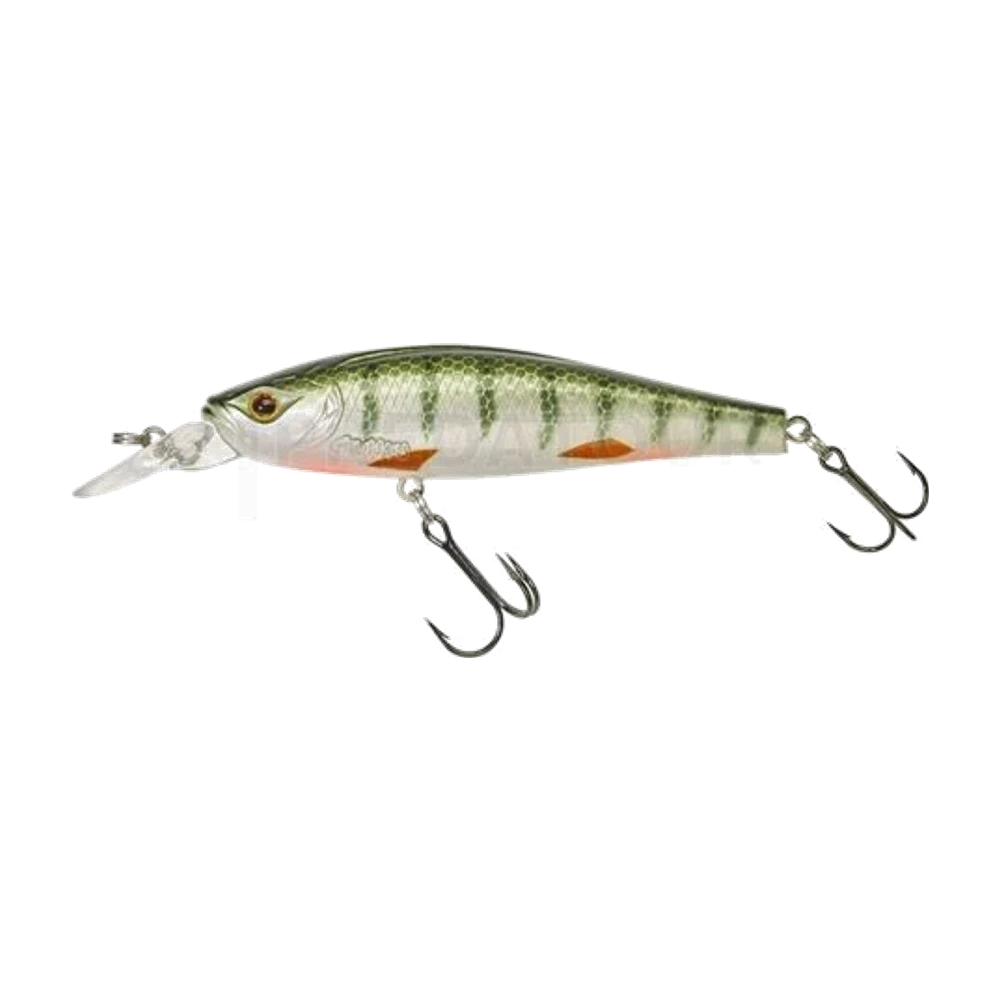
Gunki Gamera: the crankbait you have to trip up before it catches
Rather not fish it blind? Photograph your spot — CarnaFish cross-checks the conditions and points you the right way.
There is a situation that turns up everywhere: a cluttered margin, stumps, boulders, a metre and a half of water, and the obvious feeling that there are fish in there. You run a lure cleanly over the lot, without snagging, without touching anything — and nothing happens.
That makes sense. A perch or a bass sitting against cover does not react to a lure filing past at a respectful distance. It reacts to something that comes and bumps into its shelter, kicks sideways and seems to lose control. The Gamera is built for that: to go and hit, to deflect, and to get caught out at the wrong moment. This is not a crank you retrieve, it is a crank you steer through cover.
A crank built to hit, not to avoid
Three technical choices set this format apart from classic searching cranks.
- A short, deep body. It pivots fast. Instead of bouncing dumbly off an obstacle, the lure kicks hard sideways over twenty or thirty centimetres before picking its line up again. It is that sideways kick, not the knock itself, that triggers the attack.
- A wide, short lip. It caps the depth at around 1 to 2 m, but it lifts the nose the moment it catches, which limits the number of times it jams in dead wood.
- A wide roll from low speeds. You can slow right down to the edge of stalling without the lure stopping working, which is essential in cold water or on passive fish.
Size for size, those three parameters point the lure towards contact fishing rather than sweeping large areas. Remember it: this lure gives you nothing out in open water.
The retrieve: provoke the contact, then hesitate
- Cast beyond the obstacle, never onto it. You want the lure at its running depth before it reaches the zone, which takes two or three metres of travel.
- Retrieve at medium speed, rod tip low, rod at ten o'clock rather than pointed at the lure.
- On the first contact, do not pull. Give back half a turn of the handle. The lure rises a few centimetres, frees itself, and kicks off sideways.
- Pause for one second just after it comes free. That is the most frequent bite window.
- Speed up briefly over two turns, then go back to the normal rhythm until the next contact.
The classic mistake is striking on the first knock. Nine times out of ten it is wood, not a fish. Learn the difference: an obstacle is dry and momentary, a bite on a crank is a weight that settles in and pulls.
On the water: when you really do snag, whatever you do, do not pull in line with it. Give slack straight away — two metres of it — and wait five seconds. The crank floats, it comes up over the branch on its own, and you pick the retrieve back up without wrecking the spot or losing the lure.
Setting the depth without changing model
The lip sets a range, but you shift that range by several tens of centimetres with three free adjustments.
| Adjustment | Effect on depth | When to use it |
|---|---|---|
| 0.25 mm fluorocarbon straight through | Benchmark, 1 to 2 m | Standard use |
| 0.20 mm fluorocarbon | Runs 20 to 30 cm deeper | Hard bottom, need to scratch |
| 0.30 mm mono | Runs 20 to 30 cm shallower | Low weed, dense wood |
| Long cast, rod low | Maximum depth held longer | Even flat |
| Short cast, rod high | Restricted action, 60 cm to 1 m | Very shallow margins |
A fourth lever, often forgotten: the position of the boat or the angler. Fishing parallel to a margin keeps the lure in the right water layer for the whole retrieve, whereas a perpendicular cast only puts the crank at the right level for two or three metres.
The rod matters as much as the lure
A contact crank on a stiff rod means a run of dropped fish. The trebles are small, a perch's mouth is fragile, and the fish comes off the moment it shakes its head.
Aim for a through or semi-through action, medium power, with a tip that absorbs. And above all, do not strike. With a crank, you go with it: you feel the weight, you drop the rod in one movement, you keep winding and you let the lure pin itself. A sharp hookset tears out as many fish as it hooks.
Line-wise, fluorocarbon straight through stays the best compromise: it transmits contact with cover, letting you read the bottom, while keeping a little stretch. If you use braid, add a leader of at least a metre.

Not sure what to tie on?
Photograph your spot: CarnaFish reads the scene, cross-checks the conditions and gives you the zone, the lure and the retrieve. Free on iOS and Android.
Where it takes the lead, where it has no business
The Gamera's natural playground:
- Cluttered margins of 0.8 to 2 m: stumps, boulders, rock piles, bridge piers.
- Rivers and small canals where fish sit tight to shelter and the usable water layer is thin.
- Spring and autumn, when perch hold in contact with the bottom and hunt crawfish.
- Slightly stained water, where vibration counts for more than sight.
Where it is useless:
- Open water and large deep expanses. Its running range is too short, you would be fishing thin air.
- Very clear water and educated fish in high summer: the signal is too strong, a discreet soft plastic takes over.
- Dense weed. The trebles pick up everything; a weedless soft plastic comes through and the crank does not.
Gamera or a small Japanese diving crank
The natural comparison is the Illex Diving Chubby 38. Both are compact perch cranks, but they answer different questions. The Diving Chubby is a finesse lure: smaller, slower, it excels in clear water on wary fish and fishes happily on a clean straight retrieve. The Gamera is bulkier, louder, and it needs structure to express its deflection. Along a smooth margin in clear water the Chubby comes first; as soon as there is wood and a bit of colour in the water, the relationship reverses.
Against a bigger squarebill such as the Strike King KVD Squarebill, the Gamera trades range and bulk for the ability to keep perch interested: the compact size stays acceptable for a 25 cm fish, which is not the case for an American squarebill cut for bass.
And when a margin gets too cluttered for trebles, switch to a weedless soft plastic such as the Gunki Grubby Shad to finish the spot without wrecking it. Our guide to perch fishing with lures details that sequence. And if you are unsure what depth to target in front of an unfamiliar margin, CarnaFish analyses a photo of the spot and answers.
Key takeaways
- A contact lure: with nothing to hit, it loses most of its point.
- After each knock, give back half a turn then pause for a second — that is the bite window.
- When you snag, give slack: the crank floats and frees itself.
- Line diameter shifts the depth by 20 to 30 cm in either direction.
- Through-action rod and no sharp hookset, or you will drop perch.
FAQ
How deep does the Gunki Gamera run?
Between 1 and 2 m on 0.25 mm fluorocarbon and a long cast. Finer line takes it 20 to 30 cm deeper, heavier mono keeps it that much shallower.
Should I strike on a crankbait?
No, not sharply. You go with it: as soon as you feel the weight, drop the rod and keep winding. The treble pins itself, and you avoid tearing a perch's fragile mouth.
How do I avoid losing the lure in wood?
Never pull in line with it when it catches. Give two metres of slack and wait a few seconds: the floating body rises above the obstacle and frees itself on its own most of the time.
How does it differ from the Illex Diving Chubby 38?
The Diving Chubby is smaller and more discreet, cut for clear water and a clean straight retrieve. The Gamera is bulkier, works through deflection and needs cover to show what it can do.
Which colours should I favour?
Crawfish imitations, browns and oranges, over rocky bottom in spring and autumn. In coloured water, light tones or a marked belly that stand out better in poor visibility.
Does it catch pike?
Occasionally, but that is not its target and the rig is not suitable: without a wire trace, a pike take cuts you off cleanly. If pike are present on the spot, use a discreet trace or change lure.
The full perch lure guideSeason-by-season strategy: which family of lure, when, and why.Go from theory to fish
CarnaFish reads your spot from a photo and gives you the game plan: zone, lure, retrieve. Free on iOS and Android.