Evergreen Wild Hunch 5: the compact crank that works 1.2-1.5 m down
Not sure this lure fits YOUR spot today? CarnaFish tells you in 10 seconds, from a photo.
There comes a point on a busy fishery where every classic crankbait has already been shown to the fish a hundred times that season. That is the ground Evergreen claims for the Wild Hunch 5, a short, deep-bodied crank designed by Morizo Shimizu and brought back to the catalogue with the same attributes it had when he used it at the 2014 Bassmaster Classic on Lake Guntersville. A lure whose name, to begin with, tells you neither its size nor its depth.
The real numbers, and what the name suggests
The maker's table gives a single line, but a complete one: 2 in, or 5.1 cm, for 5/16 oz, which is 8.9 g, a diving range of 4 to 5 ft, that is 1.2 to 1.5 m, and the class Floating.
So the "5" in the name is neither a length in inches nor a depth in feet. It is a model reference, nothing more, and it is worth knowing before you order. What the table really says is that this is a very short and relatively heavy lure: 8.9 g for 5.1 cm is the density of a 6 or 7 cm crank squeezed into a far more compact body. On the cast that translates into a stable trajectory and honest distances despite the small size, which is rarely true of short cranks.
There is also a tension worth flagging in the maker's copy. It talks about the ability to go deeper in the water column, while the only figure in the table tops out at 1.5 m. Those two statements do not describe the same lure, and the table is the one that counts: the Wild Hunch 5 is a shallow-running bait. The depth claim should be read as a comparison with other compact lures of the same family, not as a promise to cover three metres. If the 2.5 to 4 m band is what you need, look at a large Rapala Shad Rap or a genuine deep crank instead.
Stealth and vibration in the same body
The copy pairs two qualities that normally pull in opposite directions: a stealthy lure, and a strong vibration. That is less contradictory than it sounds once you look at the body shape.
A short, deep body with fairly flat sides produces a wide roll — the lure tips from one flank to the other with every oscillation — rather than a fast, noisy wobble driven by the lip. The signal it sends is therefore strong in water displacement but poor in clicks and high-pitched noise. That is exactly what an angler wants on pressured water: movement a lateral line can read, without the acoustic signature fish have learned to associate with danger. A Lucky Craft Flat Cra-Pea plays in the same flat-sided register.
On a spot others have already worked, do not change lure first: change the line you run. A crank passing thirty centimetres from an obstacle nobody has brushed gets bitten more often than a brand new lure cast down the same track as the last ten.
Contact, and the buoyancy that makes it possible
The Floating class in the table is the single most usable piece of information on the whole spec sheet. A floating crank rises the moment you stop reeling, and that opens two uses.
The first is deflecting off cover. The maker highlights the lure's ability to avoid snags; that is primarily a consequence of buoyancy. When the lip hits a stump or a rock, slackening for a second is enough: the body rises, pivots and sets off again above the obstacle. A sinking crank in the same situation drops and buries itself.
The second is the trigger effect of the pause. Many bites on a floating crank come not during the retrieve but during the rise that follows contact with bottom or wood. The lure abruptly changes direction and speed, and it is that change, more than the continuous vibration, that makes a following fish commit.
Setting the retrieve speed
With a 1.2 to 1.5 m range, you do not need to speed up to reach maximum depth. A steady retrieve, slow to medium, is enough. Speeding up does not take a medium-lip crank much deeper: mostly it lifts it off the bottom and costs you the contacts that trigger strikes. Keep a slow hand and let the lip look for the substrate.
Not sure what to tie on?
Photograph your spot: CarnaFish reads the scene, cross-checks the conditions and gives you the zone, the lure and the retrieve. Free on iOS and Android.
Where to run it
Its natural ground is 1 to 2 m of water where the lure can touch. Soft breakline edges, rocky flats, sunken wood whose position you already know, low weed early in the season. In rivers, the slow seam behind an obstruction, where the crank works against the flow without you having to reel fast.
The 5.1 cm format also opens a use the copy, written for bass, never mentions: in Europe it is an excellent perch calibre. A compact crank with a wide roll running at 1.5 m matches the way perch hold on rocky humps in late summer, and the stock Japanese trebles are fine enough to pin a hard mouth.
The classic mistake
Clipping it to a heavy snap swivel to save time. On an 8.9 g body, a thick snap adds weight at exactly the wrong point, right in front of the lip: the attitude noses down, the roll closes up and the lure loses half its amplitude. A direct knot or a fine round-wire snap solves it in ten seconds.
Colors by season and water
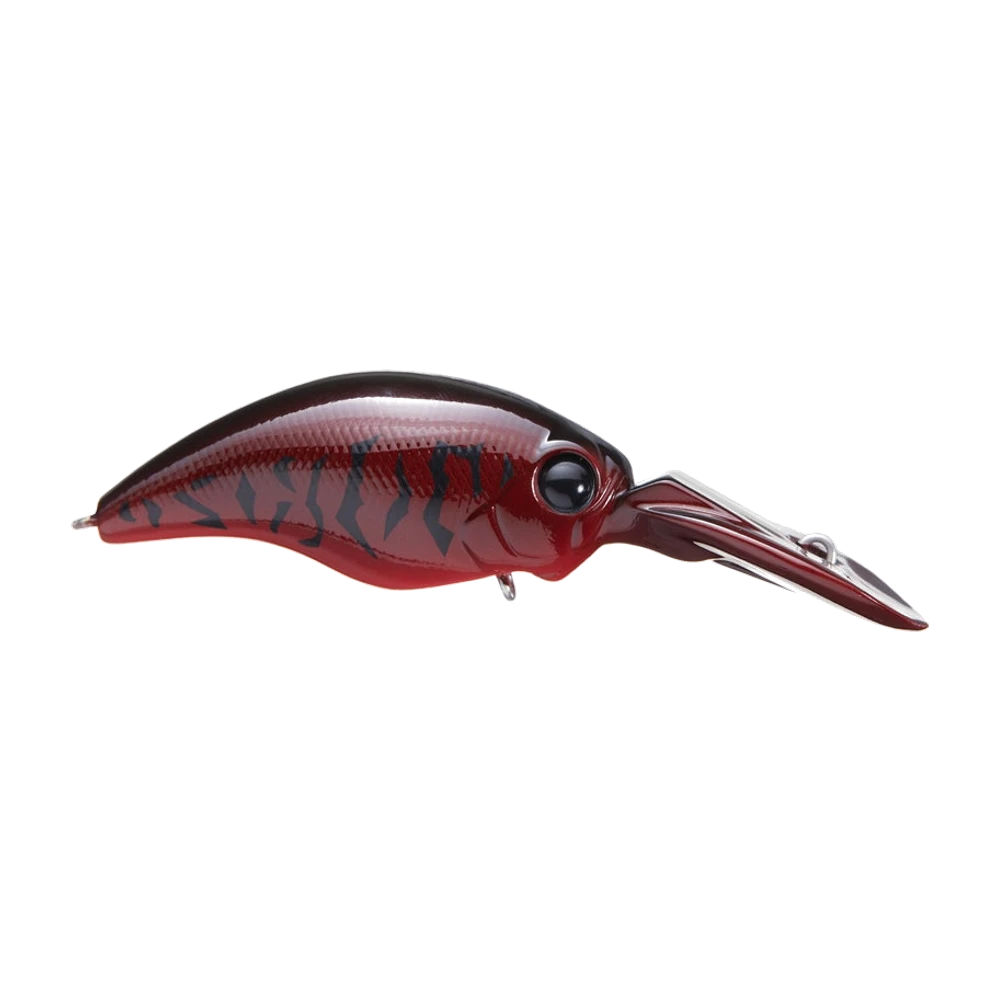
- Spring, cool water, rocky bottoms: the red crawfish pattern with black bars, the one in the photo on this page. That is when crayfish are active and this pattern beats any baitfish finish.
- Clear water, summer: a natural silver or gold, more believable when fish can see well and the dominant prey are coarse fish.
- Coloured water or late in the day: a plain dark back, which gives a clean outline despite low visibility. In that water, silhouette and vibration do the work, not the detail of the finish.
The right crank is useless if you run it in the wrong place, and that is exactly what CarnaFish fixes: one photo of the spot and the AI suggests the zone to attack, the depth to target and the lure type that fits the day. To learn to spot those breaklines and flats yourself, our guide to reading a fishing spot sets out the method, and the Evergreen Combat Crank rounds out the range on other depth bands.
Key takeaways
- One line in the table: 5.1 cm for 8.9 g, a 1.2 to 1.5 m range, class Floating.
- The "5" in the name is neither a length nor a depth, just a model reference.
- The copy promises more depth, the table stops at 1.5 m; the table is the one to trust.
- Buoyancy is what makes obstacle deflection possible and what turns the pause after contact into the key moment.
FAQ
How deep does the Wild Hunch 5 run?
The maker's table states 4 to 5 ft, which is 1.2 to 1.5 m. The marketing copy mentions an ability to go deeper in the column, but no figure supports it: sticking to the table's 1.5 m avoids disappointment.
What are its exact size and weight?
2 in, or 5.1 cm, for 5/16 oz, which is 8.9 g. That is dense for the length, which is why the lure casts properly despite its compact format.
Is the Wild Hunch 5 floating or sinking?
Floating, as the class column of the table states explicitly. That is what lets it rise as soon as you stop reeling and skirt a stump rather than bury itself in it.
Is it a perch bait?
Yes, that is one of its good uses in Europe. A 5.1 cm body working between 1.2 and 1.5 m suits perch holding on rocky humps, and the fine stock trebles pin a hard mouth well.
Do I need to reel fast for it to reach depth?
No. With a lip this size, speeding up does not take the lure much deeper and mostly costs you bottom contact. A slow to medium, steady retrieve produces better results.
Can I fish it on a snap?
Yes, but only a fine round-wire snap. On an 8.9 g body, a thick snap adds weight right in front of the lip, drops the nose and closes the roll.
The full bass lure guideSeason-by-season strategy: which family of lure, when, and why.Go from theory to fish
CarnaFish reads your spot from a photo and gives you the game plan: zone, lure, retrieve. Free on iOS and Android.