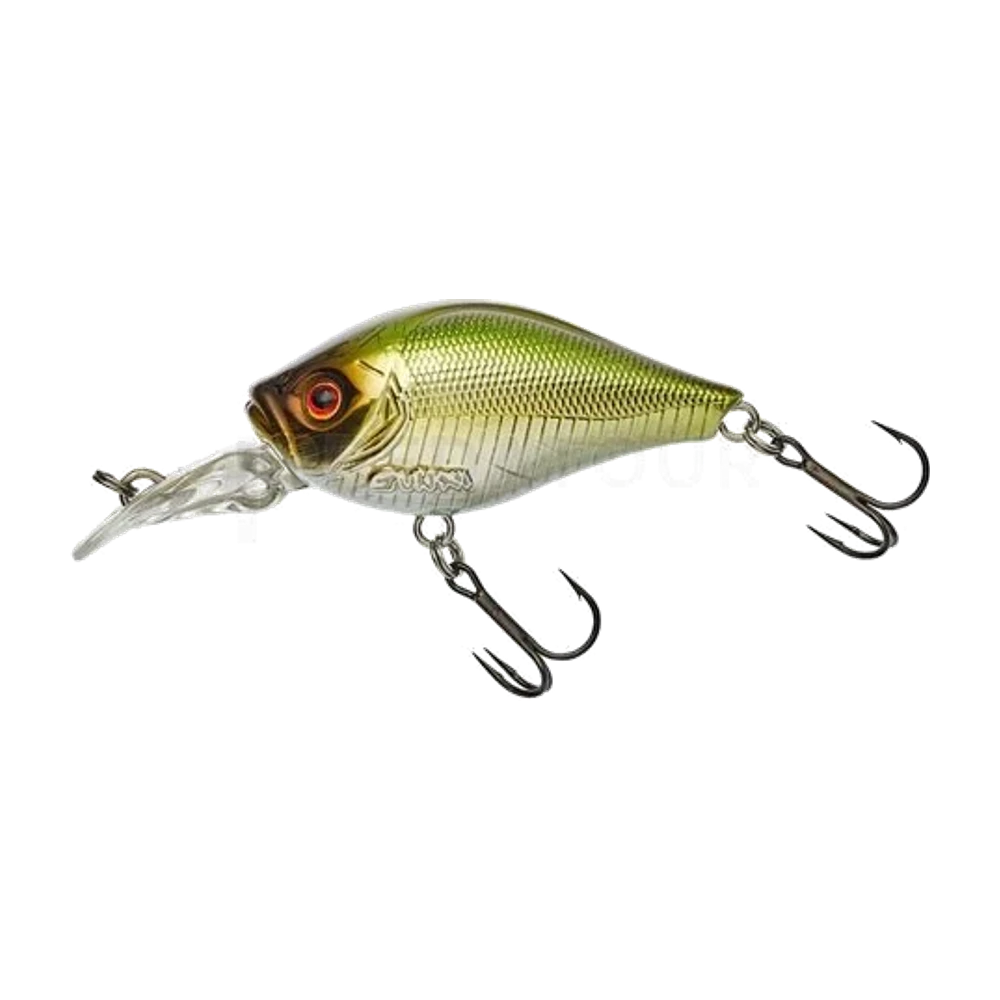
Gunki Gigan: the minnow built to cast far into a headwind
This lure shines under specific conditions. CarnaFish tells you in 10 seconds if today is one of them.
Every bank angler knows the situation: the margin is empty, the fish are twenty metres further out, and the wind is blowing straight at you. You tie on your usual minnow, it helicopters, it lands at fifteen metres, and you spend the afternoon fishing water that holds nothing.
The Gigan is designed for that exact situation. Its mass moves to the back during the cast, giving it a flat trajectory and a distance a minnow of the same size cannot reach. Then, once in the water, the mass returns to place and the lure swims like a normal minnow.
This is not a lure with a spectacular gimmick. It is a lure that lets you reach the zone the fish are in, which remains the number one factor in success, ahead of any consideration of action or colour.
What a weight-transfer system changes on a minnow
A hardbait that does not manage its mass on the cast spins in flight. It brakes, it loses distance, and it sometimes arrives with the line wrapped round the trebles.
On the Gigan, a moving weight slides back inside the body at the moment of the cast. Three effects follow:
- The tail goes first, the lure flies straight, with no rotation. The distance gained is real and you feel it on the first cast.
- A three-quarter headwind becomes manageable. You still lose metres, but you no longer lose control of the trajectory.
- Tangles decrease, which counts for more than you would think over a session of two hundred casts.
On impact, the weight returns forward and the lure recovers its swimming balance. One practical point: give it half a second before starting the retrieve. If you start instantly you can be winding before the weight is back in place, and the first second of the action is then unstable.
The retrieve: two rhythms depending on the species
The Gigan takes two very different treatments, and the choice depends more on the target fish than on the season.
For pike, on a brisk straight retrieve:
- Cast as far as you can, leave it half a second, then start.
- Retrieve steadily, medium to brisk. The action is tight and you feel a fine, continuous vibration in the handle.
- Every eight to ten turns, accelerate hard for two turns then go back to the original rhythm. That break simulates an escape and triggers followers.
- Slow down over the last three metres and work a definite figure of eight at the bank. Follows very often end there.
For zander, on short twitches:
- Count the sink after the cast to place your water layer.
- Two short jabs of the rod tip, sharper than round, with little amplitude.
- Pause for two to three seconds. The lure rolls onto its flank and settles.
- One turn of the handle, then start again. Zander almost always take during the pause or on the pick-up.
On the water: when you are fishing into the wind, do not cast flat. Cast low, almost parallel to the surface, following through with the rod towards the front at the end of the movement. You pass under the strongest layer of wind and comfortably gain five to eight metres — more than any lure change will give you.
Depth and speed: the table that prevents mistakes
Running depth depends as much on speed as on the lip. With this kind of minnow, slowing down does not take the lure deeper: it brings it up.
| Situation | Speed | Depth obtained |
|---|---|---|
| Fast searching, active fish | Brisk | 1.4 to 1.8 m |
| All-round setting | Medium | 1 to 1.4 m |
| Cold water, apathetic fish | Slow with pauses | 0.8 to 1.1 m |
| Over a weed bed | Medium, rod high | 0.5 to 0.9 m |
Rod position is the simplest and most neglected adjustment. Tip pointed at the water and you gain twenty to thirty centimetres of depth. Tip high and you come up by the same amount. That is often all you need to adjust to pass just over a weed bed instead of ploughing it.
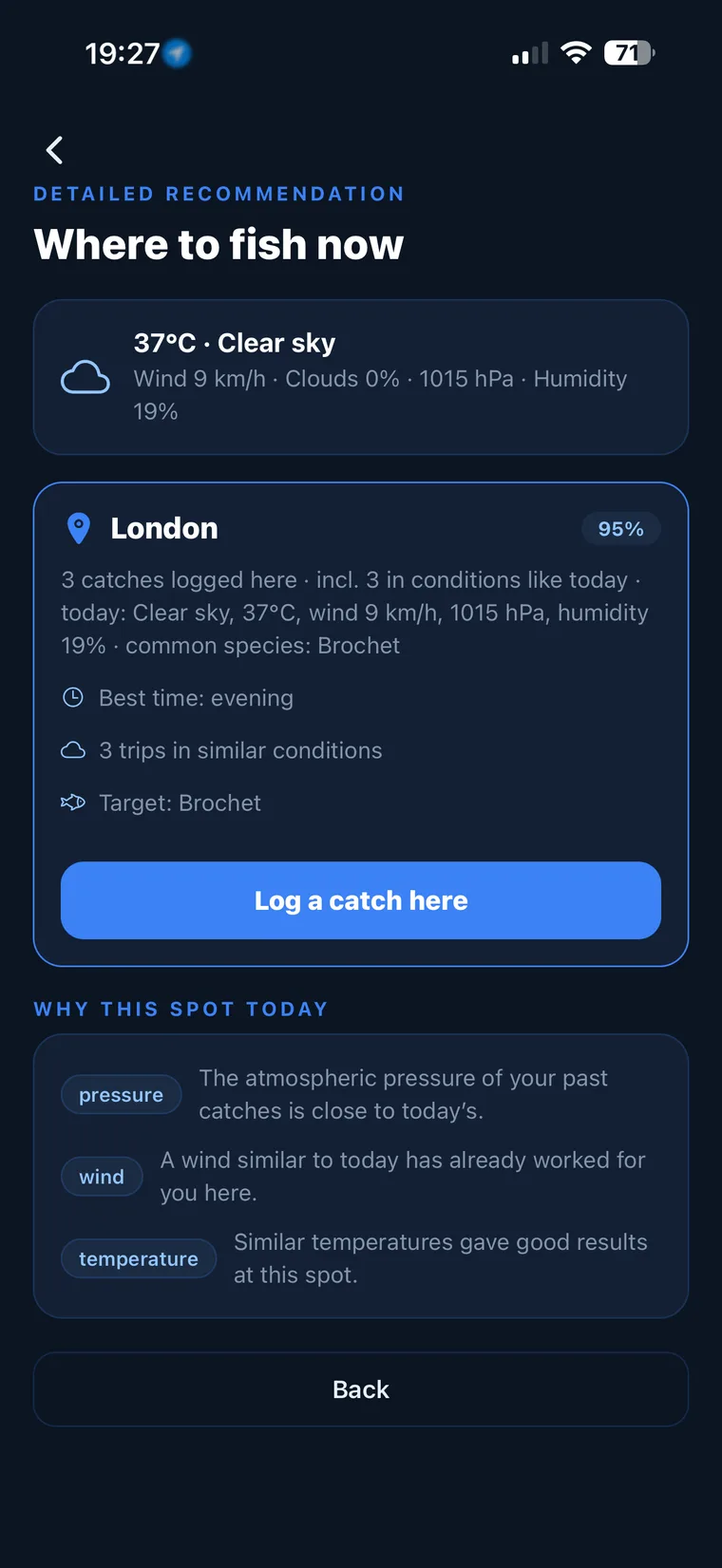
Not sure what to tie on?
Photograph your spot: CarnaFish reads the scene, cross-checks the conditions and gives you the zone, the lure and the retrieve. Free on iOS and Android.
The spots that suit it, and those that do not
The Gigan is a lure for big water and distance.
- Large lakes and reservoirs, from the bank, when the fish are out of reach of standard lures.
- Dykes and rock armour where you have to cast parallel to the structure over thirty metres.
- Windswept margins: churned water concentrates the forage, and it is often the most productive zone of the day, the one most anglers avoid precisely because of the wind.
- Wide rivers on an across-and-down retrieve, along zander margins.
It has no interest, on the other hand, on a short cluttered spot: a small pond, a narrow canal, a hole under a branch. At twenty metres of useful range the advantage of the weight transfer disappears, and a minnow with a wider or more erratic action will do the job better. It is also poorly suited to very shallow areas with no clearance, where it catches the bottom within the first few turns.
Gigan or Whiff
The Gunki Whiff plays the opposite register: a wider action, less predictable movement, use on tight spots at short range. It is the lure for the angler who wants to provoke a reaction at five metres.
The Gigan is built for the reverse problem: reaching fish when they are far out, with a steady action that holds for the whole length of the retrieve. The two complement each other well in the same box, because they answer different questions. If you are after zander down deep, a soft plastic on a jig head stays more effective as soon as you go past two metres.
Our guide to choosing a pike lure covers how to combine minnows, soft plastics and blades through the seasons. And if you are unsure how far out to place your lure in front of a big water, CarnaFish analyses a photo of the spot and answers.
Key takeaways
- The weight transfer gives a flat trajectory and real metres on the cast, especially in wind.
- Leave half a second after impact before starting: the weight has to return to place.
- Brisk straight retrieve with accelerations for pike, short twitches and two to three second pauses for zander.
- Rod tip position sets the depth as effectively as changing model.
- With no distance to cover it loses its point: on a tight spot, pick a lure with a wider action.
FAQ
How far can you cast a Gunki Gigan?
That depends on size, rod and wind, but the gain over a minnow of equivalent weight without a transfer system is clear, in the order of several metres. Cast low and flat rather than lobbing it if you want to make the most of it.
How deep does it run?
Between 0.8 and 1.8 m depending on size and speed. A brisk retrieve with the rod tip at the water takes it to its maximum; a slow retrieve with the rod high keeps it in the first metre.
Is it suitable for zander?
Yes, by changing the retrieve. Zander respond better to short twitches followed by two to three second pauses than to a straight retrieve, and bites almost always come during the pause.
Do I need a wire trace for pike?
Fluorocarbon of 0.40 to 0.50 mm is enough in most cases and preserves the lure's action better, but it does not completely remove the risk of a cut-off on a badly placed take. On a zone with a high density of pike, a soft wire trace is safer.
Can I use it with a clip?
Yes, provided it is small and light. Too heavy a clip unbalances the front and disturbs the action as much as the flight.
What if it still spins on the cast?
First check that you are not lobbing it, then that the trebles are not too heavy. An oversized replacement treble at the back cancels part of the benefit of the weight transfer.
The full pike lure guideSeason-by-season strategy: which family of lure, when, and why.Go from theory to fish
CarnaFish reads your spot from a photo and gives you the game plan: zone, lure, retrieve. Free on iOS and Android.