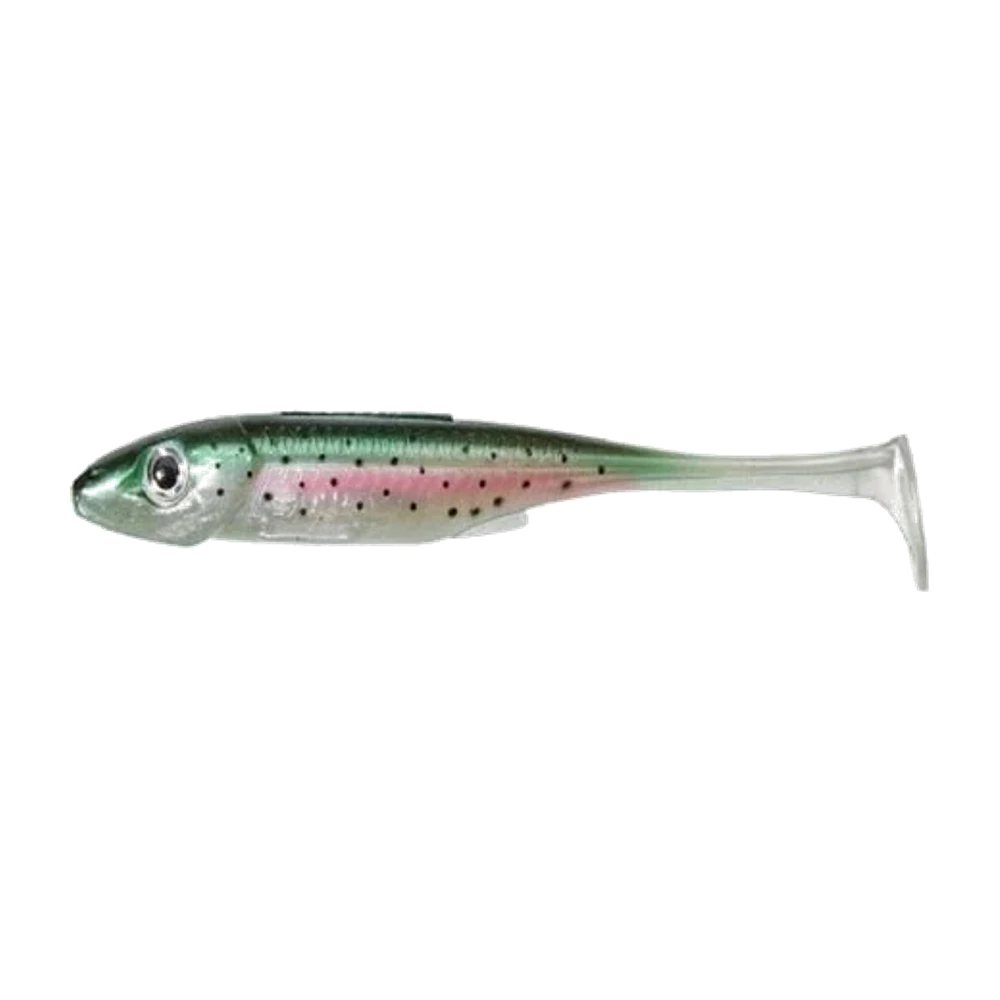
Gunki Whiff: the margin jerkbait for the quiet hours
One lure, endless conditions. CarnaFish reads your spot from a photo so you are not just guessing.
You learn to fish for zander from the bottom: jig head, lifts, drop-offs at five metres. That is right most of the time, and it is also what makes you miss an entire window — the one where zander leave the depths and come to hunt in the margins, in a metre of water, against a quay wall or a rip-rap bank, between sunset and full dark.
During that window, a lure scraping the bottom passes underneath the fish. They are above it, pinned against the wall, hunting small fish that are pinned there too.
The Whiff is cut for that slot: slim profile, low volume, a high-running action and tight lateral darts that stay readable at short range. This is not a searching lure, it is a margin lure.
Why a slim profile rather than a shad
Three technical reasons, none of which has anything to do with fashion.
It fishes high with no effort. A soft plastic on a jig head, even a light one, wants to sink. In a metre of water you spend your time correcting. The suspending jerkbait holds its layer on its own and lets you concentrate on the retrieve.
Its silhouette matches the prey of the moment. The fry and bleak that pin themselves to artificial banks at dusk are slim and bright. A thick shad looks like nothing that is actually there.
It produces flash without vibration. The flat flank throws back the low evening light on every lateral dart. Zander, whose low-light vision is excellent, pick up that signal from a long way off — without being alarmed by an aggressive push of water.
The retrieve along a wall
This is fishing on a parallel track, not fan casting.
- Stand right against the bank and cast along the wall, less than a metre out from it, as far as you can.
- Let the lure settle for two seconds, long enough for it to reach its layer.
- Give two short twitches from the wrist, 20 to 30 cm of travel, without lifting the rod.
- Stop for three seconds. The lure hangs suspended against the wall.
- Repeat all the way in, keeping the lure in the first metre of water against the wall.
- Do not neglect the last two metres: a lot of bites come at your feet, as the lure runs along the corner of the quay.
For perch, during the day, change the tempo: more twitches, faster, with pauses of only a second. Perch react to agitation, zander to stillness.
On the water: at dusk, do not change colour every ten minutes — change angle. A pale lure seen backlit against the still-bright side of the sky and the same lure seen from the dark side present completely different silhouettes. Move twenty metres along and fish the wall in the other direction before you conclude it is not working.
Setting the running depth
| Water depth | Line | Rhythm | Pause |
|---|---|---|---|
| 40 to 80 cm | 0.18 mm fluoro | 2 short twitches | 2 s |
| 1 to 1.5 m | 0.22-0.24 mm fluoro | 2 long twitches | 3 to 5 s |
| Active perch, daytime | 0.08 mm braid + 0.20 mm fluoro | 4 fast twitches | 1 s |
| Coloured water, after rain | 0.24 mm fluoro | 1 long twitch | 4 s |
Line diameter is your main depth control: heavy fluorocarbon drags the lure down by twenty to thirty centimetres, which is enormous in a metre of water. In very shallow water, drop the diameter rather than altering the retrieve.
For the rod, aim for an L or ML in 2 m to 2.30 m, with a tip soft enough not to tear the hook out of a zander's mouth — hard and bony, it comes free easily if you strike too sharply.

Not sure what to tie on?
Photograph your spot: CarnaFish reads the scene, cross-checks the conditions and gives you the zone, the lure and the retrieve. Free on iOS and Android.
The spots to cover, and the ones to skip
It gives its best on:
- Quays and sheet-pile banks on canals and river ports, an hour before and an hour after sunset.
- Reservoir rip-rap, especially the windward side, where the water is churned and the baitfish gather.
- Lock outflows and bridge footings, where fry pile up in the slow eddies.
- Pond margins in autumn, on perch circling fry shoals at the surface.
It is out of place:
- In deep water: beyond two metres you do not reach the fish and a weighted soft plastic takes over.
- In sustained current, where its low weight cannot hold a track.
- On big zander sitting on the bottom, which will not come up for a six-centimetre lure.
- In the middle of a summer day, when the fish have gone deep and the margins are empty.
Whiff or a longer minnow
A nine-centimetre minnow such as the Illex Squad Minnow 95SP covers more ground, runs a little deeper and interests pike more. It makes more sense for searching a long lake margin. The Whiff plays on discretion and low volume: it catches where the fish refuse bigger silhouettes, particularly on heavily fished canals.
Against a shad on a light jig head, the difference is holding the layer: the soft plastic sinks as soon as you stop, the jerkbait stays put, which is decisive in a metre of water. And if the zander turn out to be pinned to the bottom rather than in the margins, go back to a vertical approach with a slim shad such as the Fox Rage Zander Pro Shad.
Our beginner's guide to lure fishing for zander explains how to spot these activity windows by time of day and season. And if you are torn between fishing the margin or looking for the bottom when you arrive on a canal, CarnaFish analyses a photo of the spot and answers.
Key takeaways
- A margin and quiet-hours lure: dusk, quays, rip-rap, a metre of water.
- The jerkbait holds its layer on its own where a soft plastic sinks — a decisive advantage in shallow water.
- Set the depth with line diameter before you touch the retrieve.
- Zander: short twitches, long pauses. Perch: fast twitches, short pauses.
- Pointless in deep water, in strong current, or in the middle of a summer day.
FAQ
Can you really catch zander on a jerkbait?
Yes, within a precise window: when zander come up to hunt in the margins, essentially at dusk and at night, along quays and rip-rap. On fish sitting on the bottom during the day, a weighted rig remains far more effective.
What time should I fish the margins with a jerkbait?
The most reliable window runs from roughly an hour before sunset to an hour after. Dawn works too but often more briefly, and full-moon nights sometimes stretch the activity out.
How do I make the lure run shallower?
Drop your fluorocarbon diameter: going from 0.24 to 0.18 mm lifts the run by twenty to thirty centimetres. That is a more reliable adjustment than trying to hold the lure up by raising the rod.
What rod for a 5 g jerkbait?
An L or ML rod of 2 m to 2.30 m, with a reasonably soft tip. Too stiff and you tear the hook out of a zander's mouth, which is hard and comes free easily on a sharp hookset at close range.
Braid or fluorocarbon?
Fluorocarbon straight through, in 0.18 to 0.24 mm, is the simplest and the most discreet in the margins. Switch to a fine braid with a metre of leader if you need to cast a long way or you are fishing among snags that demand a firmer hookset.
What colour at dusk?
A pearl white or a gold stays visible longest in fading light. But before you change colour, change your fishing angle: the same colour seen backlit or with the sky behind you gives a completely different silhouette.
The full perch lure guideSeason-by-season strategy: which family of lure, when, and why.Go from theory to fish
CarnaFish reads your spot from a photo and gives you the game plan: zone, lure, retrieve. Free on iOS and Android.