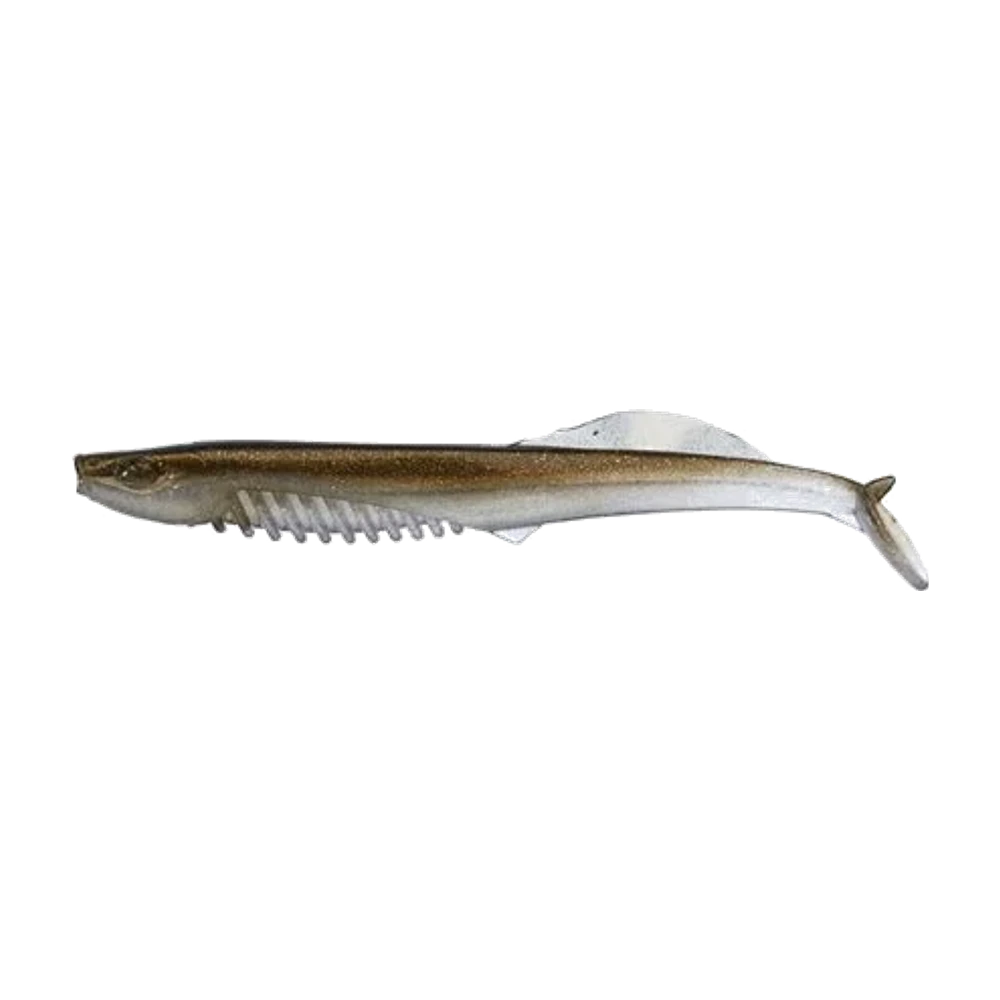
Gunki Otagiri: the jerkbait built for river pike
Not sure this lure fits YOUR spot today? CarnaFish tells you in 10 seconds, from a photo.
A river pike is not fished the way a pond pike is. It does not roam: it is posted, sitting behind something that breaks the current — a bridge pillar, a stump, a pile of boulders, the inside edge of a fast seam. It stays there for hours and moves only a few metres, and only if the prey comes past on the right side at the right pace.
That lie puts two demands on the lure. It has to hold its depth against the push of the water, without keeling over or riding up as soon as the current leans on it. And it has to stay visible in water that, in a river, is rarely clear: thirty to eighty centimetres of visibility in normal conditions, far less after rain.
The Otagiri ticks both boxes with a clear bias: a stocky body for a jerkbait of this length, a pronounced roll at the end of each glide, and a balance that brings it slowly back to level rather than freezing it dead. This is not a clear-water, endless-pause lure — it is a lure of movement, built to announce itself in water that is moving.
A thick body, and why that matters in current
Most jerkbaits that shine in clear water are slim. That makes sense: slimness allows the sharp lateral dart and the discreet silhouette. In a stained river, both qualities become secondary.
The Otagiri has a taller, thicker body than the average of its category. That produces three effects:
- A broader visual signature. Seen from the side in fifty centimetres of visibility, a tall silhouette is picked up far sooner than a pencil profile.
- A marked roll at the end of each dart. The lure does not stop flat: it tips onto its flank for a fraction of a second. On a gold or pearl finish, that is a wide flash, not a thin glint.
- Resistance to sliding sideways. In a crosscurrent, a thick body and a medium-sized lip hold their line better than a very slim profile that skids as soon as the seam picks up.
The price is slightly less casting distance than a slim jerkbait of the same weight, and more wind resistance. In a river, where you rarely fish at fifty metres, that is a bad trade that turns into a good one.
The retrieve: long pulls, not sharp snaps
This is the fundamental difference with a bass jerkbait. On a fish posted in current, a short sharp snap is often too brief for it to spot the lure and decide to leave its shelter.
- Cast upstream of the obstruction, never onto it. The idea is for the lure to arrive at the lie already working, at the right depth.
- Three or four fast turns to take it down, then steady the rod horizontally, pointed at the lure.
- Give long pulls, forty to sixty centimetres of rod travel, not wrist snaps. The lure kicks firmly to the side, then rolls.
- Hold the line tight for a second between two pulls rather than allowing real slack. The current takes care of restoring tension; complete slack in a river costs you contact and lets the lure rise.
- Mark a two to three second stop exactly as the lure crosses the line between the slack water and the fast seam. That is where 80% of the bites happen.
In very cold water, stretch the stops to five or six seconds but keep the pulls long: it is the contrast between a big glide and a dead stop that triggers, not uniform slowness.
On the water: in a river, do not fish the obstruction — fish the seam. A pike posted behind a pillar almost never attacks in the dead water where it sits; it comes out into the shear line between the slack and the current. Place your stop precisely on that line, not three metres before it.
The leader: the point that ruins the most sessions
A 12 cm jerkbait at 18 g is heavy enough to take a substantial leader, but not so heavy that it will accept anything.
| Leader | Effect on the Otagiri | Verdict |
|---|---|---|
| 0.50 to 0.60 mm fluorocarbon | Neutral on the action, sinks slightly | Best compromise in stained water |
| Supple titanium 7 to 10 kg | Action preserved, total safety against teeth | The one to pick in big-pike water |
| Stiff coated wire | Chokes the lateral dart, the lure runs straight | Avoid |
| Heavy nylon | Floats, pulls the nose up | Avoid |
Two useful lengths: thirty centimetres is enough for classic cast-and-retrieve work; go to fifty when you are fishing right against branches, since a pike rolling on the lure runs its flank up the line fast.
As for the rod, a 2.10 to 2.40 m model in medium-heavy power suits. Too stiff and you lose the feel of the lure finishing its glide; too soft and your long pulls go mushy and the roll disappears.
Not sure what to tie on?
Photograph your spot: CarnaFish reads the scene, cross-checks the conditions and gives you the zone, the lure and the retrieve. Free on iOS and Android.
Where it takes the lead, and where to switch to something else
Its favourite conditions:
- Stained rivers and large canals, from autumn to early spring, when pike settle on current breaks.
- Water at 6-12 °C, the window where the fish are still mobile but refuse to chase for long.
- Depths of 1 to 2.5 m, especially hole margins and the entrances to back eddies.
Its limits, on the other hand:
- Very clear water and pressured fish: its thick silhouette and heavy roll become too demonstrative. A slimmer jerkbait will get through better.
- More than 3 m deep: it will not get there, and lengthening the retrieve changes nothing about its lip.
- Fast searching over a big water: with long pulls and stops you cover very little ground per hour. A shad on a jig head or a deep crankbait moves faster.
Otagiri, Whiff and clear-water jerkbaits
The Gunki Whiff plays the opposite role in the same brand's range: a narrower profile and a more contained action, both excellent in clear water and on wary fish. If you could only take one to a gin-clear stretch, it would be that one.
Among big cold-water jerkbaits, the O.S.P Rudra pushes the pause logic further still: it freezes dead and is fished with ten-second stops. The Otagiri is not chasing that perfect stillness; it drifts slowly back to level, which creates movement where the Rudra creates emptiness. In a stained river, residual movement wins. In a clear cold lake, it is the other way around.
Our guide to choosing a pike lure places these two families within the season. And if you are unsure which side of an obstruction to fish when you get to the bank, CarnaFish analyses a photo of the spot and answers.
Key takeaways
- Thick body and firm roll: designed to be seen in low-visibility water, not to be discreet.
- Long 40 to 60 cm pulls, not sharp wrist snaps. It is the amplitude that pulls a posted fish out.
- Put the stop on the shear line between current and slack water, not on the obstruction itself.
- 0.50-0.60 mm fluorocarbon or supple titanium; stiff coated wire kills the lateral dart.
- Out of its depth in very clear water, beyond 3 m, and when searching a big water fast.
FAQ
How deep does the Gunki Otagiri run?
Around 1 to 1.5 m on a tight retrieve with a fluorocarbon leader. In current it holds that layer better than most slim jerkbaits, but it will not go deeper whatever your retrieve speed.
Do I need a wire leader for pike?
A bite-proof leader is essential, but not just any leader. Fluorocarbon in 0.50 to 0.60 mm or supple titanium preserves the lure's action; stiff coated wire chokes the lateral dart and turns the jerkbait into something that just swims straight.
How does it differ from a slim clear-water jerkbait?
The Otagiri has a taller body, a heavier roll and better tracking in current. It is built to be spotted in water with fifty centimetres of visibility, whereas a slim profile bets on discretion and a sharp dart in gin-clear conditions.
How long should the stops be?
Two to three seconds in temperate water, five to six below 8 °C. What matters most is placing those stops in the right spot — on the current edge — rather than stretching them out endlessly in the middle of nowhere.
Does it work in a canal with no current?
Yes, but you have to adapt: with no current to take the tension back up, alternate long pulls with two turns of the handle to keep contact. Target the margins, lock entrances and shaded water under trees.
What rod should I use?
A 2.10 to 2.40 m medium-heavy outfit. You need enough backbone to deliver forty to sixty centimetre pulls and enough sensitivity to feel the lure finish its glide before you go again.
The full pike lure guideSeason-by-season strategy: which family of lure, when, and why.Go from theory to fish
CarnaFish reads your spot from a photo and gives you the game plan: zone, lure, retrieve. Free on iOS and Android.