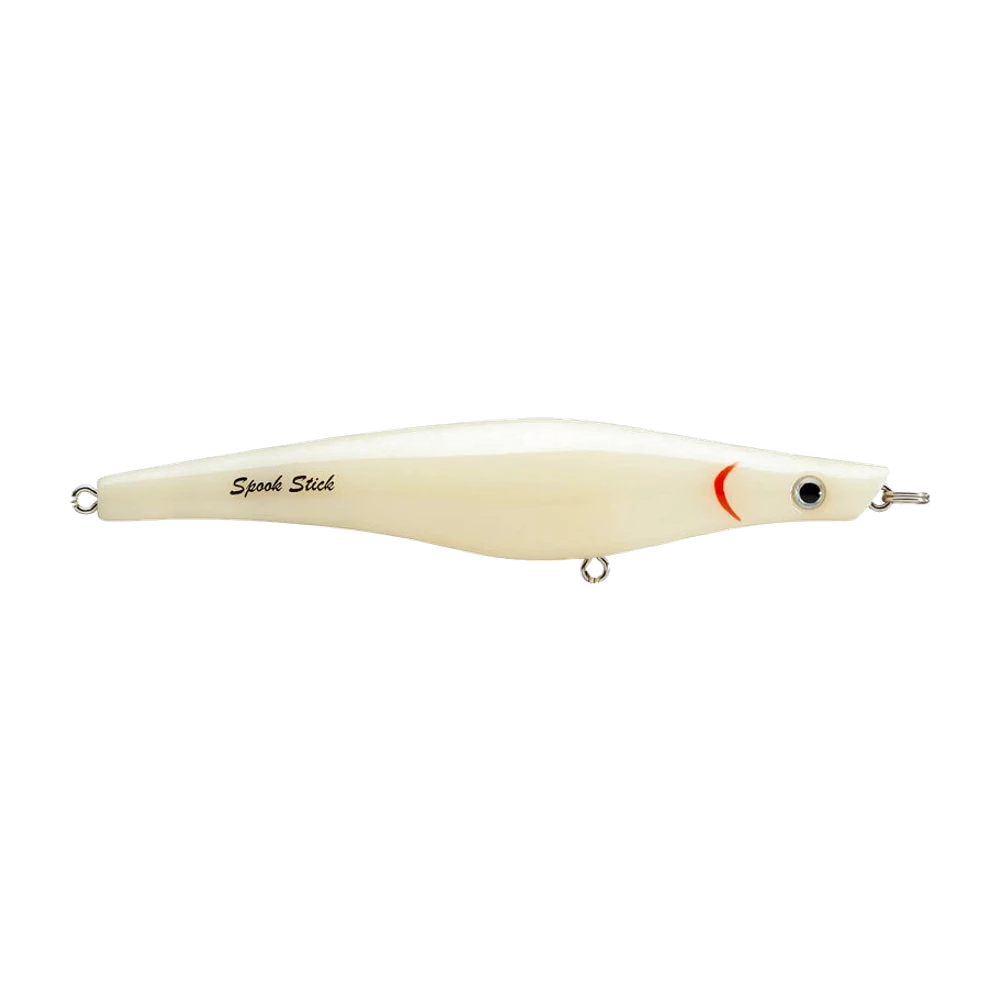
Heddon Spook Stick: a 3.5 in walking bait for fussy topwater bass
The right lure in the wrong spot still catches nothing. CarnaFish spots the zone that works, from a single photo.
Late August, on a cluttered backwater, bass are still coming up but refuse anything bigger than the fry they're pinning against the bank. A 5 in walker goes through, makes noise and triggers nothing — they've seen it ten times this season. That's exactly the Spook Stick's slot: an 8.9 cm / 3.5 in body at 7 g / 1/4 oz that walks like a big one while shifting far less water.
A shad profile, not a cigar
Heddon describes the Spook Stick as a natural shad profile designed to float, and that wording isn't cosmetic. Most topwater stickbaits are built around a cigar body, round in section, which rolls heavily and pushes a visible bulge of water on every glide. Here the body is more laterally compressed, with flanks tapering hard toward the tail: at the same cadence the surface disturbance is quieter, and the silhouette seen from below reads as a small baitfish rather than a stick.
That's a strength and a limit at once: ideal on flat water and on a fish that has already turned down two noisy lures, less good on a big windy flat where you need to call from a distance. The Spook Stick isn't a long-range search bait, it's a lure you throw at a spot you've already identified.
Walking a bait that only weighs 1/4 oz
Walking the dog rests on one principle: the bait only slides sideways if there's slack in front of it. Rod tip pointed at the water, give short crisp wrist snaps, roughly one per handle turn, letting the line go loose between each. The nose kicks left, then right, in a steady zigzag. Pull on a tight line and the lure just tracks straight.
At 7 g / 1/4 oz the setup is finer than with a 1/2 or 3/4 oz stickbait. Two consequences: the cadence settles into a shorter rhythm, with 20-30 cm (8-12 in) glides rather than wide sweeps; and a stiff tip pulls too hard on that weight and kills the walk. A medium-power rod that bends into the top third immediately gives a cleaner zigzag.
If your Spook Stick stalls and refuses to zigzag, check the leader before you change lures. A 12 lb fluorocarbon that's too stiff, knotted tight to the eye, chokes a 7 g body completely. Drop to 8 or 10 lb with a loop knot and the walk is back on the first cast.
Internal rattles: a signal you have to meter out
The Spook Stick carries internal rattles that add an acoustic layer to the glide. On the surface that noise doesn't carry like a crankbait rattle: it's punctual, synced to each direction change, and it blends into the lure's own slap. Genuinely useful in stained water, in a light breeze, or at dawn before the light gets up.
In return, in very clear water and on pressured fish, that same noise can turn a follower away: if bass rise behind the lure without ever committing, slow down to space out the rattle hits. Choosing between a noisy and a silent bait depends less on the season than on how hard the spot gets fished.
Rigging, hooks and leader
What the maker actually states about the hooks
The Heddon spec table has three columns: length, weight and hooks. For the Spook Stick that reads 3-1/2 in, 1/4 oz and size 6 hooks — the size, and nothing more. The number of trebles isn't given, and the product shot shows a bare bait: nose eye, belly hanger, tail hanger, nothing hung on them. So check the factory hardware on the packaging.
A size 6 treble is a fine-wire hook: perfectly matched to bass in open water, noticeably more fragile as soon as a pike can show up or you're fishing tight to timber. Fitting heavier trebles in the same size is possible, but every gram added to a 7 g body costs you buoyancy and walking quality — weigh what you take off and what you put on, and stay within a few tenths of a gram.
On the line side, light braid floats and passes your wrist snaps straight to the lure. Finish with a yard of fluorocarbon, less for stealth than for shock absorption: on top, a fish striking vertically often comes off against a line with no stretch at all. Loop knot or a small snap, never a knot cinched tight to the eye.
The mistake that costs the most fish
Striking at the noise. The instinct when a topwater blows up is to lift the rod straight away; the fish has often missed the bait or grabbed it sideways, and you pull it out of its mouth. The right sequence: keep walking until you feel the weight, then sweep sideways without an exaggerated swing.
Not sure what to tie on?
Photograph your spot: CarnaFish reads the scene, cross-checks the conditions and gives you the zone, the lure and the retrieve. Free on iOS and Android.
Where and when to use it
The Spook Stick is a shallow-water lure: flats from 50 cm to 2 m (2-6 ft), weed edges, rock points, submerged treetops. It's at its best when bass are feeding near the surface, which in Europe means late spring through early autumn, with two daily peaks — first light and the last hour before dark.
The size also makes it a credible perch lure, since perch readily come up for a stickbait this size when they've got a bait ball pinned in open water: a fast walk cutting through the feeding fish often draws an immediate strike. Don't expect miracles in cold water though — below 14 or 15 °C (57-59 °F) fish no longer come up freely enough for topwater to be the right call.
Colors by light level
- Overcast skies or lightly stained water: the bone white of the photo, a pale tone that stands out clearly from below without throwing harsh glare.
- Clear water and hard sun: a natural shad back, green or silver-grey, which stays believable when fish can see properly.
- Dawn, dusk, after dark: solid black, giving the sharpest silhouette against a sky that's still light — the fish reads the cut-out shape, not the color.
How it fits the rest of the box
In a coherent topwater box, the Spook Stick fills the small, quiet slot. The Heddon Zara Spook remains the reference for bulk and long-range calling, the Heddon Super Spook Jr sits in between with a thicker body at a similar length, and the Heddon One Knocker Spook shifts the sound signature to a single low knock. Three levels of disturbance: it's usually that trio, not the color, that unlocks a tough morning.
Still, the best topwater is worthless if you cast it in the wrong place. That's exactly what CarnaFish does: photograph the spot and the AI suggests the zone and the presentation that fit the day's conditions. To build the groundwork on gear and bass holding spots, our beginner's guide to bass fishing is a useful companion to this sheet.
The short version
- 8.9 cm / 3.5 in for 7 g / 1/4 oz on a shad profile: a quiet walker built for fish that have stopped eating big volumes.
- Walking needs slack in the line and a rod that bends; a stiff tip smothers a bait this light.
- The internal rattles help in stained water and chop, but can turn followers away in clear water on pressured fish.
- Hooks listed in size 6, with no count given: sharp and fine, but worth watching as soon as a pike may be around.
FAQ
Does the Spook Stick float at rest?
Yes, Heddon explicitly presents it as a bait designed to float. You can stop it dead mid-walk and leave it sitting for two or three seconds over a spot: that pause often converts fish that were following without committing.
What rod suits a 1/4 oz walking bait?
A medium-power rod between 1.90 m and 2.10 m (6'3" to 7') with an action that bends into the top third. A stiff tip pulls too sharply on a body this light and blocks the zigzag; the shorter length makes repeated wrist snaps easier.
How does it differ from a classic Zara Spook?
In bulk and section. The Heddon Zara Spook is longer, thicker and shifts far more water, so it calls from further away. The slimmer Spook Stick disturbs the surface less and does better on wary fish or fish feeding on small prey.
Can you fish it for pike?
Occasionally, but that's not what it's for: the size 6 hooks listed are fine wire for that fish, and you'd need an abrasion-resistant leader anyway. If you know there's pike on the spot, fit heavier trebles and accept a slightly degraded walk.
Why does my lure track straight instead of zigzagging?
Three causes, in order of frequency: the line stays tight throughout, the knot is cinched straight to the eye, or the leader is too stiff. Leave slack between wrist snaps and switch to a loop knot before blaming the lure.
Should I replace the factory hooks?
Not on principle: size 6 trebles are right for bass in open water. Swap them near timber, if you run into pike, or when the points dull — checking the weight so you don't ruin the buoyancy.
The full bass lure guideSeason-by-season strategy: which family of lure, when, and why.Go from theory to fish
CarnaFish reads your spot from a photo and gives you the game plan: zone, lure, retrieve. Free on iOS and Android.