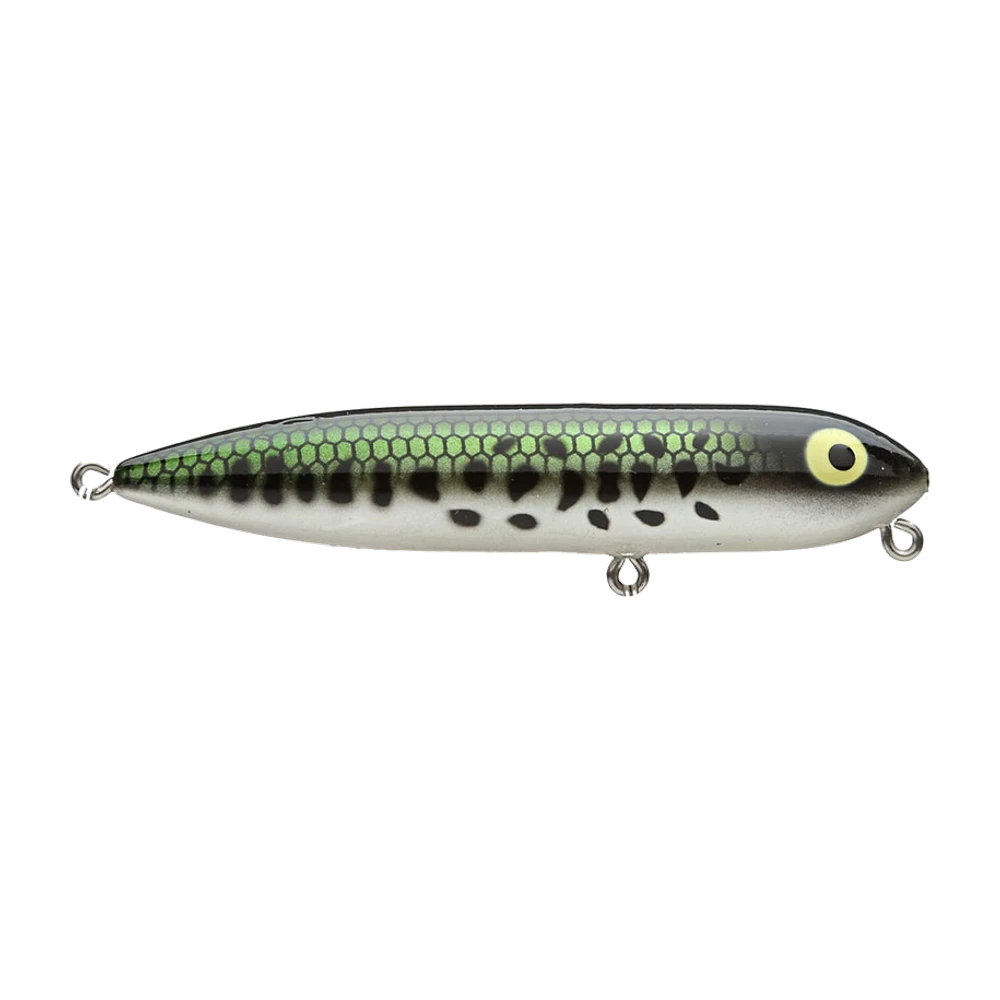
Heddon Zara Puppy: walk-the-dog scaled down to 7.6 cm
One lure, endless conditions. CarnaFish reads your spot from a photo so you are not just guessing.
A pond pocket, two feet of water, a windless morning. You run a 11 cm stick through it three times and nothing moves, then a twelve-inch fish rises underneath, escorts it for two metres and drops back without opening its mouth. That refusal almost never comes down to colour: it is a question of scale. The Zara Puppy puts the exact same walk into 7.6 cm, a size those fish eat instead of inspecting.
A scaled-down walk, not a watered-down one
The maker's spec table is short and leaves no room for doubt: 3 in, so 7.6 cm, for 1/4 oz, a touch over 7 g, filed under Topwater class. That matters, because plenty of small surface baits lose their action as they shrink. Too light, they no longer carry enough inertia to flip hard from one side to the other, and the zigzag turns into a limp wiggle. With 7 g packed into a short cigar body, the Puppy keeps enough mass for every snap to genuinely change its heading.
The bait descends in a straight line from the Zara Spook, whose profile and gait it carries over at reduced scale — a silhouette that has been catching fish in the Heddon range for over seventy-five years. If you already know the Heddon Zara Spook, there is nothing new to learn here: the motion is identical, only the window of fish it reaches shifts downward.
On hooks, the description lists two stock trebles and suggests upgrading them. The exact size of those trebles is not published, and that is the kind of detail to read off the packaging rather than guess: on a 7 g bait, fitting trebles that are too heavy is enough to drown the nose and kill the zigzag.
The motion: three things to fix, in this order
The principle is quick to describe and slow to master. You cast, you leave a little slack between rod tip and bait, then you give short, even snaps of the tip while reeling just enough to keep that slack from piling up. The bait then kicks out to one side, then the other, sweeping a corridor far wider than the straight line it actually travels.
What stops most anglers comes down to three settings. First, tip position: it should point down, around ten or eleven o'clock relative to the water, never up in the air. Second, slack: it is the slack that lets the body pivot freely between impulses. A tight line sends your snap straight into the nose of the bait, which then runs forward instead of flipping. Third, rhythm: a metronomic cadence, even a slow one, produces a clean zigzag, while an uneven one breaks it at every hesitation.
The mistake that ruins most sessions
Speeding up. The natural reflex when nothing rises is to go faster, and that is precisely what pulls the bait off its rail. On a Puppy the right correction is the opposite: slow the cadence without shortening the snaps, and above all slip in pauses of one to two seconds. Very often the strike comes on the pause, with the bait sitting still and slowly pivoting in place. A fish that has followed without committing finally commits when the prey stops.
The other classic fault is the hookset. A topwater strike is loud, and the hand leaves on its own at the sight of the water blowing up. Except the fish often misses on the first try. Wait until you feel weight in the rod before setting: set on the sound and you rip the bait out of the zone before the mouth has closed on it.
Where and when it beats a full-size stick
The Puppy is not a water-covering bait. Seven grams on a short body casts acceptably but not far, and it gets unmanageable as soon as wind puts a chop on the surface. Its window is narrow and worth respecting: calm to lightly rippled water, shallow to medium depth, fish holding on visible targets — a weed edge, a laydown, a line of docks, the outside edge of a lily pad field.
It is also a bait for small waters and medium rivers, where a 11 cm stick sweeps too wide and where you want to drop precisely into a pocket. The best hours stay first light and the last hour before dark, but an overcast day widens that window considerably.
In Europe this size also opens a door the American description never mentions, since the maker only talks about bass: perch. A 7.6 cm stick walked over a pack of feeding perch draws very committed strikes, provided you drop the cadence further still. That is an extrapolation from European fishing, not a maker's claim — but it holds up, and it is worth testing before reaching for something more exotic.
If the bait refuses to zigzag, check your knot before blaming the lure. A tight knot cinched straight onto the nose ring locks the tilt and turns the Puppy into a bait that simply runs forward. Loop knot or a small snap, and the problem disappears on the first cast.
Rod, line and rigging
A 1.90 to 2.10 m medium-power rod with a tip that keeps some give does the whole job. Too stiff and it transmits sharp jolts that make the bait jump clear; too soft and it imparts nothing at all. Length matters as much as power: you are going to deliver hundreds of impulses in a session, and a 2.30 m rod will burn out your forearm well before the morning ends.
For line, the standard setup is thin braid as a mainline for instant transmission, extended by a metre or so of mono leader. The mono is deliberate: it floats, where fluorocarbon sinks and quietly pulls the nose of the bait downward. On a topwater bait that is a real difference in behaviour. Connect with a loop knot or a fast snap, never with a knot cinched against the ring.
One last rigging point, often overlooked: make sure the two trebles cannot tangle with each other. On a body as short as the Puppy's, an oversized belly treble ends up catching the tail treble in flight, and the bait lands on the water in a ball.

Not sure what to tie on?
Photograph your spot: CarnaFish reads the scene, cross-checks the conditions and gives you the zone, the lure and the retrieve. Free on iOS and Android.
Colour by water and light
- Clear water, bright light: a scaled green back over a white belly, exactly the finish visible on the photo in this page. It is the pattern that best reads as a small baitfish seen from below.
- Overcast, lightly stained water: bone or opaque white. On top, the fish mostly sees a silhouette against the sky, and a solidly opaque belly cuts a cleaner shape than a pearl one.
- Last light, dark water: a genuinely dark back. Counter-intuitively, what counts is the contrast against the sky, not the colour itself.
A small size worth keeping in the box permanently
The Zara Puppy does not replace a big stickbait, it covers the other half of the problem. When fish rise but will not commit, dropping size is usually more effective than switching lure family. Next to a Heddon Super Spook Jr or a Megabass Dog-X, it occupies the bottom of the spectrum: tough days and tight targets.
Choosing the right topwater size starts with reading the spot and the depth, and that is exactly what CarnaFish makes easier: a photo of the spot, and the app suggests a zone and a presentation suited to the day's conditions. To build the tackle and spot fundamentals for bass, our beginner's guide to bass fishing remains the best place to start.
Key takeaways
- 7.6 cm for 7 g in Topwater class: a genuinely miniaturised walking bait, not a lightened surface lure that lost its action along the way.
- The zigzag depends on three things: tip down, a little slack in the line, and an even cadence. Speed only comes after that.
- A one to two second pause draws more strikes than continuous walking.
- Mono leader and loop knot: fluorocarbon and a cinched knot both pull the nose down and kill the tilt.
FAQ
What is the real difference from a Zara Spook?
The gait and the profile are the same, only scale changes: the Puppy is listed at 3 in and 1/4 oz in the maker's table. In practice it catches the mid-size fish that merely escort a full-size stick, at the cost of a shorter cast.
Why will my Zara Puppy not walk?
In order: a knot cinched against the nose ring, a rod tip held too high, a line kept too tight between snaps. Fix those three before changing anything about the bait itself. Trebles heavier than stock can also drown the nose.
Should I replace the stock hooks?
The description lists two trebles and itself recommends upgrading, without giving a size. If you swap them, keep the total weight identical: on a 7 g bait, a few tenths of a gram change the attitude and the action.
Does the Zara Puppy catch perch?
The maker only mentions bass. In Europe this 7.6 cm size works well on feeding perch, with a slower cadence and longer pauses — that is a local extrapolation rather than a maker's claim, but it is well proven on the water.
What rod handles a full day of walking?
A 1.90 to 2.10 m medium with a tip that still has some give. Short length matters as much as power: walking the dog is a wrist motion, and a long rod will exhaust your forearm before the morning is out.
Can it be fished in wind and chop?
That is its real limit. Seven grams on a short body casts poorly into wind, and a marked chop breaks the zigzag constantly. As soon as the surface gets rough, a heavier topwater or a prop bait reads more clearly to the fish.
The full bass lure guideSeason-by-season strategy: which family of lure, when, and why.Go from theory to fish
CarnaFish reads your spot from a photo and gives you the game plan: zone, lure, retrieve. Free on iOS and Android.