Z-Man Scented Jerk ShadZ: the soft jerkbait that rises instead of sinking
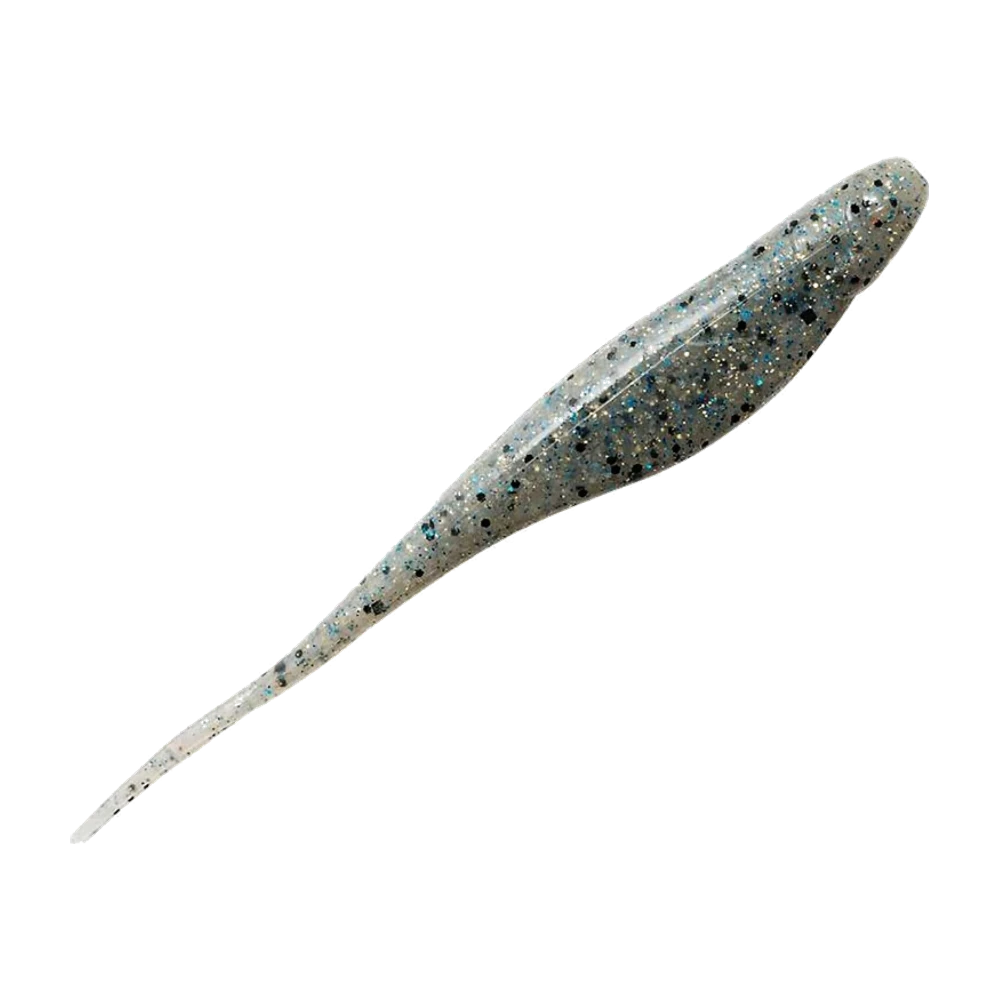
One lure, endless conditions. CarnaFish reads your spot from a photo so you are not just guessing.
You are fishing a weightless soft jerkbait over a weed bed. The first two twitches are perfect: the lure darts right, then left, exactly like an injured baitfish. Then you pause, and it disappears into the vegetation. You pull to free it, you collect a clump of pondweed, and the spot is burnt.
That is the structural flaw of the standard soft jerkbait: plastisol is denser than water. Every second of stillness takes it down, and stillness is precisely when the fish makes up its mind. The Scented Jerk ShadZ flips that balance. Its material, ElaZtech, is less dense than water: at rest the lure does not sink, it rises slowly, nose down and tail up.
That nose-down posture is not a gimmick. It reproduces exactly the attitude of a fry that has lost its footing and is trying to recover, and it turns the pause into an active phase instead of dead time.
What a material lighter than water changes
ElaZtech is not coloured plastisol. It is an elastomer, and it behaves differently on three points that all matter on the water.
- It floats. A Jerk ShadZ on a plain weightless Texas hook rises gently at rest. With a standard 5/0 hook, the whole thing becomes roughly neutral, or very slowly sinking depending on wire gauge. You set the buoyancy by changing hooks, not lures.
- It lasts. This material does not tear like standard plastisol on teeth or gill plates. On bass, ten or fifteen fish on the same lure is not unusual. On sea bass, the limit comes mainly from how it holds on the shank, not from the body.
- It springs back. The elasticity returns the body to shape after each twitch instead of leaving it slack. The zigzag stays crisp even after an hour's fishing, where a tired plastisol ends up swimming sideways.
Trade-off to know about: ElaZtech cannot be stored in contact with standard plastisol. The two materials react chemically and melt into each other. Keep it in its original bag or in a dedicated box — that rule has no exceptions.
The retrieve: three twitches, a pause, and you stop moving
The motion is a walk-the-dog, but underwater and much shorter.
- Cast past the spot and let the lure settle for two seconds on or just below the surface.
- Three sharp twitches close together, rod tip down, wrist only, taking up the slack between each. The lure darts alternately one side then the other over 30 to 50 cm.
- Pause of 2 to 5 seconds. Line slightly tight, rod tip still. The lure rights itself, tail up, and rises a few centimetres.
- Take up the slack without working the lure before the next series — that is often the exact moment you feel the weight of a fish that took during the pause.
- Repeat to within three metres of the bank, never shortening the pauses over the last third of the cast.
On the water: when a fish follows without biting, do not lengthen the pause — shorten it and double the number of twitches. On a floating lure, too long a pause gives the fish time to examine everything; a tight series of twitches followed by a dead stop leaves it a fraction of a second to decide.
Setting depth with the hook, not with the retrieve
This is the real lever on this lure. The body being buoyant, it is the hook that fixes the layer of water you work.
| Hook | Behaviour on the pause | Zone covered |
|---|---|---|
| 4/0 fine-wire Texas, weightless | rises clearly | 0 to 40 cm, above weed beds |
| 5/0 standard-wire Texas | near motionless | 40 cm to 1 m, in open water |
| Weighted Texas 2 to 3.5 g | sinks slowly and flat | 1 to 1.5 m, along a steep bank |
| 1 g lead fixed to the shank | nose-down posture exaggerated | shallow margins, less stable action |
The glued-lead trick deserves a word: a small mass fixed under the shank, just behind the eye, does not sink the lure much but markedly exaggerates the nose-down tip during the pause. It is the most effective configuration on holding fish that watch it rise.
For line, stay on 0.12 to 0.15 mm braid with a 0.28 to 0.35 mm fluorocarbon leader. The braid is essential: with no weight, you have no mass to transmit the twitches — it is the line's lack of stretch that creates the zigzag.
Where it takes over, and where not to use it
This soft jerkbait is a cover-and-margin lure, not a tool for searching wide.
- Above submerged weed beds, at the exact place a sinking jerkbait buries itself. That is its reference situation on bass.
- Under low branches and docks, because a weightless lure makes no noise on impact and can be skipped in flat.
- On sea bass along rocky margins, when fish are hunting fry near the surface but refusing a hard lure. The slim profile and erratic movement often get through when everything else is ignored.
- In very clear, heavily fished water, where the absence of a lip and of mechanical noise is the main argument.
Conversely, it is unsuited as soon as you need to cast far into a headwind: 7 g with no lead is not much, and the wind resistance of a 12.5 cm body costs metres. It is also badly placed for exploring a big deep area — over a 4 m drop-off, a shad on a jig head covers ground far faster.
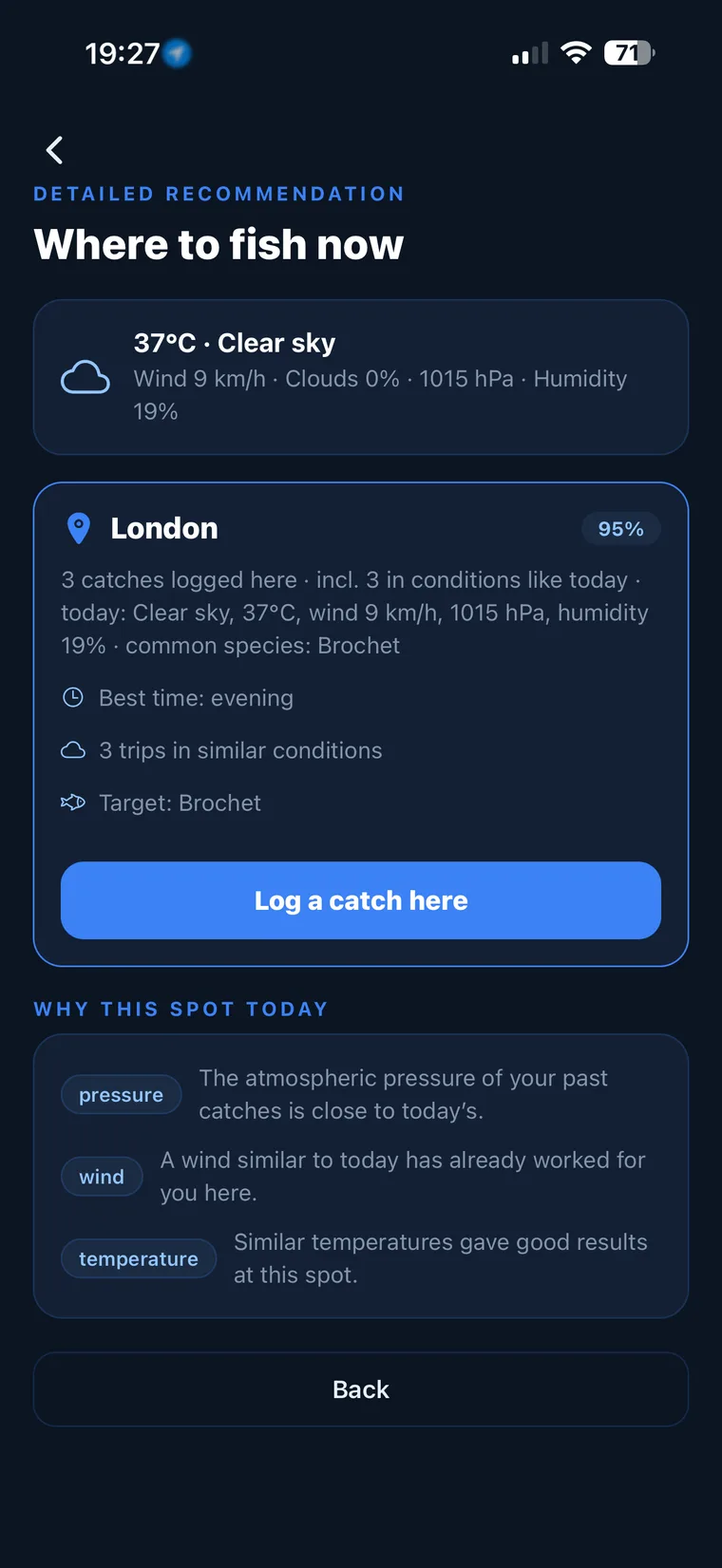
Not sure what to tie on?
Photograph your spot: CarnaFish reads the scene, cross-checks the conditions and gives you the zone, the lure and the retrieve. Free on iOS and Android.
Jerk ShadZ or Super Fluke
The Zoom Super Fluke is the historic benchmark of the genre, and the comparison is instructive because the two lures do different jobs despite a similar profile. The Super Fluke is plastisol: it sinks slowly at rest, with a steeply angled falling-leaf drop. It is an excellent lure for reaching a fish holding under the surface, in a metre of open water.
The Jerk ShadZ does the exact opposite: it goes up. Over a weed bed just under the surface, over a lily pad mat or above drowned timber, that difference decides everything. Add the durability, which changes the logistics of a day: where you get through a handful of Flukes on a session with big fish, one Jerk ShadZ often lasts the whole day.
For a chunkier profile and a more pronounced tail kick on a straight retrieve, look instead at the Z-Man DieZel MinnowZ, which uses the same material on a continuous-swimming logic. And if you want to plan your season, our beginner's guide to bass fishing covers the periods when the soft jerkbait beats the crankbait. If you are unsure which buoyancy to pick when you arrive in front of a weed bed, CarnaFish analyses a photo of the spot and answers.
Colours
- Clear water, visible fry: pearl white or translucent with flake. The profile counts more than the shade.
- Stained water or a low sky: dark back, pale belly, or a touch of chartreuse on the tail as an aiming point.
- Saltwater: pearl with a blue or green back, echoing the tones of sardine and sandeel.
Key takeaways
- The ElaZtech material floats: at rest the lure tips nose-down and rises instead of sinking.
- You set depth by changing hooks, not by changing speed.
- Three tight twitches then a 2 to 5 second pause; shorten the pause on followers.
- Fine braid is compulsory: with no weight, the line is what transmits the action.
- Never store it touching standard plastisol, both materials degrade.
FAQ
Does the Scented Jerk ShadZ really float?
Yes, the bare body rises to the surface. Rigged on a standard-wire 5/0 Texas hook, the whole thing becomes roughly neutral and sits still in mid-water. The hook determines the final buoyancy, not the lure.
What hook should I use with it?
A wide-gap Texas hook in 4/0 or 5/0 for the 12.5 cm size. Fine wire preserves the buoyancy, heavy wire brings it near neutral, and a weighted version of 2 to 3.5 g lets it work down a steep bank.
Why shouldn't I store it with my other soft plastics?
Because ElaZtech reacts chemically on contact with plastisol: both materials deform and fuse. Keep it in its original bag or in a box reserved for this range.
How many fish can one lure take?
Far more than a standard soft plastic. On bass, ten to fifteen fish on the same body is common. The limit usually comes from the anchor point on the hook shank, which eventually elongates, not from the body itself.
Does it work in saltwater for sea bass?
Yes, along rocky margins and on beaches with gullies, when sea bass are hunting fry near the surface. Its toughness is a real advantage on a fish with sharp gill plates. Rinse it in fresh water after the session.
Can I fish it on a plain straight retrieve?
Not its strong point: with no weight and no paddle tail, a continuous retrieve produces only a flat, unattractive action. The lure is designed for twitch-and-pause work; for straight retrieves, go for a paddle-tail shad.
The full bass lure guideSeason-by-season strategy: which family of lure, when, and why.Go from theory to fish
CarnaFish reads your spot from a photo and gives you the game plan: zone, lure, retrieve. Free on iOS and Android.