Ima Little Stik 135: the rear-weighted stickbait that walks effortlessly
One lure, endless conditions. CarnaFish reads your spot from a photo so you are not just guessing.
You have spotted fish busting bait 40 m off the bank, and a headwind is making every cast a lottery. That is exactly the situation where a badly balanced stickbait spends the day helicoptering in flight and landing sideways. Ima built the Little Stik 135 for the other scenario: weight set in the rear, a body that flies straight, and a walk that starts on the first twitch without you having to hunt for it.
The rear weight, and what it actually changes
Ima builds this bait with a fixed weight in the rear section. Two concrete consequences, both stated by the maker and easy to verify on the first cast.
The first is distance. A bait whose mass sits near the tail leaves the rod nose-first and does not turn broadside in the wind. On a surface bite where you are fishing by sight and have to reach a school that keeps moving, every extra metre counts as much as the colour does.
The second is how easily it walks. A rear-weighted stickbait naturally sits nose-up at rest, which means a single flick of the rod tip is enough to tip it over to one side and then the other. Ima makes a point of this: the walk takes very little effort. In practice you can keep a steady walk going for an hour without wearing out your wrist, which matters when you remember that a topwater bait only works while you are animating it.
The head detail, and the noise inside
The second design element is the head. Ima describes it as purpose-built to push water as it slaps against the surface. This is not a popper: there is no cupped face throwing a spray. It is subtler — on each tip-over, the top of the head claps against the surface and produces a small acoustic burst along with a spreading ripple.
Add to that an internal rattle chamber, which the maker says generates a pronounced tonal footprint as the bait is walked. The lure therefore does three things at once: a visual zigzag signal, a surface signal from the head slapping, and a continuous acoustic signal. On rippled water or at the end of the day, it is usually the sound that brings a fish in from a distance, and the sight of the bait that triggers the strike in the last metre.
The specs, and a small inconsistency worth knowing
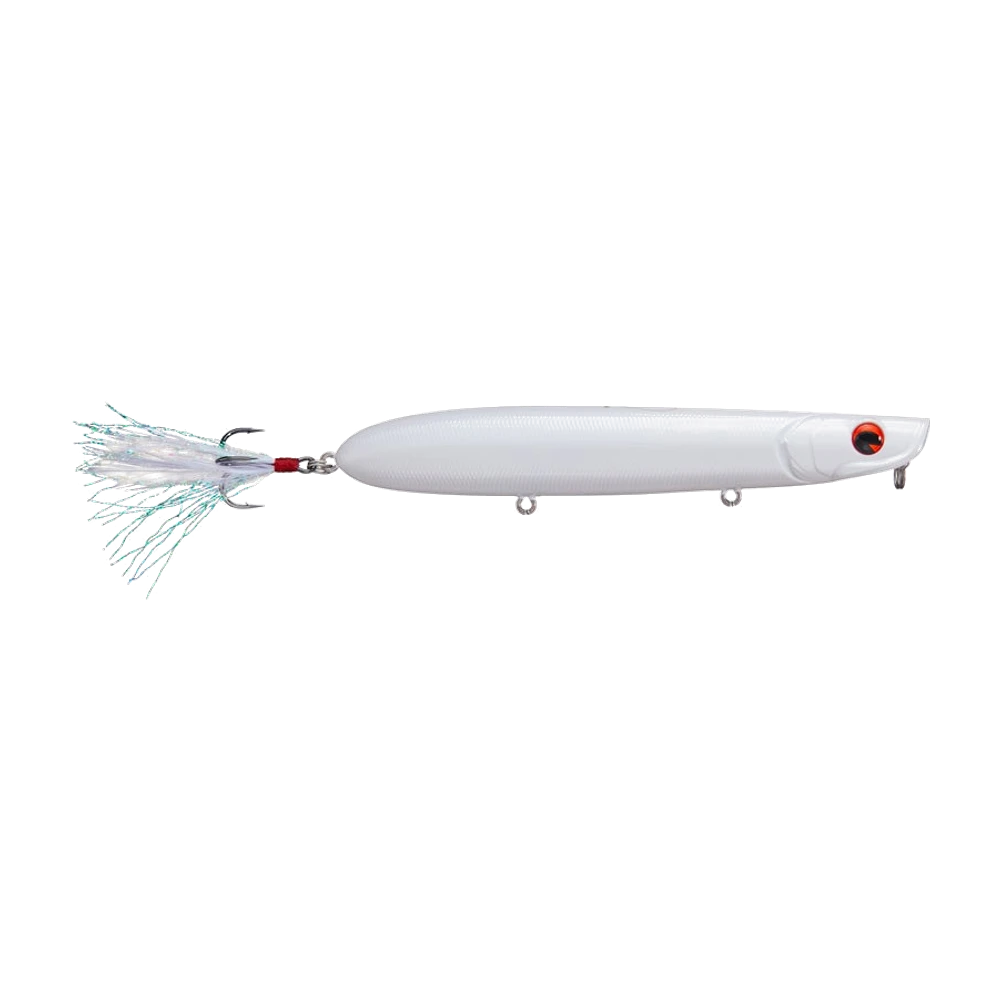
Ima's table gives a single line: 5-1/2 in, 1 oz, topwater class, size 4 hooks. Converted, that works out to 14 cm and 28 g, for a strictly surface bait.
The model name, on the other hand, says 135, meaning 135 mm. The gap with the table's 5-1/2 in — 139.7 mm — is almost certainly a rounding of the inch figure meant for the US market. Take it as 13.5 to 14 cm: the difference changes nothing on the water, but it saves you from suspecting a reference error when comparing two product sheets.
Be careful not to read the "4" in the table as a weight. It is a hook size: the Little Stik 135 carries two size 4 trebles, which is serious hardware for a bait this size without being heavy-duty.
The trap with a stickbait is striking on sight. You see the fish come up, you lift the rod, and you pull the bait out of its mouth. Wait until you feel the weight in the rod before setting, however endless that wait feels: on a topwater bait, half a second of delay turns half your misses into fish.
Working it: rhythm over force
Walking the dog is built on regularity, not amplitude. Rod low, pointed at the bait, you give short, crisp twitches while taking up half a handle turn between each. The bait then alternates its tip-overs and zigzags forward without ever stopping.
The two variations that change everything
Tight rhythm. Twitches close together, narrow zigzag, slow progress: the bait stays a long time in one small area. That is the setting over a precise target — a laydown head, a rock breaking the surface, a weed edge — where you know a fish is holding.
Wide rhythm with pauses. Two or three tip-overs, then a one to two second pause with the bait sitting still on the surface. The pause is what triggers the most bites on wary fish or on very calm water. The rear weight helps here: the bait stays nose-up during the stop instead of lying flat.
On choppy water, do not try to slow down. A stickbait needs a bit of speed to stay readable among the waves, and that is where the internal rattle takes over from the visual.
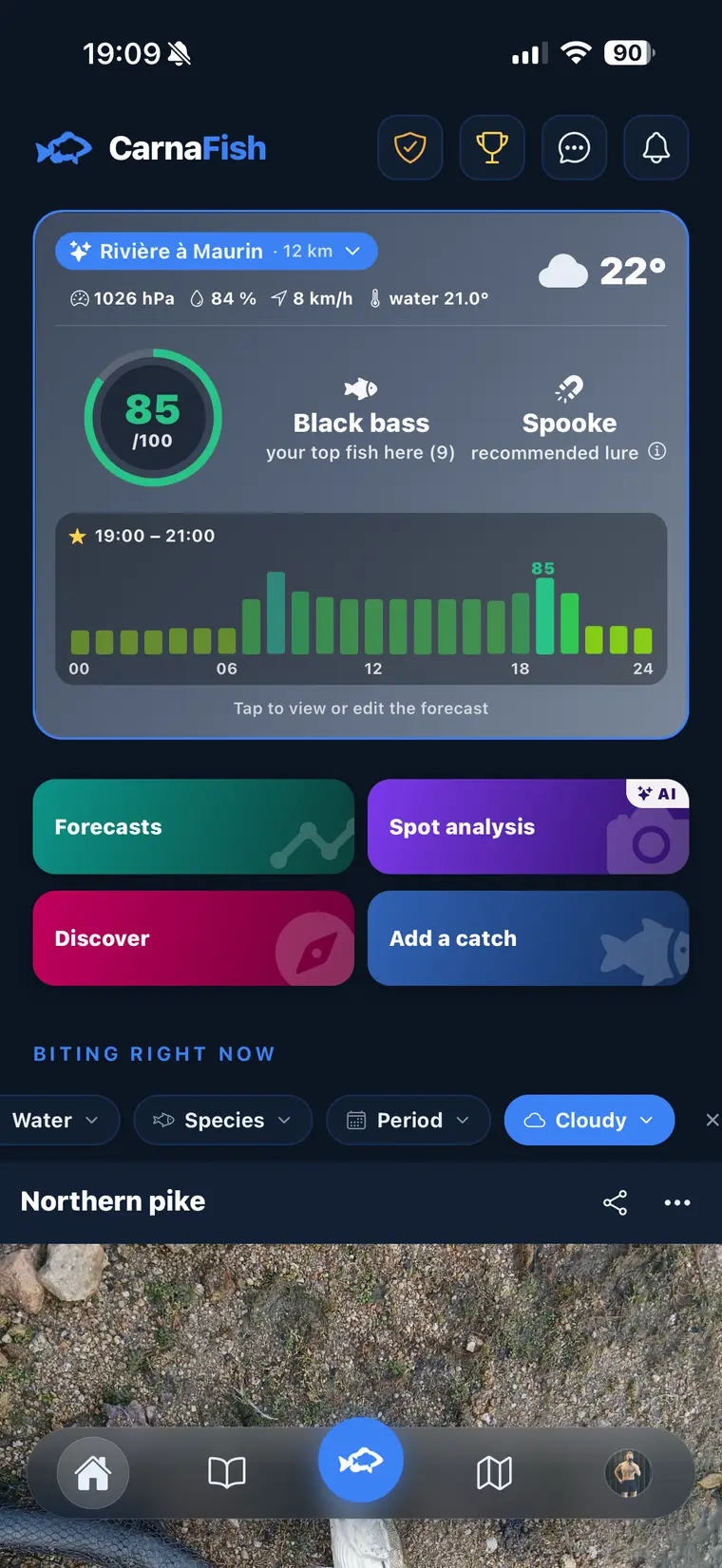
Not sure what to tie on?
Photograph your spot: CarnaFish reads the scene, cross-checks the conditions and gives you the zone, the lure and the retrieve. Free on iOS and Android.
Which species, honestly
Ima positions this bait for bass fishing, in a size it calls tournament-oriented. But 14 cm and 28 g is also, across Europe, exactly the format of a sea bass stickbait over a shingle beach or a rocky plateau, and a perfectly credible size for a summer pike on a clear pond.
Two useful caveats. For pike, a steel or titanium leader is not optional: a surface strike often comes in sideways, and the line ends up inside the mouth. And while size 4 trebles are plenty for bass, they deserve upgrading to a heavier-wire model if you regularly target pike over 80 cm.
Colour by light
- Overcast, dawn, dusk: the pearl white shown in the photo. On the surface a fish mostly sees a silhouette against the sky, and a very pale belly stays readable even as the light fades.
- Clear water and full sun: a natural silver baitfish finish, which throws short flashes rather than shining constantly.
- Stained water or dark bottom: a decisively dark back, which cuts a clean silhouette seen from below.
The right tool for a narrow window
A topwater bait is not a universal search tool: it works when fish are willing to come up, meaning warm water, low light or visible activity. If you want to fish the same water with a more discreet size, the Ima Baby Stik 105 gives the same walk in a smaller package. For a very different sound signature, a Heddon Super Spook or a River2Sea Whopper Plopper 130 cover both ends of the register: a sharp clack on one side, continuous churn on the other.
Knowing whether the topwater window is open starts with reading the spot: edge depth, vegetation, wind exposure. That is exactly what CarnaFish offers — a photo of the swim, and the app gives you the zone to work and a presentation consistent with the conditions. If you are targeting sea bass with this bait, our guide to sea bass lure fishing breaks down tide windows and the spots that deserve a stickbait.
Key takeaways
- 14 cm for 28 g, strictly topwater class: this bait does not dive, it works on the surface only.
- The rear weight delivers two measurable gains: a long, stable cast and a walk that is easy to sustain.
- Internal rattle chamber: the sound carries, especially on rippled water where the visual alone no longer does the job.
- The trebles are listed in size 4 — that is a hook size, not a weight, and it is worth upgrading for big pike.
FAQ
What is the exact size of the Little Stik 135?
Ima's table lists 5-1/2 in, or 14 cm, for 1 oz, meaning 28 g. The model name suggests 135 mm: the gap comes from rounding the inch conversion and has no bearing on how it fishes.
Does this stickbait need a particular rod?
A 7 to 7'6" casting or spinning rod, medium to medium-heavy, with a tip that is not too stiff. Too stiff a tip makes the walk jerky; too soft a tip no longer transmits the twitch down to the bait.
Is the Little Stik 135 suitable for pike?
Yes, 14 cm is a sensible size for a summer pike in shallow water. Plan on a steel or titanium leader, and consider replacing the size 4 trebles with a heavier-wire model if you target fish over 80 cm.
Why won't my bait zigzag?
Three causes, in order: a knot cinched straight onto the split ring, which chokes the nose; too high a rod position during the retrieve, which lifts the bait out of the water instead of tipping it over; and twitches that are too long, pulling the bait in a straight line.
What time of day should a stickbait come out?
The first two hours after daybreak and the last hour before dark are the most consistent. Overcast skies, a light wind rippling the surface or slightly stained water stretch that window considerably.
Should you strike as soon as you see the hit?
No, and it is the most common topwater mistake. Wait until you feel the fish's weight in the rod before setting. Striking on sight pulls the bait away before the mouth closes on it.
The full bass lure guideSeason-by-season strategy: which family of lure, when, and why.Go from theory to fish
CarnaFish reads your spot from a photo and gives you the game plan: zone, lure, retrieve. Free on iOS and Android.